 Auto Secure Login
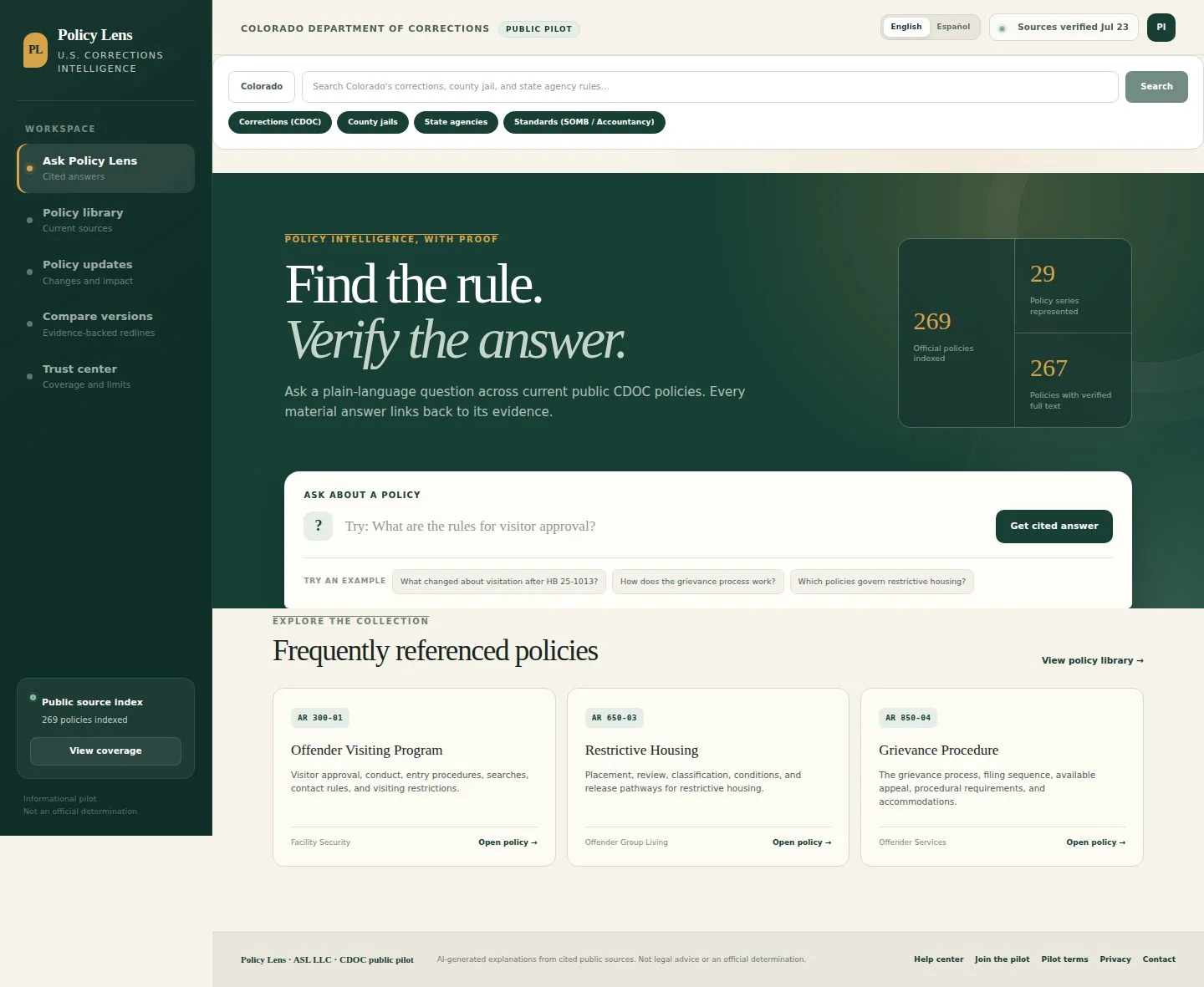
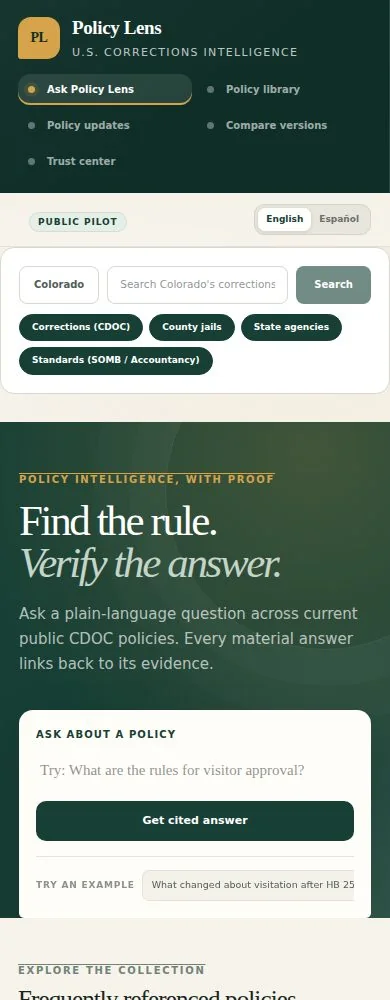
Find the rule. Verify the answer.
Ask a plain-language question about Colorado public law and get a cited answer, or an honest no.
Built for: A person dealing with a Colorado agency who does not know which agency owns the rule they need · A licensed professional checking a licensing or continuing-education rule before a renewal deadline · A public librarian or legal-access volunteer helping a walk-in who arrived with a question, not a citation · A family member trying to find a county jail's published visiting, mail, or property rules
The problem
Policy Lens exists because of this.
You have a question about a rule. You do not know which agency wrote it, what it is numbered, or what the government calls the thing you are describing. So you type the question into a search box and get thirty results, none of which is the rule. You land on an agency website whose navigation assumes you already know the answer, or on a 180-page PDF with no way to search inside it. An hour later you are less sure than when you started. The frustrating part is that all of it is already public. Colorado's current agency rules, the rulemaking record behind them, its enacted laws, its judicial rule changes, its published appellate opinions, its Attorney General opinions, its department manuals, its city codes, its county jail handbooks, and its parole board minutes are published. They just live on separate websites, in separate systems, in separate archives, under separate filing conventions. A person with a real question has no map, and the people who most need the answer are usually the least equipped to guess which of eleven agencies filed it. The tool most people reach for now is a general chatbot. Ask it a Colorado rule question and it will hand back a confident paragraph containing a rule number that may not exist, phrased exactly like a paragraph that is correct. That is worse than getting nothing, because you cannot tell the difference by reading it. When the answer decides whether you file a form, renew a license, drive across the state, or tell someone their appeal deadline, a plausible guess is the wrong instrument.
What changes
- It abstains. Most search tools return their best guess no matter how thin the evidence is; this one is built to withhold an answer and say what is missing, and that behavior is tested every release with hard-negative questions that must be refused.
- Authority separation is enforced, not decorative. A proposal is never returned as a current rule and a county policy is never returned as state policy, and a rebuilt index is not accepted if verification finds any authority violation.
- It refuses before it searches. A question about a named person's private record stops the whole request, so no unrelated public evidence can leak out of a combined search that individually would have abstained.
- Your question is not kept. Raw question text is excluded from durable logs; only a one-way fingerprint and operational identifiers remain.
- The coverage labels are honest about their own gaps. Metadata-only, current-subset, and full-text are separate labels, and a missing government file downgrades the claim rather than being hidden.
- Full statute text is deliberately excluded rather than scraped. The official dataset was requested from the state and stays out until it arrives with terms that permit the use.
- Spanish is a first-class path through every surface, including corrections, refusals, and the parole records, not a machine translation layer over an English product.
What it does
How Policy Lens works, start to finish.
Policy Lens is one search box over Colorado public law. You type the question you actually have, in English or Spanish, and it routes that question across authority-separated public collections. The source library is organized into twelve bounded groups: current agency rules, the Colorado Register rulemaking history behind them, enacted Session Laws, a metadata-only historical Session Law catalog, judicial rule changes, current published appellate opinions, Attorney General opinions, executive-department guidance and manuals, municipal sources, agency policy and standards collections, county jail sources, and a separately refreshed Parole Board public-record lane. The public collection reports 63,759 indexed source documents and 675,576 searchable passages, and the front page shows when sources were last verified: August 31, 2026 at the most recent refresh. Every result stays attached to who issued it and what kind of document it is, and that separation is the whole point. A proposed rule is never presented as the rule in force, and proposal material stays visibly nonbinding. A city ordinance is never blended into a state rule. A county jail's handbook is never mixed into the state corrections department's policy. An Attorney General opinion is labeled as an opinion rather than as law. When you get a supported answer, it names the originating authority and links straight to the official document, because the document is what you should rely on and the agency that published it remains the authority. It is built for the way people really type. If you write a word that is not a word, it corrects it. If you write a real word that is commonly confused with a legal term, it only tries the alternative when the corrected question turns up substantially stronger official evidence, and it tells you on screen that it made the correction. If you paste an exact citation, a rule-change number, a bill or Session Law identifier, or a municipality-scoped ordinance ID, it goes directly to that record instead of ranking keywords. When a title repeats across years, an ordinary request resolves to the newest indexed year unless you supply a year or a genuine historical qualifier. All of this works in Spanish as completely as it does in English, including the corrections and the refusals. The most important behavior is what it refuses to do. When the indexed evidence is missing, conflicting, or too thin to support an answer, Policy Lens says what is missing instead of writing a paragraph that sounds right. When a question asks about a named person's private record or an internal government security matter, it stops before any collection is searched at all, returns nothing, and keeps no raw question text. It does not make official determinations, predict individual outcomes, replace a grievance or appeal process, or give legal advice, and it says so where you can see it rather than in a footer nobody reads. Two other things sit alongside the main search. A separate Colorado Parole Board lane lets you search the current published review list by name or DOC number, search final public meeting minutes by name, DOC number, date, outcome, or Board member, and compare each member's published release and defer votes, always with a link back to the official minute. And a public help center answers questions about how Policy Lens itself works, coverage labels included, selecting passages from eight reviewed articles and returning their citations under the same abstention rule as the main search, so the tool holds itself to its own standard.
Features
Everything in the current release.
Each of these is built and working today. Nothing on this list is a roadmap item.
Ask in the words you already have
You do not need the agency, the rule number, or the official term. Start with the question you would ask a person at a counter. The search maps everyday wording onto official terminology and routes it to the collections where the answer would actually live.
Every authority kept separate
State rules, city ordinances, county jail policies, court opinions, and Attorney General opinions are never blended together. Each result carries its issuing authority and document type. A local rule is never dressed up as state law, and an opinion is never presented as a binding rule.
Current rules are not confused with proposals
The rulemaking record is indexed alongside the rules themselves, but a notice or a proposal is never returned as the rule in force, and proposal material stays visibly nonbinding. Where a title repeats across years, an ordinary request resolves to the newest indexed year; supply a year or a genuine historical qualifier and the older record wins instead.
An honest no instead of a confident guess
When the indexed evidence is missing, conflicting, or too weak, Policy Lens withholds the answer and tells you what is missing. A withheld answer is labeled as withheld and does not show an empty citation heading or call itself grounded. Nothing is invented to fill the gap.
Cited evidence you can open and check
Every supported answer names the originating authority and links to the official document. The explanation is a way in; the source is the record. This is the workflow the product is designed around, not a disclaimer bolted on at the end.
Exact citation and identifier lookup
Paste an appellate citation, a judicial rule-change number, a bill or Session Law identifier, or a municipality-scoped ordinance ID and it goes straight to that record rather than ranking keywords. On a freshly frozen 199-case test set with no overlap with any earlier case, it returned the right record first every time.
Spelling handled two different ways
A clear misspelling that is not a real word gets corrected outright. A real word that is easily confused with a legal term is only swapped when the corrected question turns up substantially stronger official evidence. Either way you are shown the correction, and your original question is still displayed.
Spanish is a complete path, not a translated shell
Navigation, search, results, citations, spelling corrections, refusals, coverage labels, the help center, and the Parole Board records all work in Spanish. Official document titles stay in English because those are the controlling government publications, and the source link is always preserved.
County jail sources stay local
County jail policy is local authority, so it is never merged with state corrections policy or with another county. The county view inventories all 50 Colorado counties currently identified as operating a jail, separately lists the 14 counties identified as not operating one, and labels exactly what kind of public material was located for each.
Colorado Parole Board records made searchable
Search the current published review list by name or DOC number, search final public meeting minutes by name, DOC number, date, outcome, or Board member, and see every published release or defer vote with a link to the official minute. Member votes appear as raw counts and as a share of that member's own recorded votes, labeled as descriptive public-record counts that do not establish quality, bias, or causation and do not predict a future vote.
A private-fact boundary that stops before searching
Ask about a named individual's private record or an internal government operation and the request is refused before any collection is touched. No results, no evidence, no partial answer from an unrelated source, in English or Spanish. Only a one-way fingerprint of the question is kept, never the question itself.
Coverage you can inspect before you trust it
A trust center reports what is indexed, what is full text, what is catalog metadata only, what is a current published subset, and what is deliberately excluded. Cataloged is never presented as text-verified. If a government file goes missing, the record stays visible and the full-text claim is dropped rather than hidden.
Weekly refresh with a visible verification date
Official sources are re-crawled on a weekly Monday refresh cycle, and the front page shows the date sources were last verified. A rebuilt index is only accepted after it passes verification with zero extraction errors, zero records needing review, and zero authority violations, so a bad refresh does not silently go live.
Usable with a keyboard and a screen reader
Skip links, one main landmark per page, explicit form labels, spoken status regions, 44-pixel touch targets, high-visibility keyboard focus, a reduced-motion mode, and a one-column fallback on narrow screens. Text and background colors on light and solid surfaces meet the WCAG AA 4.5:1 normal-text threshold, protected by an automated contrast check.
Citations name the rule before the excerpt
A statewide answer shows the regulation number and full title first, then the matched excerpt, the section or page reference, and a direct link to the original official source, so you can see which rule matched without opening the document to find out.
Proof
Numbers we can stand behind.
Every figure below comes from the product's own release record or test suite, not from a marketing estimate.
- It is independent of the government. Policy Lens does not represent, operate for, or claim affiliation with any government entity, and it says so up front.
Where it runs
Surfaces and status.
Status as of 2026-09-08. The public site at policy.autosecurelogin.com answers real questions today with no account and no sign-in. The homepage, help center, and Parole Board records all returned live content when checked on September 2, 2026: the homepage showed 63,759 source documents, 675,576 searchable passages and "Sources verified Aug 31", the help center listed 8 current reviewed articles, and the Parole Board lane showed 353 final decisions and 2,352 named votes. The September 1, 2026 release notes in record the current statewide index as accepted and active, with 23 source and runtime contract checks, 261 repository checks, 7 spelling checks, and 12 query-guard checks passing, and English, Spanish, keyboard, and screen-reader acceptance performed against the live site.
Works with
Worth more together.
Products on this platform share one sign-in, one support queue, and one engineering standard. These pair naturally with Policy Lens.
ASL Therapy
Treatment programs written against the same published Colorado standards Policy Lens indexes, so a clinician can check the standard and run the program that maps to it.
Explore →ASL Intake
For firms that research a rule and then have to act on it, practice management keeps the matter, the deadline, and the documents in one place.
Explore →ASL Supervision
Agencies that follow Colorado corrections and standards material for their caseloads get the same authority-separated sources next to their day-to-day case tools.
Explore →What is new
Recent progress.
This product ships often. The most recent verified changes, newest first.
September 3, 2026: a reproducible acquisition path now gathers substantially more of Colorado's official record into a private candidate, including 345 expanded appellate opinions, 77 Chief Justice Directives, 156 Office of Administrative Courts documents, 573 executive orders, 117 current and 81 archived formal Attorney General opinions, 445 judicial-rule documents, and 10,138 State Publications Library files.
The same acquisition captured 11,436 of 11,438 superseded or inactive historical Code of Colorado Regulations (CCR) renditions, all 714 current-session General Assembly bill, memorial, and resolution pages with their 6,156 linked files, both 2026 chamber journals, and further official municipal, county, and department material. Known gaps are declared as source defects rather than hidden.
Downloaded does not mean live: nothing from the September 3, 2026 candidate reaches the public index until it passes text extraction, provenance, authority and currentness, rights and sensitivity, duplicate, frozen search-evaluation, and immutable admission checks. Historical rule text stays in a separate history lane and cannot answer a current-law question. September 1, 2026: a fail-closed privacy boundary went live. A question about a named person's private record or an internal government operation is now refused before any collection is searched at all, in both English and Spanish, returning no results and keeping no raw question text. The release cleared 23 source and runtime contract checks, 261 repository checks, 7 spelling checks, and 12 query-guard checks, and lint with zero errors. September 1, 2026: keyboard and screen-reader acceptance was performed against the live public site in English and Spanish, covering focus order, accessible names, pressed states, search-status announcements, safe no-evidence handling, and an on-screen spelling correction. August 31, 2026: the weekly statewide refresh was rebuilt from freshly inventoried official sources and accepted, producing a candidate of 62,290 documents and 589,980 passages with zero extraction errors, zero records needing review, and zero authority violations. The source sweep accounts for 298 Colorado Register issues, 4,959 currently listed modern Session Laws, 445 judicial-rule documents, 117 Attorney General opinions, 125 acquired appellate PDFs, all 270 Colorado municipalities re-inventoried, 6,441 verified department-publication bindings, and 35,475 historical Session Law catalog records. An initial 200-case exact-record set failed closed at 197 of 200 and exposed three municipal-identity grammar gaps; after a bounded parser repair, a genuinely fresh freeze excluding all 497 previously consumed cases passed 199 of 199 with zero overlap. August 31, 2026: exact-citation routing was corrected for three real collisions found by the new index, so an opinion title containing a bill ID is no longer read as two records, an ordinary title containing the word Between is no longer read as a comparison, and a municipality name is matched as a whole word. August 31, 2026: Spanish spelling and word-confusion handling shipped, using a pinned dictionary as a valid-word guard and a small set of reviewed public-law pairs. Broad fuzzy rewriting stays off because it was shown to alter valid Spanish words. August 30, 2026: county sources were reconciled. A corrected health check across 334 active documents in 48 counties reduced 25 apparent failures to two known access barriers and 29 raw differences to 12 genuine content changes, which were then refreshed without disturbing any other record. August 30, 2026: the whole public experience was rewritten around statewide public law rather than a single department, four official-source links that governments had moved were repaired and verified, and text and background colors across the site were corrected to meet the WCAG AA 4.5:1 normal-text threshold on light and solid surfaces, protected going forward by an automated contrast check.
Pricing
Pricing for Policy Lens is quoted after a short conversation about your situation, because the right scope differs from one team to the next. There is no charge for that conversation.
Ask about pricingQuestions buyers ask
Straight answers.
What does it cost?
The public search at policy.autosecurelogin.com is open right now with no account, no sign-in, and no paywall. We have not published a price list, so there is no paid tier to describe honestly today. If your organization needs something beyond the public search, tell us what you are trying to do and we will answer plainly about what exists and what does not.
We already use the state websites and a general search engine. Why would we need this?
Because those work only if you already know where the answer lives. The state's material sits across separate sites, systems, and archives with different filing conventions, and a general search engine ranks pages, not rules, and will not tell you when a result is a proposal instead of the rule in force. Policy Lens starts from a plain question, keeps each authority separate, and links you back to the same official page you would have eventually found.
Is it actually ready, or is it still being built?
It is live and answering real questions today, in English and Spanish, with no login. The current statewide index was built from a fresh August 31, 2026 source inventory and activated on September 1, 2026 after passing 199 of 199 exact-record lookups, refusing 5 of 5 unsupported questions, and clearing 261 automated repository checks. Coverage keeps growing, and the coverage labels on the site tell you exactly what is indexed and what is not.
What happens to the questions I type in?
Your question is used to run the search and is not kept. Raw question text is excluded from durable logs, which retain only a one-way fingerprint and operational identifiers. The site stores only your language choice in your browser. We ask you not to type private facts, and a question about a named person's private record is refused before anything is searched.
Do we have to migrate or upload anything?
No. There is nothing to import, no records to move, and no account to create. Policy Lens indexes material that governments have already published; it does not need anything from you. Open the site and ask a question.
What happens if you stop running it, or if we stop paying?
Nothing you built goes away, because you did not build anything inside it. Every answer points at the government's own page or document, so if this service disappeared tomorrow the sources it links to are still exactly where they were. That is deliberate: the tool is a way in, not a place your work gets locked up.
How accurate is it, really? Can we act on an answer?
Act on the source, not on the summary. The design assumption is that you will open the linked official document, which is why every supported answer carries its authority and citation. On the current index, exact-record lookups returned the right record first in 199 of 199 freshly frozen cases, and unsupported questions were refused in 5 of 5 cases. It is still a research aid, not an official determination, and for a decision with real consequences you should confirm with the responsible agency or a qualified professional.
Does it cover our jurisdiction?
Colorado, today. Within Colorado it covers current agency rules and the rulemaking record, enacted Session Laws, a metadata-only historical Session Law catalog, judicial rule changes, current published appellate opinions, Attorney General opinions, department guidance and manuals, municipal sources located for 128 of the 270 Colorado municipalities inventoried, agency policy and standards collections, county jail sources across 48 counties, and published Parole Board records. Pick another state and it will tell you it is not indexed rather than guessing.
How do I know an answer is not made up?
Every supported answer names the authority that issued the document and links to the official source, and the intended workflow is that you open it. When the indexed evidence is missing, conflicting, or too thin, Policy Lens withholds the answer and says what is missing. A withheld answer is labeled as withheld and shows no citation heading, so you can always tell the difference between an answer and a refusal.
What should I know before I rely on it?
We would rather you hear this from us than discover it later. As of 2026-09-08:
- Colorado only, today. Other states appear in the picker but tell you plainly that their collection is not indexed yet rather than returning weak results.
- The full text of the Colorado Revised Statutes is not included. The official 2026 dataset was requested from the state and stays out until it arrives with terms that permit the use. Enacted Session Laws, current agency rules, and the rulemaking record are indexed.
- Historical Session Laws are catalog records. They identify the law and where it lives; they do not carry full text.
- Appellate coverage is the current published set, not the complete historical archive.
- Municipal coverage is partial. All 270 Colorado municipalities were inventoried, but official published code sources were located for 128 of them, and the inventory does not assert that every place has a codified code.
- Parole Board coverage is deliberately narrow: 22 published full-board minutes covering final decisions from April 1 through July 31, 2026, plus the current review list. Because coverage starts April 1, 2026, member vote statistics do not describe lifetime behavior. Ordinary application, rescission, and revocation hearings, unpublished records, executive-session discussion, decision reasons, and victim information are all excluded.
- County jail coverage is not complete. Official public material was located for 35 of the 50 Colorado counties operating a jail; the rest are labeled as pending source review, which means nothing was verified, not that no policy exists. Two county sources have known access barriers and are labeled rather than hidden.
- It is not legal advice and not an official determination. It does not predict outcomes or replace a grievance or appeal process.
- Live licenses, personal records, and case files are not here and never will be. They stay in the official systems that own them.
- The Android app is in limited release while it goes through store review; its status was In review as of August 23, 2026, and no approval or publication is claimed. The web service works in a phone browser today.
Find the rule. Verify the answer.
Ask a plain-language question about Colorado public law and get a cited answer, or an honest no.
Prefer email? contact@autosecurelogin.com