 Auto Secure Login
Research an unknown number or suspicious message
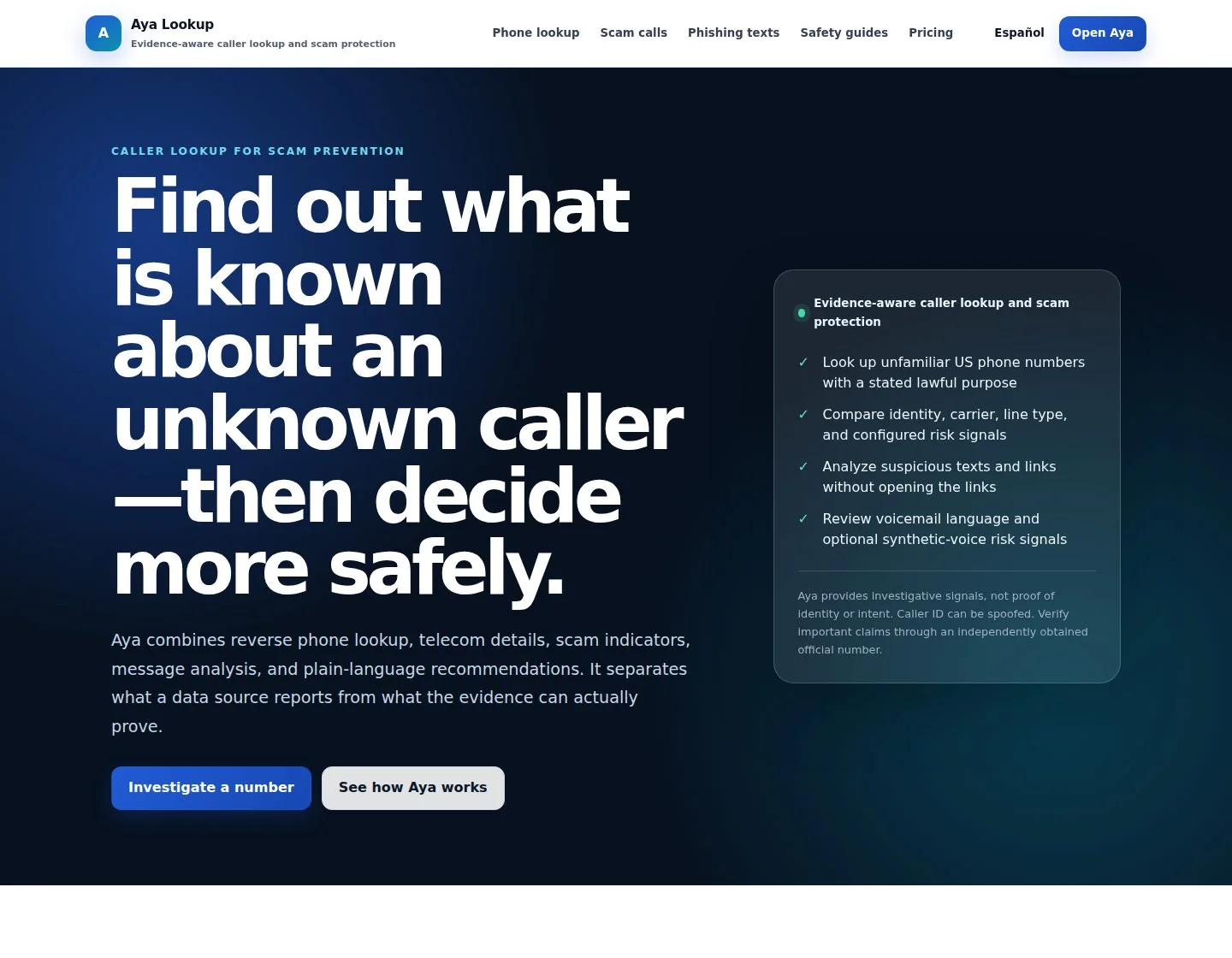
Aya helps research unknown callers and suspicious messages. Explore source coverage, privacy controls, uncertain results and current access options.
Know whether to trust that call.
Check an unknown caller or a suspicious text, and get an honest answer instead of a guess.
Built for: Anyone getting repeated calls from numbers they do not recognize · Adults over 65, who are targeted more than any other group and want a straight answer instead of a technical report · Adult children keeping an eye on a parent's phone, often across a language gap · Spanish-speaking households who want the whole thing in Spanish, not a half-translated menu
In one sentence
Check an unknown caller or a suspicious text, and get an honest answer instead of a guess.
Separates what a source reported from what the evidence can prove, with two independent 0-to-100 scores instead of one blended number that hides the uncertainty.
The problem
Aya Scam & Privacy Lookup exists because of this.
The phone rings from a number you do not know. The voice says it is your bank's fraud department, or the county sheriff, or your grandson. There is a problem, it is urgent, and the only way to fix it is to move money right now: a gift card, a wire, a code read aloud from your own text messages.
The pressure is not a side effect of the scam. It is the whole method. Every script is written to take away the ten minutes you would need to check. So you do what everyone does. You type the number into a search box. What comes back is often worse than nothing.
Free lookup sites show a teaser, then a paywall, then an upsell for a “full report” that is guesswork dressed up as certainty. Some will cheerfully hand you a name that belonged to whoever had that number four years ago. Almost none of them tell you the two things that actually matter: that the caller ID on your screen can be faked outright, and that they did not really find anything.
Then there is the harder version of this problem, which is that it is not your phone. It is your mother's. She is the one getting six of these a week, in Spanish, and she does not want to call you every time. You want her to have something she can use on her own — something that gives her a plain answer in her own language, does not try to sign her up for a subscription she cannot cancel, and does not pretend to know more than it does.
What changes
- Separates what a source reported from what the evidence can prove, with two independent 0-to-100 scores instead of one blended number that hides the uncertainty.
- Answers “unknown” rather than inventing an owner, and tells you in plain words not to treat the absence of a warning as safety.
- Deliberately not a background check: no criminal records, no relatives or property dossiers, no “who searched me”, and a lawful-purpose acknowledgment that has to be given before any lookup runs.
- A multi-source investigation only completes when at least two independent sources actually respond, and charges nothing when they do not.
- Never opens a suspicious link. Link risk is read from the address itself, and a clean result is reported as no known threat found, never as safe.
- No free plan and no unlimited tier anywhere in the catalog, which is why there is no incentive to pad results or upsell a report that does not exist.
- Prices and credit grants are set by the service, never by the app on the phone, and a retried request settles as the same request rather than a second charge.
What it does
How Aya Scam & Privacy Lookup works, start to finish.
You enter a US phone number and confirm you have a lawful reason to look it up — the service will not run a lookup without that acknowledgment, and the permitted reasons are a short fixed list. Aya then checks the number against the independent phone-data sources connected to the service: the kind that hold registered names, carrier records, whether the line is a mobile, a landline, or an internet line, whether the number is still in service, and whether it has been reported for abuse.
Aya does not blend those answers into one confident-sounding sentence. It keeps each source's answer separate and shows you where they disagree, because two sources disagreeing is itself information about how much to trust the result. What you get back is a decision card written in plain language.
It carries two separate scores, not one: how risky this looks, and how much evidence is actually behind that judgment, each on a 0 to 100 scale. A number with a nasty abuse history and one weak source is a very different situation from a number with a clean history and two sources that agree, and one blended score would hide that difference.
Underneath the scores are the specific reasons — a number the source says is no longer valid, a virtual or internet line, a prepaid number, a recent move between carriers, an abuse category — followed by a short label (likely scam risk, suspicious, identified but still verify, possible identity match, or unknown), what to do next, and the limits of what was just told to you.
Every card ends the same way: this is a safety signal, not proof of identity, residence, innocence, or wrongdoing. Suspicious texts work the same way.
Paste the message in and Aya weighs it against twelve scored patterns that turn up in nearly every scam text — manufactured urgency, gift cards and crypto and wire transfers, requests for a password or a one-time code, claimed government or police authority, a prize you did not enter for, a remote-support or virus warning, a family emergency, a delivery problem with a fee attached, a too-good job offer, a guaranteed investment return — plus two patterns for the links themselves and a further check for strings of code-like digits.
Those patterns are written to match English and Spanish wording in the same rule, not English with Spanish bolted on afterward. Aya also takes apart every link in the message: shortened links that hide their destination, raw numeric addresses, a destination hidden after an @ sign, domains built from encoded international characters that imitate familiar names, a real brand name buried inside a hostname that brand does not own, stacked subdomains, and paths built around words like login and verify.
Aya never opens the link, never loads the page, and never follows a redirect. It reads the address the way a careful person would, from the outside. Around that core sit the things that make it usable week after week. Save numbers as contacts with your own notes, tags, and favorites, and keep a searchable history of what you checked and what it said.
On Android, Aya registers itself as a call-screening service and checks incoming numbers against rules held on the phone, so the decision happens inside Android's time limit without a network round trip; it can warn you about a text your messaging app has already shown you, if you switch that on; and it can match a number against your own contacts without your contact list leaving the device.
A household plan covers up to six consenting family members, with alerts that mask phone numbers, an alert threshold the owner sets between 40 and 95, and a rule that nobody is added or watched without accepting an invitation first. Voicemail review, an optional voice-authenticity check, community reporting, and pushed family alerts are built and priced, but each is switched off in the service's default configuration and depends on connected outside services, so ask before you rely on any of them.
The money side is deliberately boring. There is no free plan and no unlimited tier. You buy credits: a standard lookup costs 10, a multi-source investigation costs 25, a text check costs 2. Prices and credit grants are decided by the service, never by the app on your phone, so a modified app cannot award itself credits or invent a discount.
Every billable request carries a key that makes a retry after a dropped connection settle as the same request instead of a second charge. And if a multi-source investigation cannot get two independent sources to answer, it is not completed and you are not charged for it — you get told it could not be finished instead of paying for half an answer.
Everything you accumulate stays yours to remove. You can export your account data, request a correction when a source has you wrong, ask to have a number suppressed, or delete the account outright. Suppressing a number is a single all-or-nothing operation: it either clears that number from saved history, contacts, cached results, protection rules, reports and voicemail records, or it changes nothing at all.
Account deletion clears the same ground and removes the account record itself last, deliberately, so that if any step fails you can still sign in and run it again rather than being left as a half-deleted account nobody can finish removing.
Features
Everything in the current release.
Each of these is built and working today. Nothing on this list is a roadmap item.
A verdict, not a data dump
Every lookup ends in one short label: likely scam risk, suspicious, identified but still verify, possible identity match, or unknown. Under it sits a recommended next step written for a person in a hurry, such as ending the contact and verifying the claimed organization through a number you obtained independently. You do not have to interpret raw records to know what to do.
Risk and confidence are two different scores
Most lookup tools give you one number and hide the uncertainty inside it. Aya scores how risky the caller looks and how much evidence stands behind that judgment as two separate values from 0 to 100. A high-risk reading with low confidence tells you to be careful and to keep checking. A low-risk reading with low confidence tells you almost nothing, and Aya says so on the card.
Independent sources, kept apart
Aya is built to draw registered-identity records, carrier and line-type records, number-validity checks, and abuse or reputation signals from separate independent sources, and it never merges them into one voice. Each answer stays attributed and disagreements are shown to you rather than quietly resolved in favor of whichever source sounds most confident. The live service currently runs two connected sources: one for identity records and one for carrier and line-type evidence.
It says “unknown” instead of making something up
When no reliable owner name comes back, the result is labeled unknown and the limitations say exactly that. Aya never treats a missing database match as evidence that a caller is safe — the recommendation on an unknown result tells you in so many words not to rely on the absence of a warning. It also will not fill the gap with a stale name from a previous holder of the number.
A multi-source investigation that has to earn its fee
The deeper investigation calls more than one connected source and compares them. It only reports a comparison when at least two independent sources actually respond; if fewer than two come back, the investigation is not completed and zero credits are charged. You get a clear explanation instead of a bill for an inconclusive result. It needs at least two sources connected to your service, so it is not offered on a single-source configuration.
Suspicious text analysis written for English and Spanish
Paste a text message and Aya weighs it against twelve scored patterns: urgency, hard-to-reverse payment demands, credential and one-time-code requests, claimed government or law-enforcement authority, prizes, remote-support and virus claims, family emergencies, delivery fees, job offers, guaranteed-return investment pitches, and two link signals. Each pattern matches English and Spanish wording in the same rule, so a Spanish message gets a real reading rather than a translated guess. A further check flags strings of code-like digits.
Links examined without ever being opened
Aya pulls the links out of a message and inspects their structure: shorteners that hide the destination, raw numeric hosts, a destination hidden after an @ sign, domains built from encoded international characters that imitate familiar names, a real brand name buried inside a hostname that brand does not control, stacked subdomains, unusually long or heavily hyphenated domains, throwaway domain suffixes, and credential-themed paths. It never visits the page, downloads content, runs scripts, or follows redirects. A quiet result is reported as no known threat found, never as safe.
Call screening on Android
The Android app registers as a call-screening service and checks incoming numbers against rules held on the phone, so the decision lands inside Android's time limit with no network round trip. You set your own allow, warn, silence, and block rules, and your own rules beat any shared list; saved contacts are not caught by shared warnings. Community reports can only ever raise a warning, never a silent block. Acceptance of screening on physical handsets is still outstanding for the current build.
Contact matching that stays on your phone
Aya can check a number against the contacts already on your device so a call from someone you know is recognized as such, and so a saved contact is not flagged by a shared warning list. Your contact list is never uploaded. The service only ever sees the single number you deliberately chose to look up, and the contacts permission is optional — the app works without it.
A household plan built around consent
The family plan covers up to six people, and every one of them has to accept an invitation before anything is shared. Each member controls whether their own checks can raise an alert and whether a transcript may be shared. Alerts carry a masked phone number rather than the full one, the owner sets the alert threshold anywhere from 40 to 95, and nobody's lookup history or saved contacts are shared with the group. Owners can remove members, members can leave, and owners can delete the group.
Keep a record of who has been calling
Save numbers as contacts with notes, tags, and favorites, and keep a searchable history of what you checked and what came back. That record is what turns a single scary call into a pattern you can show to a family member, a bank, or an investigator. You can export the whole account, including that history, at any time, and you can clear the history without deleting the account.
Removal designed to be finishable
You can export your data, ask for a correction when a source has you wrong, request that a number be suppressed, or delete the account entirely. Suppressing a number is one all-or-nothing operation across saved history, contacts, cached results, protection rules, reports and voicemail records — it either clears everything or changes nothing. Account deletion clears the same ground and removes the account record last on purpose, so a step that fails leaves you able to sign in and finish the job rather than stranded half-deleted.
Fixed prices the app on your phone cannot change
A standard lookup is 10 credits, a multi-source investigation is 25, and a text check is 2. Those amounts and every credit grant are decided by the service, so a modified app cannot award itself credits or invent a discount. Every billable request carries a key that makes a retry after a dropped connection settle as the same request rather than a second charge, and unused credits stay in your account.
It refuses the uses that hurt people
Aya is not a consumer reporting agency, and you have to acknowledge that before a lookup runs: no employment, housing, tenant, credit, insurance, or eligibility decisions, and no stalking or harassment. It carries no criminal records, no relatives-and-associates or property dossiers, no public comments about individuals, and no “see who searched for you” claims. Those features sell well and cause real harm, so they were deliberately left out rather than gated behind an upgrade.
Proof
Numbers we can stand behind.
Every figure below comes from the product's own release record or test suite, not from a marketing estimate.
- Bilingual by construction rather than by translation: the scam-language rules match English and Spanish wording in the same rule, and the interface was verified phrase for phrase at 728 of 728.
- Voicemail audio is processed and not retained, and any voice-authenticity screening is reported as a risk signal, never as proof that a voice is real or fake.
- Every result card publishes its own limits, including that caller ID can be spoofed, that records go stale, and that a returned address is not proof of current residence.
Where it runs
Surfaces and status.
Status as of 2026-09-02. The web service is live and working. On 2 September 2026 every public page checked answered over HTTPS: the English and Spanish home pages, reverse phone lookup, scam call checker, phishing text checker, the scam safety guides, caller ID spoofing, what to do after a scam, and pricing — and the service's own readiness check reported both the service and its storage ready.
The current release has been serving since 16 August 2026 with a recorded content fingerprint over 390 files. The paid catalog is live at the published prices and the site states plainly that there is no free plan. Android version 1.9.10 went out to its invite list on 24 August 2026.
Aya is called early access rather than launched for three honest reasons, all recorded in the project's own release status: it has not been signed off for unrestricted public launch; the Android app is invite-only with acceptance on physical handsets deliberately deferred; and while the paid catalog and payment configuration are in place, production has processed exactly one real store purchase to date — a licence-check purchase that correctly awarded 100 credits and correctly refused a duplicate delivery — with the full renewal, refund, and dispute lifecycle so far exercised only against simulated transactions.
Works with
Worth more together.
Products on this platform share one sign-in, one support queue, and one engineering standard. These pair naturally with Aya Scam & Privacy Lookup.
ASL Support
If something goes wrong with a purchase or a result looks wrong, there is one public place to reach a real person about any Auto Secure Login product, with no login required.
Explore →Colorado Complaint Access
If the person on the other end of the call turned out to be a licensed professional or a regulated business, this walks you through filing an official complaint by phone or web, in English or Spanish.
Explore →ASL Files
After a scam attempt you often need to send a document to a bank, an attorney, or a family member. Secure Send hands it over behind a password with an expiring link instead of emailing or texting it.
Explore →Pricing
Credit packs: 10 Secure Lookups $9.99 (100 credits), 30 Secure Lookups $24.99 (300 credits), 75 Secure Lookups $49.99 (750 credits), 100 Secure Lookups $59.99 (1,000 credits). Buying inside the Android app costs more to absorb the app store's commission; the in-app amount is set by the store and shown to you before you buy.
Subscriptions: Personal Scam Shield $9.99/month (120 credits/month), Advanced Scam Shield $19.99/month (300 credits/month), Family Scam Shield $34.99/month (600 credits/month, up to 6 consenting members), Personal Scam Shield Annual $99.99/year (1,440 credits/year), Family Scam Shield Annual $349.99/year (7,200 credits/year).
Usage: standard lookup 10 credits, multi-source investigation 25 credits, suspicious-message analysis 2 credits. Voicemail review is priced at 10 credits and specialist voice-authenticity analysis at 15 additional credits per started 15 seconds (120 seconds maximum), and both are enabled per account rather than on by default — ask before counting on them.
No free plan, no signup credits, and no unlimited product anywhere in the catalog.
Questions buyers ask
Straight answers.
How much does it cost, and is there a free version?
No free version, and that is on purpose. Credits start at $9.99 for 10 lookups, and the best value is $59.99 for 100 lookups. A standard lookup costs 10 credits, a suspicious text check costs 2. Free lookup sites make their money by selling your attention to an upsell for a report that does not really exist. Aya makes its money when you buy credits, which means it has no reason to pad a result or scare you into a bigger purchase.
We already use a caller ID app that blocks spam. Why add this?
Those apps are good at nuisance calls: they recognize a number lots of people have flagged and silence it. Aya answers a different question, which is the one that matters when a call actually gets through. It gathers evidence from independent sources, shows you what each one said, tells you separately how risky it looks and how much proof there is, and explains what to do. It also reads suspicious texts and their links, which most call-blocking apps do not do well in Spanish.
Can Aya tell me exactly who called me?
No, and any service that promises that is misleading you. Aya reports the identity, carrier, line-type, and risk evidence that its sources actually hold, but caller ID can be faked, numbers get reassigned, and records go stale. Aya labels a result unknown when nothing reliable comes back, rather than handing you a plausible name. Treat any name as a lead to verify, never as proof.
What happens to my searches and my data? Is any of it sold?
Your lookups and saved contacts belong to your account and are not sold or used to build a profile for anyone else. Your phone's contact list never leaves your device; the service only ever sees the single number you chose to look up. You can export everything at any time, ask for a correction when a source has you wrong, request that a number be suppressed, or delete the account outright. Suppressing a number clears it from history, contacts, cached results, rules, reports, and voicemail records in one all-or-nothing step.
What happens if I stop paying?
Credits you already bought stay in your account and are designed not to expire on a monthly clock. If you cancel a subscription you keep whatever credits it already granted, you simply stop receiving new ones, and the protection features tied to a paid plan turn off at the end of the period you paid for. You can still export or delete your data after cancelling; those are account rights, not paid features.
Is this actually ready to use, or still being built?
The service is live and you can sign up and run a real lookup today. It has been serving continuously since mid-August 2026, the English and Spanish sites are up, and the paid catalog is published at fixed prices. The honest caveats are that it has not been signed off for unrestricted public launch, only one real store purchase has been processed in production so far, the Android app is still on an invite list, there is no iPhone app yet, and a few extras such as voicemail review are built but switched off by default.
If you are about to buy, ask us to confirm checkout for your platform first.
Can I use Aya to check a job applicant, a tenant, or a contractor before I hire them?
No. Aya is not a consumer reporting agency and prohibits screening people for employment, housing, tenancy, credit, insurance, or any similar eligibility decision — you have to acknowledge that before a lookup runs. That is a legal line and a design decision, and there is no upgrade that unlocks it. Aya is meant for deciding whether to trust an incoming call or message, not for making decisions about someone's life.
My mother only speaks Spanish. Can she use this by herself?
Yes, that is one of the main reasons it was built this way. The app, the help content, the emails, the legal pages, and the billing labels are in Spanish, and the wording was verified phrase for phrase against the English — 728 of 728, none missing, none blank — so nothing falls back to English halfway through a screen. The scam-language rules match real Spanish scam wording rather than being translated from English. She sets the language once and it stays that way.
How do I know a wrong result will not follow me around?
You can report a result as incorrect — wrong identity, wrong address, a reassigned number, or a privacy concern — and you can ask for a correction or ask that a number be suppressed entirely. A suppressed number is cleared from saved history, contacts, cached results, protection rules, reports, and voicemail records in a single step that either completes or changes nothing, and future lookups of it are refused. A privacy request stays open until it is explicitly resolved, so it cannot be quietly marked done.
What should I know before I rely on it?
We would rather you hear this from us than discover it later. As of 2026-09-02:
- There is no free version and no free trial. Every lookup, text check, and voicemail review costs credits, and you buy credits before you use them.
- Aya is in early access. The service is live and usable, but it has not been signed off for unrestricted public launch, and a handful of acceptance items are still open.
- The paid catalog is live and payment configuration is in place, but production has processed exactly one real store purchase so far. Renewals, refunds, and disputes have been exercised against simulated transactions, not real ones.
- Identity and caller-name coverage is built for United States numbers. Validity and carrier checks reach further, but do not expect a name on an international number.
- Aya cannot prove who placed a call. Caller ID can be faked outright, numbers get reassigned to new owners, records go stale, and an address on a record is not proof of current residence. Every result says so on its face.
- “Unknown” is a common and correct answer. If no source has a reliable name, Aya will tell you that rather than guess.
- The multi-source investigation needs at least two sources connected to your service. Where only one is connected it is not offered, and where two are connected but only one answers, the investigation does not complete and nothing is charged.
- Aya is not a consumer reporting agency and must not be used to screen anyone for a job, an apartment, credit, or insurance. You have to acknowledge that before a lookup runs; it is a hard rule, not a setting.
- The Android app is on an invite list right now rather than open on the store, and it needs Android 8.0 or newer. Older Android 7 phones are not supported.
- Android call screening, notification-based text warnings, and push delivery have been exercised on a simulated device but not yet accepted on physical handsets for the current build.
Know whether to trust that call.
Check an unknown caller or a suspicious text, and get an honest answer instead of a guess.
Prefer email? contact@autosecurelogin.com