 Auto Secure Login
Explore Android games and the Bars or Badge prison-life RPG
Explore ASL Games, including Bars or Badge and five other Android worlds. Review gameplay, offline modes, platform requirements and current availability.
Play offline. Play with friends. Never pay to win.
Six original Android games, led by a prison-life career that has no final turn.
Built for: Someone who plays on a commute, a break, or a flight, where the signal drops out exactly when the free twenty minutes start · A player who wants a character that survives the session instead of being deleted the moment a round is scored · Anyone worn down by ads, energy timers, loot boxes, and leaderboards decided by whoever spent the most · Two or more people in the same room who want to play the same world together without either of them needing internet
The problem
ASL Games exists because of this.
You open a game on your phone and the game opens its hand. An advertisement before the first move. A timer telling you to come back in four hours, or pay now. A chest you can buy. A ranking full of people who bought more chests than you did.
There is probably a good game buried under all of it, but somewhere around the third tap you stopped being a player and became an account with a balance. Then there is the signal problem. The subway, the plane, the basement break room, the hospital waiting area, the campsite: the exact places where you finally have twenty free minutes are the places your phone has no bars.
The game shows a spinner, then gives up. You are holding a computer more powerful than the machines that once ran entire arcades, and it will not deal you a hand of cards against a robot because it cannot reach a distant machine to ask permission first.
And when you do get online, multiplayer usually means a stranger, a chat box, and a match that ends in eleven minutes. Nothing carries over. Nobody remembers you. The character you spent an hour building is wiped the second the score is tallied, so you never get the part that actually makes a world worth returning to: a person who owes you a favor, a job you worked up to, a reputation you earned the slow way.
And if the person you actually want to play with is sitting on the couch next to you, most games have no way to do that at all.
What changes
- Playing alone gives you the complete world, including all 1,000 residents and their schedules, rather than a trimmed practice mode against dumb opponents.
- Careers persist for as long as you want them to. There is no final turn, no seasonal wipe, and no round that deletes the character you built.
- Phones in the same room can share one world with no internet at all: one phone hosts, the others join from a code on its screen, and a guest who leaves stays in the world as a resident.
- The shared world settles its own rules, so nobody can take your turn, add an ally who is not there, pull someone from another room into a fight, award themselves points, or edit a finished result.
- The thirty-minute window governs your one major decision only. Walking around, talking, reading and checking your property never wait on a clock, so a thousand residents never become a thousand-person turn queue.
- Every published download lists its exact size and fingerprint, and after each release the public file is downloaded back and compared against the staged copy before the release is considered done.
- No advertisements, no energy timers, no purchasable currency, no open chat, and nothing collected about you when you play offline. There is no analytics or tracking code anywhere in the apps.
What it does
How ASL Games works, start to finish.
ASL Games is six original Android games on one page. You choose a game, download it straight to your phone, and play. There is no store account to create, no advertisement, no energy timer, no currency for sale, and nothing that asks for a card number.
They run on any Android phone from 8.0 forward. Five of them are short, strange, and finishable in a sitting. The sixth, Bars or Badge, is the large one: a prison-life career you can keep for months. Every game asks one question before anything else.
Are you playing on your own, online with other people, or with the phones in the room with you? Playing on your own starts immediately: no account, no connection, and nothing leaves your phone. The computer opponents are not filler. They read the actual state of the game, stay inside legal moves, and tell you which visible clue or standing rule made them choose what they chose.
Playing online signs you in once with your AutoSecureLogin account and drops you into a shared world where the rules are settled in one place, so nobody can take your turn, invent an ally, award themselves points, or rewrite a result that already happened. Bars or Badge adds a third path: one phone hosts the entire institution and the phones beside it join by scanning a code on its screen, over a direct local link, with no internet involved at all.
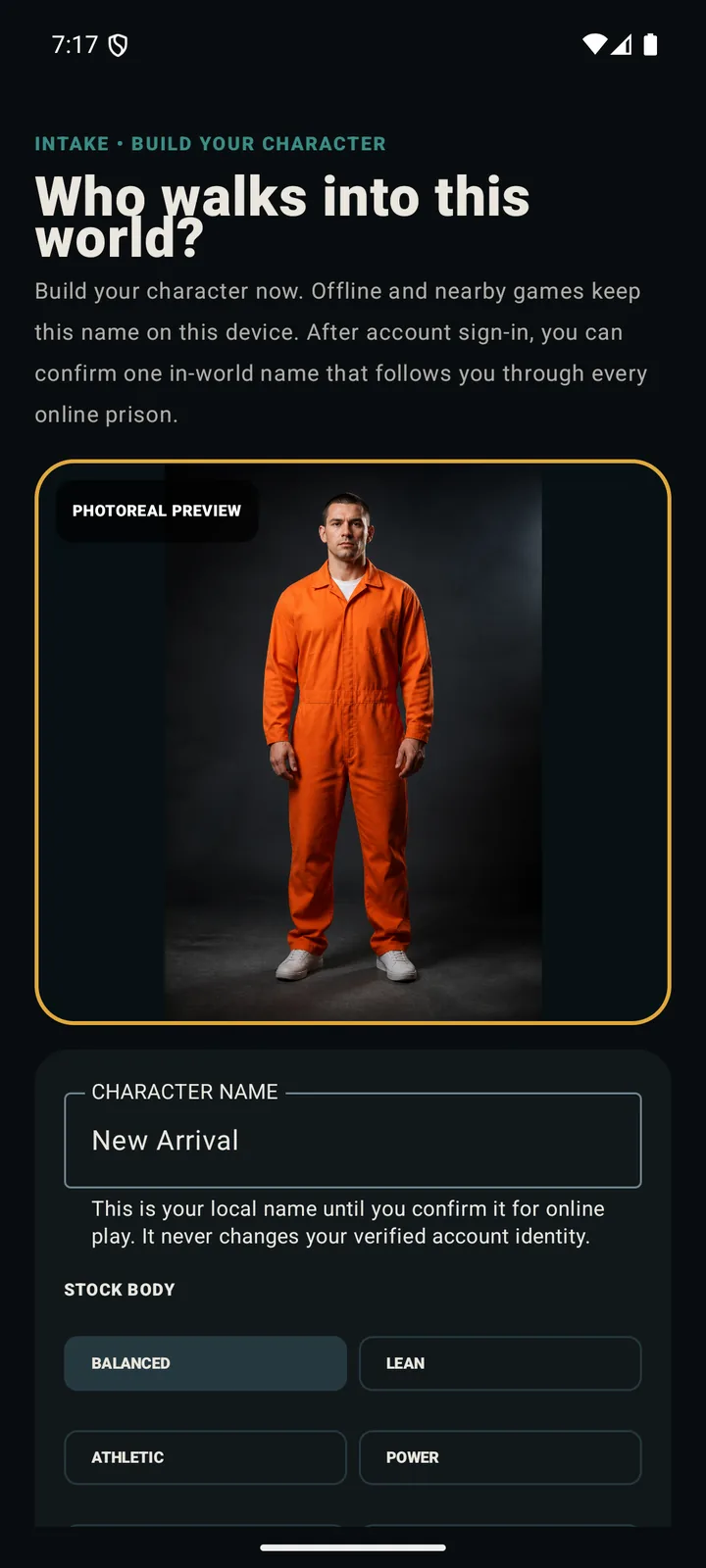
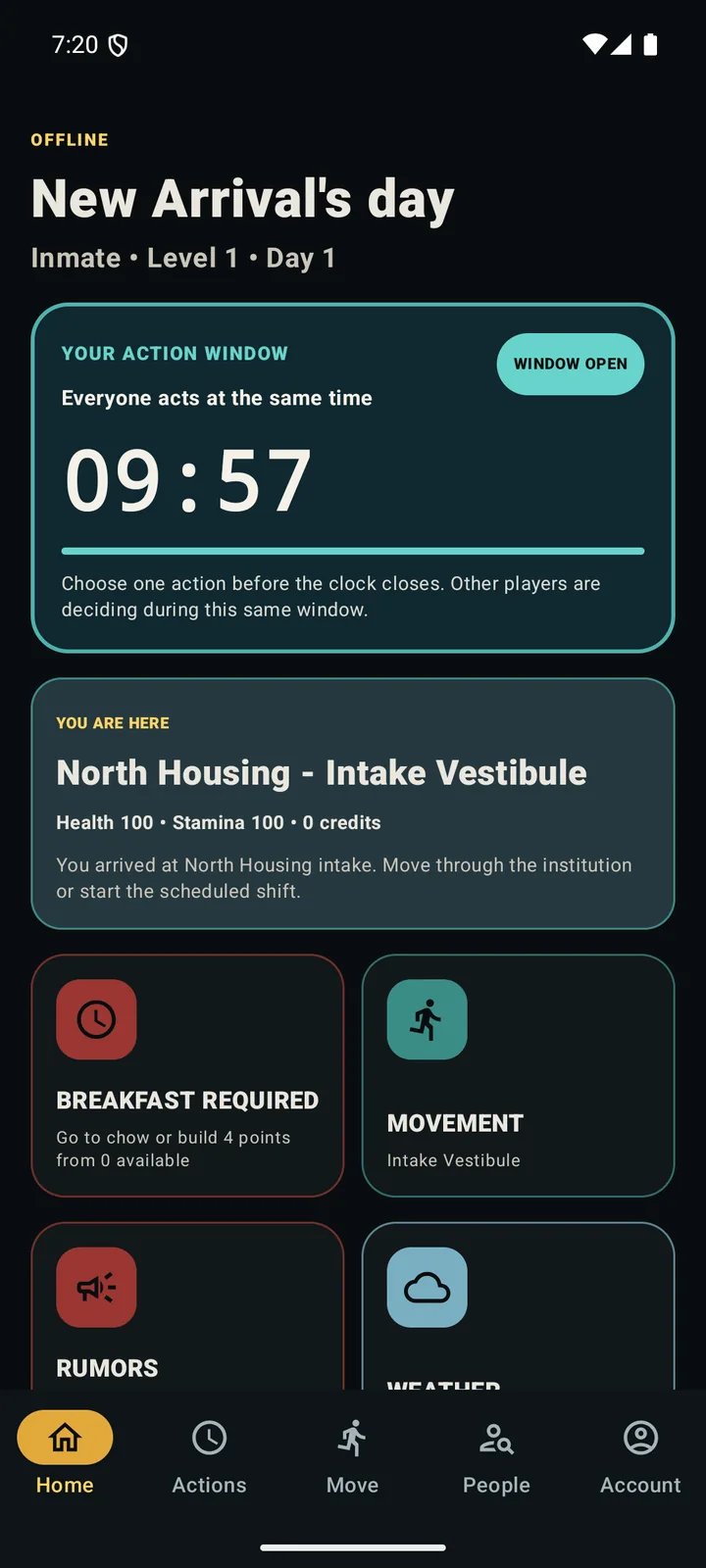
Bars or Badge is the reason most people stay. You create a character, choose the inmate side or the officer side, and enter an institution of a thousand residents: 952 inmates and 48 officers, spread across four housing blocks of 250. The institutions are fictional simulations that borrow their orientation names from the public federal institution index, and every one of them carries a plain notice that no real agency is affiliated with or endorses the game.
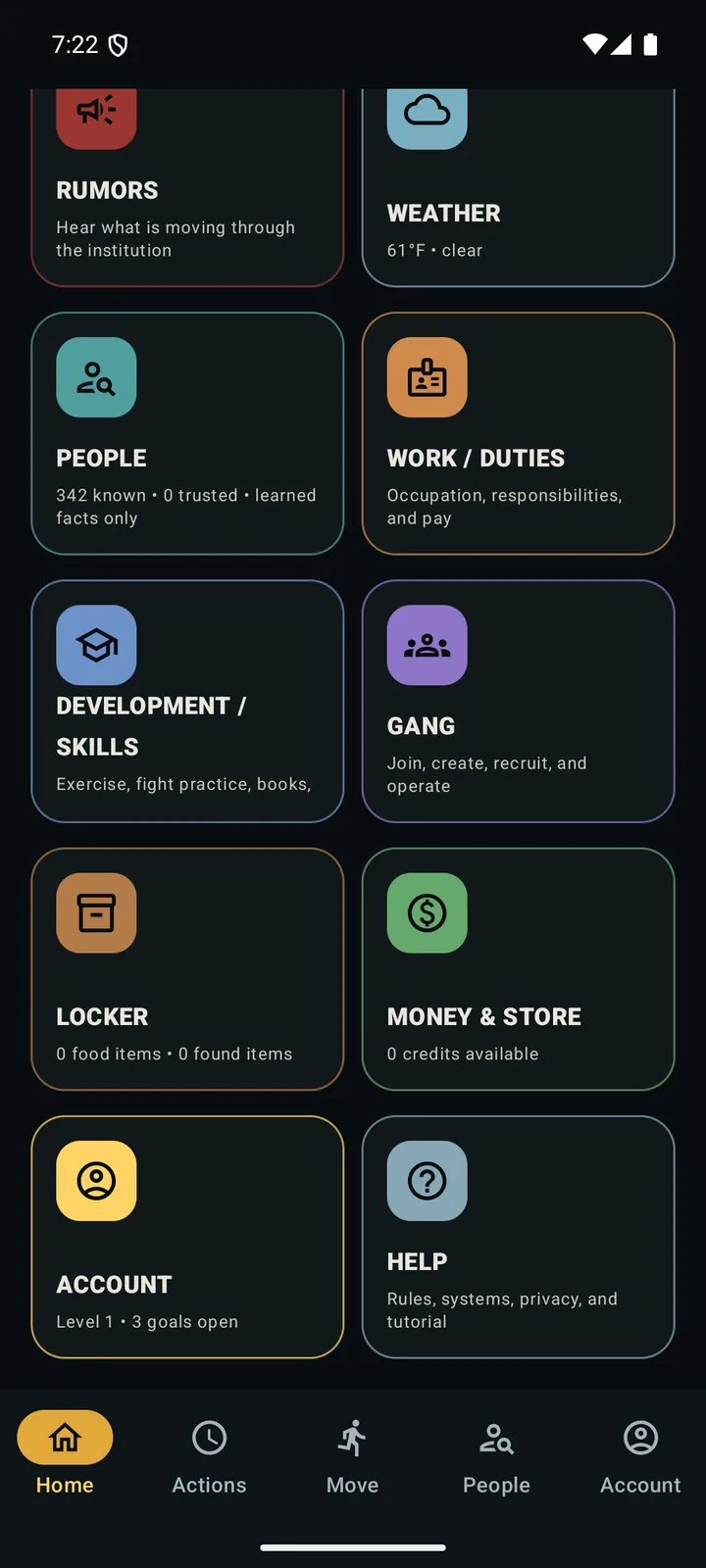
There is no final turn. Your level, rank, health, discipline, money, property, job, gang or unit membership, and the people who remember you all carry forward between sessions, and they follow you when you transfer to another institution. You do not arrive knowing everyone. Seeing someone gets you recognition and nothing else; a name takes an introduction; their job, their circumstances, their temperament, their motives and finally their private history each take more contact than the last, and the roster search will only find facts you have actually earned.
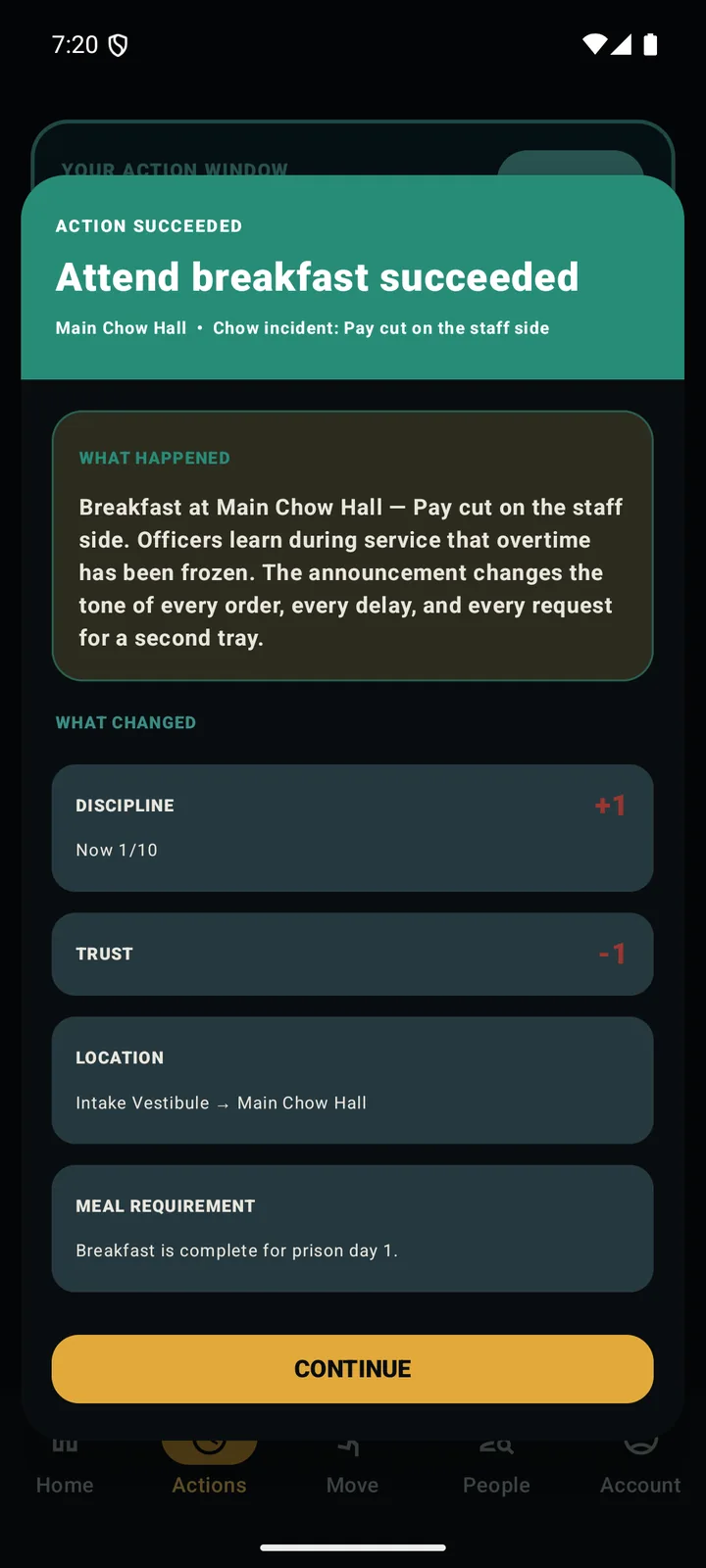
The other 999 residents do not stand still waiting for you. They eat, work, sleep, argue, get promoted, get hurt, form opinions and carry them. Meals are real obligations: breakfast, lunch and dinner have to happen before your next routine action, and going to the chow hall always puts you in a situation with the people, debts, shortages and rumors in that room, while eating from your own locker avoids the risk and restores less.
Everyone in the institution acts inside the same repeating thirty-minute window, so one person taking their time never blocks anyone else, and if you are away, a default you saved earlier resolves for you at the deadline. Movement, reading, conversation and checking your property stay available the whole time, so the countdown governs your one big decision and nothing else.
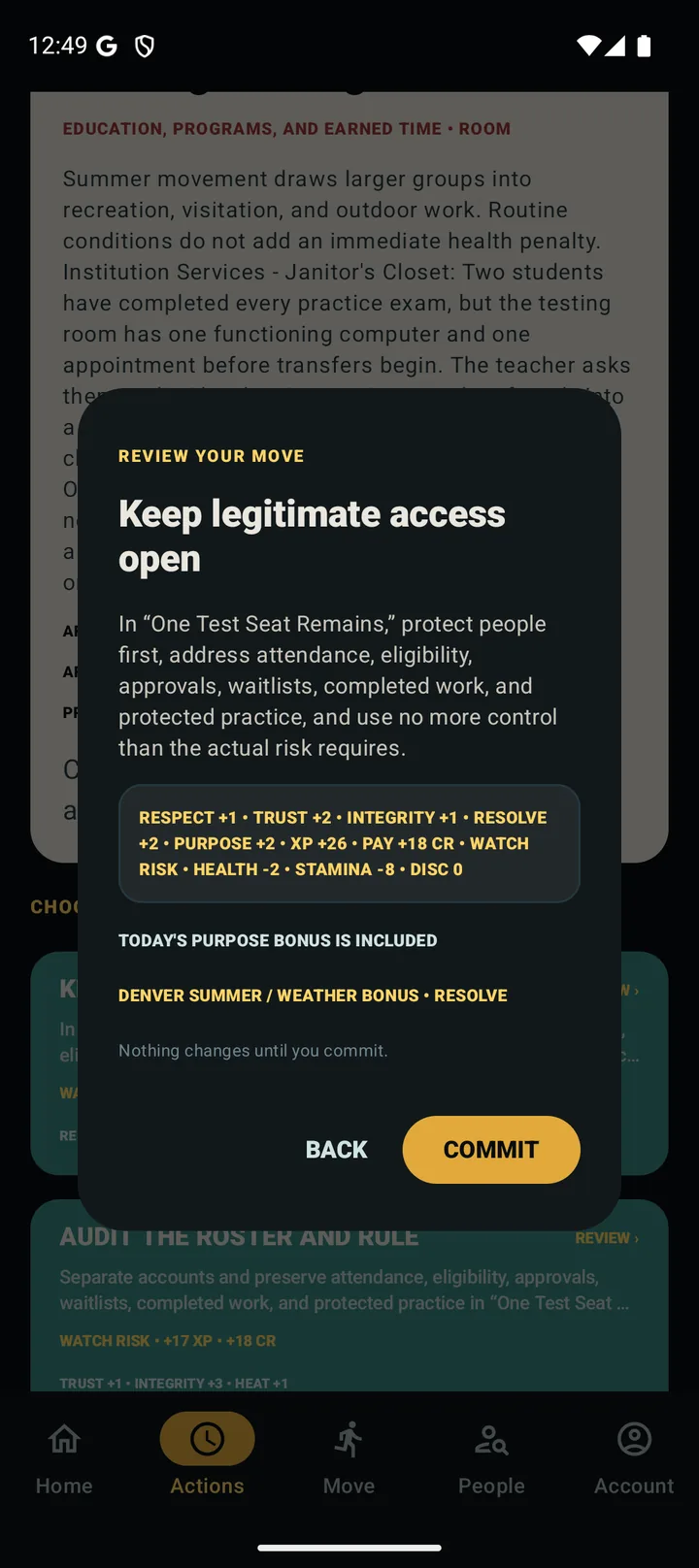
What happens in that window is shown before you commit. Choose an action and you get a plain review of the intent, the target and the real risks; nothing changes until you confirm. Afterward you get a receipt naming what happened, who was involved, which of your stats, property, location, relationships and skills moved, and what you can do next.
Movement is not a menu of place names: each of the 130 rooms is drawn, and you look down on the one you are standing in, with a green marker for you and color-coded markers for everyone else according to what you know about them.
You walk across the floor, walk over to a person, and the interaction panel opens only once you have actually arrived beside them. You can search a room or inspect a specific fixture, and tampering with one costs stamina, raises attention and can be caught live or on later review.
Officers walk real patrol routes and can arrive mid-incident, and whether they step in, call for help, or look the other way depends on duty, fatigue, personality and what the evidence would cost them. Fights use who is genuinely in the room, which means the sides are often uneven; gangs can be formed, officers can build official or corrupt units, and forty-one different person-to-person actions cover the four combinations of inmate and officer.
Emergencies are not a line of flavor text: thirty-seven kinds run through warning, active response, modified operations, evacuation where required, and recovery, changing what movement and services are available while they last. Play long enough and rare endings become reachable: an exceptionally long release case, an abstract escape, an officer's clean retirement, all shadowed by informants and investigators whose identities are never disclosed and whose cases are built only from what you actually did.
The other five games are deliberately small and each has its own voice. One More Knock is a neighborhood door ritual with five neighbors, twelve postcards and twelve parcel reveals. Probably Weather is a municipal department that treats impossible events as ordinary scheduling problems, with twelve incidents and stamps that build a readable five-statement case file.
Please Take a Number is queue politics played straight, with seven bells whose rules are explained rather than hidden. Static Club is a shortwave listening circle where four receivers combine notes and the game refuses to invent a decode before the evidence exists. Unclaimed Baggage is airport lost property, eighteen clue-rich bags and twenty-four objects in matched pairs, where what a bag shows and what inspection reveals are kept apart.
Across all six, friends work by exact email address that nobody else ever sees: the address is never shown to another player, never stored in readable form, and a lookup never reveals whether an account exists. Other players see only a safe display name, and you can decline, remove, or block anyone.
Features
Everything in the current release.
Each of these is built and working today. Nothing on this list is a roadmap item.
A career with no last turn
Bars or Badge does not end after twenty rounds. Your level, rank, health, discipline, money, property, job assignment, gang or unit membership, saved defaults and every relationship you have built persist between sessions and travel with you when you transfer to another institution. Health reaching zero sends your character to the Observation Bay for treatment; it does not delete the career you have spent weeks on.
Three ways to play, decided before anything else
The first screen asks whether you are playing alone, online, or with the phones next to you. Nothing is buried three menus deep, and switching modes never erases a saved career. Each mode keeps a population of a thousand residents, so the world does not shrink when you pick the one that fits where you are.
Playing alone is the whole game
Offline is not a practice room. The full institution, its 999 other residents, their schedules, their personalities, the rooms, the jobs, the emergencies and the consequences all run on your phone with no connection and no account. Nothing is sent anywhere while you play this way, and your progress is kept in protected storage on the device.
A thousand residents who keep living when you close the app
Every institution holds exactly 1,000 resident slots: 952 inmates and 48 officers, in four housing blocks of 250. When a human being joins, they take over one existing slot rather than adding a person, so the population never inflates. Residents keep their room, money, career progress, health, stamina, discipline and their history of incidents instead of being rebuilt from nothing each time you open a screen.
You only know the people you have actually met
Knowledge runs through seven steps, from bare recognition through an introduction, familiarity, temperament, motives and finally private history. The roster search indexes only what you have unlocked, so guessing a name gets you nothing. Officers receive duty-authorized roll-call facts for their post, which is a different thing from a private dossier on everyone in the building.
Everyone acts inside the same thirty minutes
There is no queue of a thousand people ahead of you. Every resident acts during the same repeating thirty-minute window, a large countdown shows the shared deadline, and one person deliberating never holds anyone else up. Movement, conversation, reading and checking your property stay available the whole time, so only your one major decision is on the clock. If you are away when the window closes, a default you saved earlier resolves for you, and your phone can give you one reminder before the deadline.
See the consequence, then confirm, then get a receipt
Choosing an action opens a review that names the intent, the target and the genuine risks, and nothing changes until you confirm it. Afterward a separate result screen tells you exactly what happened: who was involved, which stats moved, what property or relationships changed, where you ended up and what you can do next. Actions and their consequences are never mashed into one paragraph you have to decode.
130 illustrated rooms and an overhead view of the one you are in
Every travelable room has its own illustration with fixtures that match its purpose, and the room you occupy is drawn from above with a green marker for you and individually tappable markers for everyone else. Marker colors reflect what you know about each relationship, from unknown grey through friendly blue to hostile red. Your institution map names only rooms you have entered, unexplored exits reveal a count and nothing more, and both maps now start collapsed so the room itself is what you see first.
Search the room, tamper with a fixture, get caught or do not
You can sweep a room for a quick opportunity or tap a specific fixture and work on that object. Tampering can recover a named component, but it costs stamina, raises attention, can damage the room and can be spotted live by an active camera or found later during a review. The searchable locker carries 100 distinct improvised pointed and impact projects, each with its own picture, the exact property it consumes, and its own concealment, detection and combat tradeoffs.
Officers who actually walk the building
Officers follow duty routes between rooms and can arrive in the middle of a fight, a theft or another incident rather than materializing when the plot needs them. Whether one intervenes, calls backup, delays or looks away depends on their post, their fatigue, their personality, their relationship with the people involved, whether a camera saw it, and how much paperwork it would cost. Inmates and officers both lose stamina and need sleep, and exhaustion changes what people choose.
Meals, the commissary, and your own locker
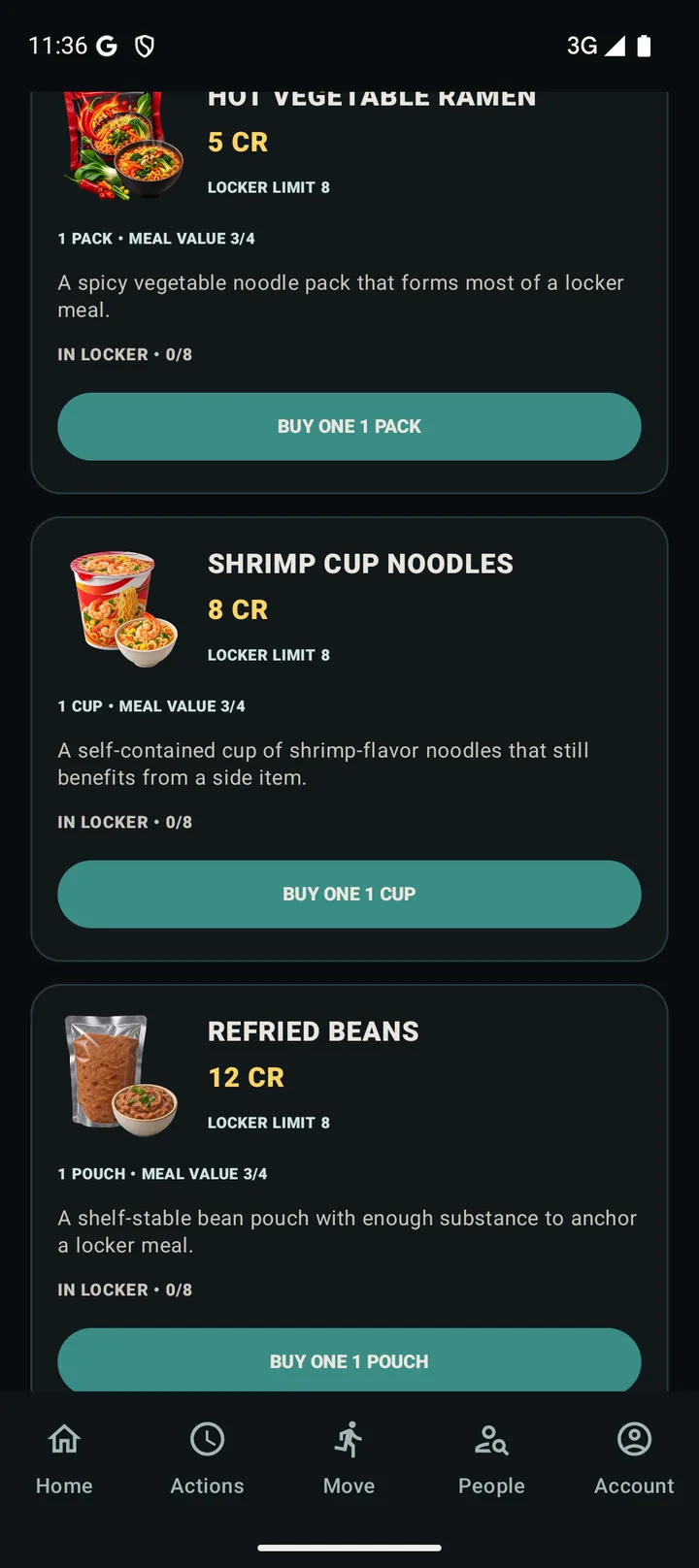
Breakfast, lunch and dinner are obligations, not decoration; the next routine action waits until you have eaten. Going to the chow hall always resolves a social situation with whoever is there, while combining four meal points from food you already own skips that risk and restores less stamina. The store carries 100 individual foods, each with its own picture, plus durable property upgrades and 20 drawn cell layouts, and every item has a locker limit the game enforces on both sides.
Gangs, units, and fights decided by who is actually present
Inmates can form gangs at level 8 and officers can build official or corrupt units, each with its own internal rank ladder alongside the ten formal officer ranks. A fight freezes exactly the people standing in that room, which means sides are frequently uneven, and power combines each participant's career level with their strongest eligible item. The odds are bounded, one deterministic roll decides it, and the outcome is applied to every participant exactly once.
Emergencies that develop and then recover
Thirty-seven emergency types move through warning, active response, modified operations, shelter or evacuation where required, and recovery, rather than appearing as a one-line announcement. Each one publishes its current phase, which services and routes are affected, what inmates and officers are directed to do, and when the next review happens. A local failure closes one route or service without unrealistically shutting the entire institution, and meals continue as documented tray service when the kitchen route cannot run.
A world that notices the actual season and the actual weather
Each online institution freezes one shared snapshot of real Denver conditions, current alerts and neutral public agency operating notices, then applies them as pressure on staffing, movement, medical demand, visits and recreation. Everyone in that window previews and resolves against the same snapshot, so nobody plays a different day than anyone else. Offline uses the last snapshot the device received, or says plainly that it is running on season alone, rather than dressing up stale data as current.
Rare endings you have to earn
Long careers can reach genuinely difficult conclusions: an exceptionally long court-release case, a deliberately abstract escape attempt, or an officer's retirement backed by service, savings and a clean record. Hidden informants and investigators build cases from things you actually did, and someone is only described as having informed after a report truly happened. Covert identities are never leaked into public state, and no real-world escape or contraband method is ever described.
Five short games, five distinct voices
One More Knock is a warm neighborhood door ritual, Probably Weather is deadpan municipal paperwork about impossible events, Please Take a Number treats queue politics as serious public business, Static Club is a patient shortwave listening circle, and Unclaimed Baggage is airport lost property with museum-label calm. Each has its own artwork, sounds, interaction loop and save file. Automated checks enforce catalog size, complete sentences and callbacks, so the writing cannot quietly degrade into placeholder text between versions.
Friends without handing over an email address
You can add someone by their exact email address, from a shared match, or accept an incoming request, and you can decline, cancel, remove, or block at any time. Your address is never shown to another player and is never held in readable form, and a lookup returns the same answer whether or not an account exists, so the friends list cannot be used to fish for who is registered. Other players see only a safe display name and your relationship status.
Rumors that travel
What people saw drifts one room at a time, picks up distortion on the way, and draws attention to you once your story has reached three rooms.
Side hustles and lending
Artwork, crochet, hooch, tattoo work, laundry, haircuts, a sports ticket, cell cleaning and radio repair earn commissary credits, and money lent at fifty percent comes back or defaults depending on who you lent it to.
A 60-minute segregation lock
Being sent to segregation is a real-time lock with a red timer across every screen, and the next movement returns you to the unit you were taken from.
Appointments, family and release
Sick call, dental, chapel, class, the law library, visits and the barber are requested and approved on your record, family can be called or written to, and the court petition, the escape and the officer's retirement live on one Release screen.
A face for every person
Every resident and officer has a generated portrait that matches their written description and stays the same in the room, the roster, an interaction and the loan book; none is of a real person.
The yard
The compound opens in the middle of the day, empties for count, closes for storms or cold, and a crowd of up to two hundred is cover for what you are carrying while two officers watch all of it.
A prison family
A family closes around the people you already sit with, no sooner than a fortnight in and one person at a time, and its members can step in, warn you in time, or ask you to cover them.
Routines of up to four
Each moment takes an ordered list of up to four choices, and the first legal one is filed for you at the deadline.
Proof
Numbers we can stand behind.
Every figure below comes from the product's own release record or test suite, not from a marketing estimate.
- The writing is authored and then guarded by automated checks: catalogs cannot silently shrink, scenes cannot borrow objects from other scenes, and computer players must name the visible clue or rule behind a decision.
- Content rules are written down and enforced. Race, religion, disability, orientation and gender expression never make a character more hostile or more criminal, conflict is modeled without real-world instructions, and identity-based harassment is treated as harm rather than as a bonus.
Where it runs
Surfaces and status.
Works with
Worth more together.
Products on this platform share one sign-in, one support queue, and one engineering standard. These pair naturally with ASL Games.
ASL X-Ray
The same Android build inspection we apply to our own releases is available on its own. If you publish Android apps, it checks what actually ships in the file rather than what the project claims.
Explore →ASL Messaging
The AutoSecureLogin account that signs you into the games signs you into our other apps too, so friends and messaging work from one identity instead of another set of credentials.
Explore →ASL Meet
For a group that plays together, the same single sign-in covers voice and video calls without setting up yet another account.
Explore →What is new
Recent progress.
This product ships often. The most recent verified changes, newest first.
Bars or Badge and its online service are recorded at 0.60.0 on 2026-09-08, up from the 0.37.0 published on 2026-09-02; the five shorter games remain at 0.9.0.
Versions 0.47 through 0.58 brought live room incidents with a two-minute reaction window, a crafting and lending economy, a 60-minute real-time segregation lock, appointment and family menus, generated portraits for every resident and officer, an outdoor yard, and a prison family system.
Version 0.58 fixed an action window that could sit in front of a player for hours after a device clock correction; a window now always has to contain the present moment. Bars or Badge reached 0.37.0 and the shared online service reached 0.37.0, both published to the download page on 2026-09-02 as release games-site-20260902T080659Z.
Version 0.37 is the largest change so far: it stretches the shared action window from ten minutes to thirty so nobody is rushed, adds a searchable catalog of 100 improvised weapon projects with their own artwork and tradeoffs, adds searching and tampering with individual room fixtures, adds camera evidence that can catch you live or on later review, gives officers real patrol routes and the judgment to intervene or not, and adds fatigue, sleep, family visits and corrupt propositions.
The authored world grew with it, from 230 to 240 event types and from 23,000 to 24,000 deterministic situations, and from 120 to 130 illustrated rooms. Both a phone-sized 56.58 MB build and a 78.63 MB universal fallback are published with their exact fingerprints, and the public file was downloaded back and matched before the release was called finished.
Version 0.36 separated the safe ASL Games account name from the Bars or Badge character name that follows a career between institutions, added a searchable 15-topic Help Center inside Account, and made secure sign-in state survive an app update. Version 0.35 added long-horizon endings, hidden informants and investigators, and a deeper private psychology layer for every resident; 0.34 added 100 item-specific commissary pictures, 20 drawn cell layouts and visual lockers; 0.33 added the prominent live countdown and detailed action receipts.
On 2026-08-31 the full 21,000-record resident catalog was regenerated and hashed with zero failures and 21,000 unique signatures, and on 2026-09-01 the fictional commissary catalog was re-checked against public agency sources.
Pricing
Pricing for ASL Games is quoted after a short conversation about your situation, because the right scope differs from one team to the next. There is no charge for that conversation.
Ask about pricingQuestions buyers ask
Straight answers.
What does it cost?
Nothing. All six games are free to download and there is no charging switched on anywhere in them: no advertisements, no energy timers, no currency for sale, and no card details requested. Everything you spend inside Bars or Badge is currency you earned by playing. If paid extras ever appear, they will be cosmetic or convenience items and will never substitute for rank or required play.
Is it actually ready to play, or am I downloading a demo?
It is a real game you can play today. Bars or Badge 0.37 is a full career with 130 rooms, 1,000 residents, jobs, gangs, emergencies and long-horizon endings. It is a direct download rather than an app store listing, and nearby local play is behind online play in a few specific ways we list openly.
Do I need an account?
Only for online play and friends. Playing on your own needs no account, no connection, and sends nothing anywhere. If you do want other people in your world, one AutoSecureLogin account covers every ASL game, and your email address is used only to sign you in and for exact friend lookups. It is never shown to another player.
What happens when I have no signal?
You keep playing. Choose the offline path and the entire institution runs on your phone, with all 999 other residents living their schedules, the same 130 rooms, the same jobs and the same emergencies. The five shorter games behave the same way: the computer opponents, the sounds, the haptics and the saved progress all work with the network switched off. Nothing waits on a connection.
How long is a turn? Do I have to sit and wait?
Everyone in the institution shares the same repeating thirty-minute window, and that window covers one major decision. Walking between rooms, talking to people, reading your mail and checking your property are never on the clock. A large countdown shows the shared deadline, one player thinking it over never blocks anyone else, and if you step away the default you saved earlier resolves for you when the window closes.
We already play something else. Why would we move?
Most phone games take your character away when the round ends and take your attention away when the advertisement starts. Here a career keeps going, the people in it remember what you did, and there is nothing to buy. Nothing needs migrating either: these are separate games, so you can install one, play a career for an evening, and keep whatever else you already play. Losing nothing is part of the point.
What do you collect about me?
Offline play collects nothing at all and makes no request off your phone. Online play needs a verified account, and even then your email address is never shown to another player, never returned in readable form, and never used to reveal whether an account exists. Other players see a safe display name and your relationship status, and nothing else. There is no advertising, no tracking for advertising, no analytics code in the apps, and no open chat to scrape.
If you stop running the online part, do I lose my game?
Your offline career lives on your own phone in protected storage and does not depend on us at all, so it survives. Nearby local play is hosted by one of your own phones, so that survives too. Only an online institution depends on the shared world staying up, and that is exactly why offline is built as the complete game rather than a fallback. If you want a career that nobody can switch off, play it offline.
Why isn't this on an app store, and how do I know the download is safe?
The games come straight from our page while the store listing is prepared. Every build is published with its exact byte count and a fingerprint you can check, the page is served only over an encrypted connection, and after each release we download the public file back and confirm it matches what we staged. Android will ask once whether to allow installing from your browser; that prompt is normal and you can revoke it afterward.
What is actually in Bars or Badge? Is it appropriate?
It is a fictional strategy role-playing game about life on both sides of a correctional institution, written for adults. Violence, medical emergencies and victimization are kept non-graphic, and choices always include protecting, reporting, verifying, de-escalating and getting medical help. It never gives real-world instructions for weapons, contraband or escape, and no player identity trait makes a character more hostile or more criminal. There is no age verification yet, so it is not a game to hand to a child.
Are these real prisons?
No. Every institution, resident and incident is invented. The worlds take their orientation names from the public federal institution index so the setting reads as a recognizable American system, and each one carries a plain notice that the game is a fictional simulation and is not affiliated with, licensed by, or endorsed by any named institution or agency. The commissary catalog and the event list are researched against published public material and then written as fiction; they are not a claim about how any specific facility operates.
Can I play with the person sitting next to me?
Yes, in Bars or Badge. One phone hosts the whole institution and shows a code on screen; other phones scan it and join over a direct local link with no internet and no account needed. Both devices confirm matching digits before anything connects. When a visitor leaves, their character stays in the host's world as a resident, and reconnecting from the same device reclaims the same person, role, appearance and room.
What should I know before I rely on it?
We would rather you hear this from us than discover it later. As of 2026-09-08:
- Android only. There is no iPhone, tablet-specific, or desktop version, and none is in progress.
- You install the games yourself from our download page instead of an app store, so Android will ask you to allow the install once. Store distribution needs further review and packaging first.
- If something behaves oddly on your phone, we want to hear about it.
- Some screenshots on the download page were captured from earlier versions and are labeled with the version each one came from. The current room, action, locker and weapon-project captures are from 0.37; the lifetime-goal capture is 0.35 and the start-screen capture is 0.33, and the five shorter games still show their 0.8 captures.
- Playing with nearby phones is behind online play. A guest who returns does not yet get their earned money, health, discipline, inventory and property back into their own career screen, a connected person does not yet receive an accept-or-refuse prompt, and guest schedule controls stop with an explanation rather than guessing an answer.
- The resident capacity of 1,000 describes the saved population, most of it computer-controlled. It is not a claim about 1,000 phones connected to one host at the same time; real nearby-guest capacity depends on the hosting phone and has not been measured, so no number is published.
- There is no in-game purchasing and no charging at all right now. The economy is earned currency only.
- There is no open chat, and there is no staffed moderation desk yet. You can block a player today; reporting operations are still being built.
- There is no age verification or guardian control yet. Bars or Badge portrays adult institutional conflict and is not intended for children.
- The five shorter games sit at 0.9 and receive updates less often than Bars or Badge.
Play offline. Play with friends. Never pay to win.
Six original Android games, led by a prison-life career that has no final turn.
Prefer email? contact@autosecurelogin.com