 Auto Secure Login
ASL Games
Explore ASL games and the Bars or Badge prison-life RPG
Build a life on either side of the bars.
Six original Android games, led by a prison-life career that has no final turn.
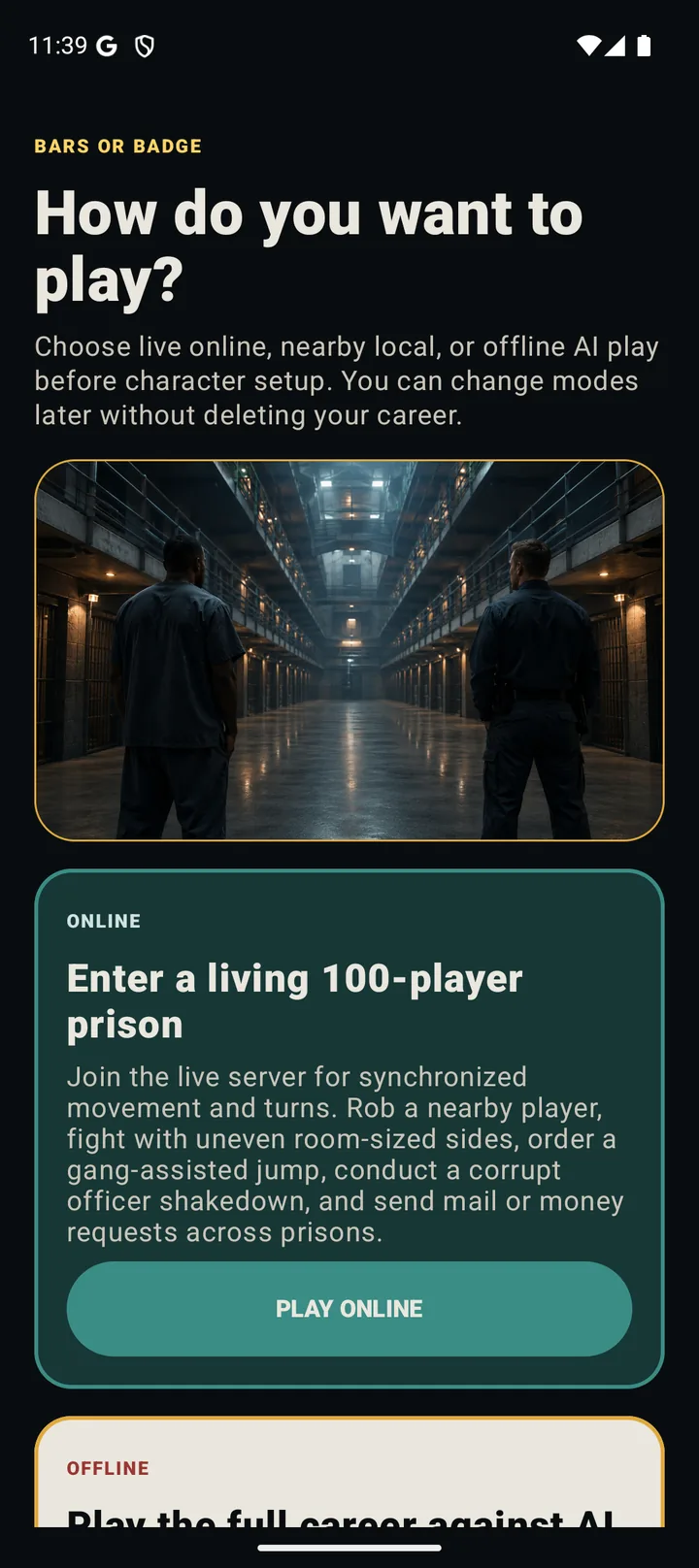
Why it exists
A game that never opens its hand.
You walk in as nobody. The intake vestibule does not care who you were outside, and neither does anyone else on the tier. Everything you will ever have here you have to earn in small, specific pieces: a job that pays, a locker with food in it, a name that someone recognizes across the dayroom, a person who will stand next to you when it goes bad.
Meals are not flavor text - if you have not eaten, you cannot work. Health is not a bar that refills between missions - if it hits zero you wake up in the Observation Bay and lose two turns of your life to treatment. The people around you remember what you did the last time you were both in this room, and they tell other people, and eventually the version of you that moves around the institution is not the one you meant to build.
Or you pin on the badge and find out that the other side is not the easy one. You are forty-eight staff for nine hundred and fifty-two people. You run count, you supervise movement, you write the reports that follow you for the rest of your career - and every shift somebody offers you a shortcut.
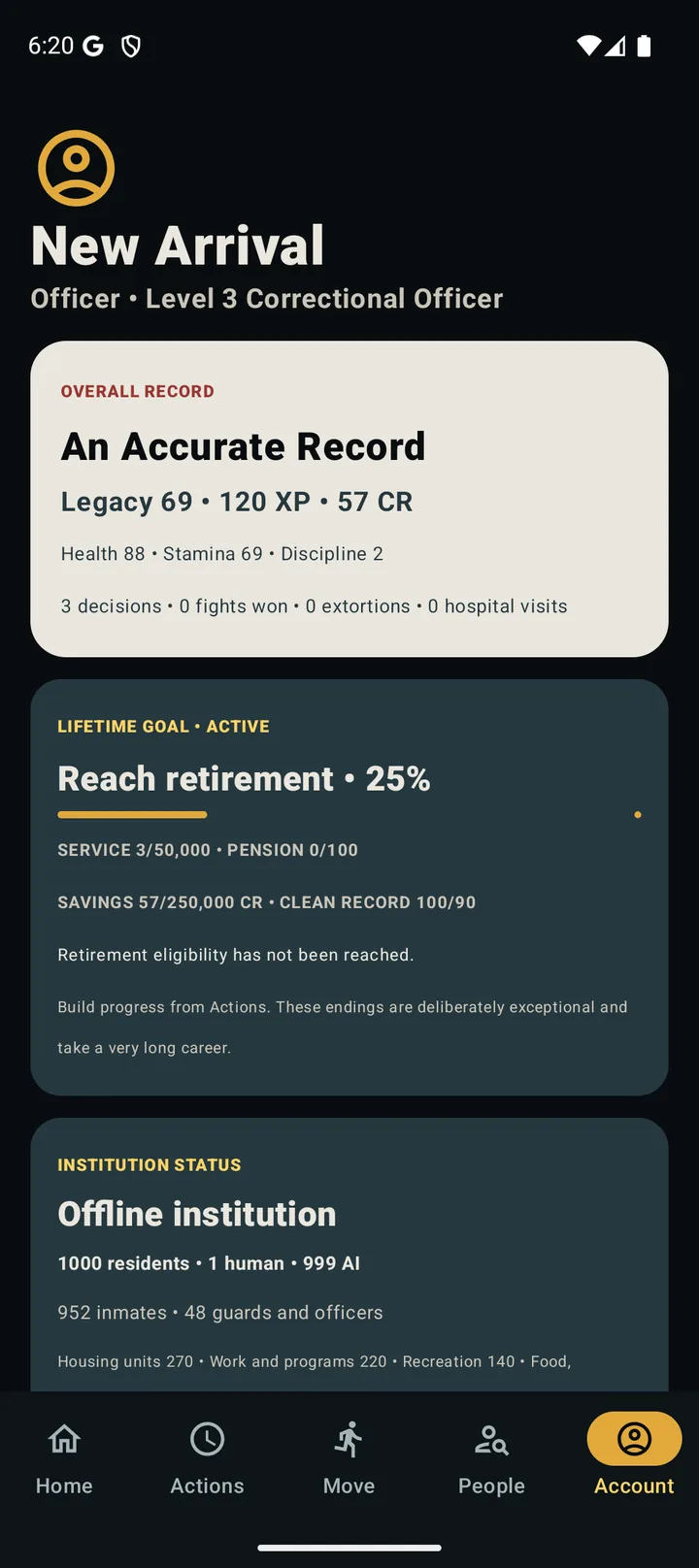
Take it and it pays now, and somewhere in that thousand-person population there is an informant, a plant, or an Inspector General investigator quietly building a file you will never see until it is finished. Play it straight and it takes an exceptionally long career to reach the service, pension, savings, and clean record that let you file for retirement.
Both sides are playable. Both sides are hard. The game never tells you which one you are: it just keeps the ledger and shows you, one thirty-minute decision at a time, who you actually turned out to be.
Inmate
Arrive with nothing and a number. Work a job, take a course, read in your cell, hold a legal case together across months of filings, and decide every day who you owe and who owes you. Gangs form once you have earned the standing for them.
Officer
Walk a ten-rank command ladder with a duty post, a roll call, and authority that is only ever as good as the paperwork behind it. Build a clean record and a pension, or take the other road and hope the investigator three cells down is not who you think.
Bars or Badge is a persistent prison-life role-playing game for Android. You create one character and live their whole institutional life from one side of the bars or the other: an inmate working a job, holding a cell, building a crew and a reputation, or a correctional officer running a post, writing the reports, and climbing a ten-step command ladder that ends at Headquarters Investigator.
The institution around you holds 1,000 residents, normally 952 inmates and 48 officers, spread across 130 hand-illustrated rooms in thirteen zones. Every one of those residents has a name, a body, a job, a schedule, a private history, and an opinion about the people they keep running into.
There is no final turn and no score screen. The career only ends the way a real one would, and only if you get that far.
Systems
What is actually in the game.
Every system below is in the build you can download today. None of it is a roadmap item.
The thirty-minute action window
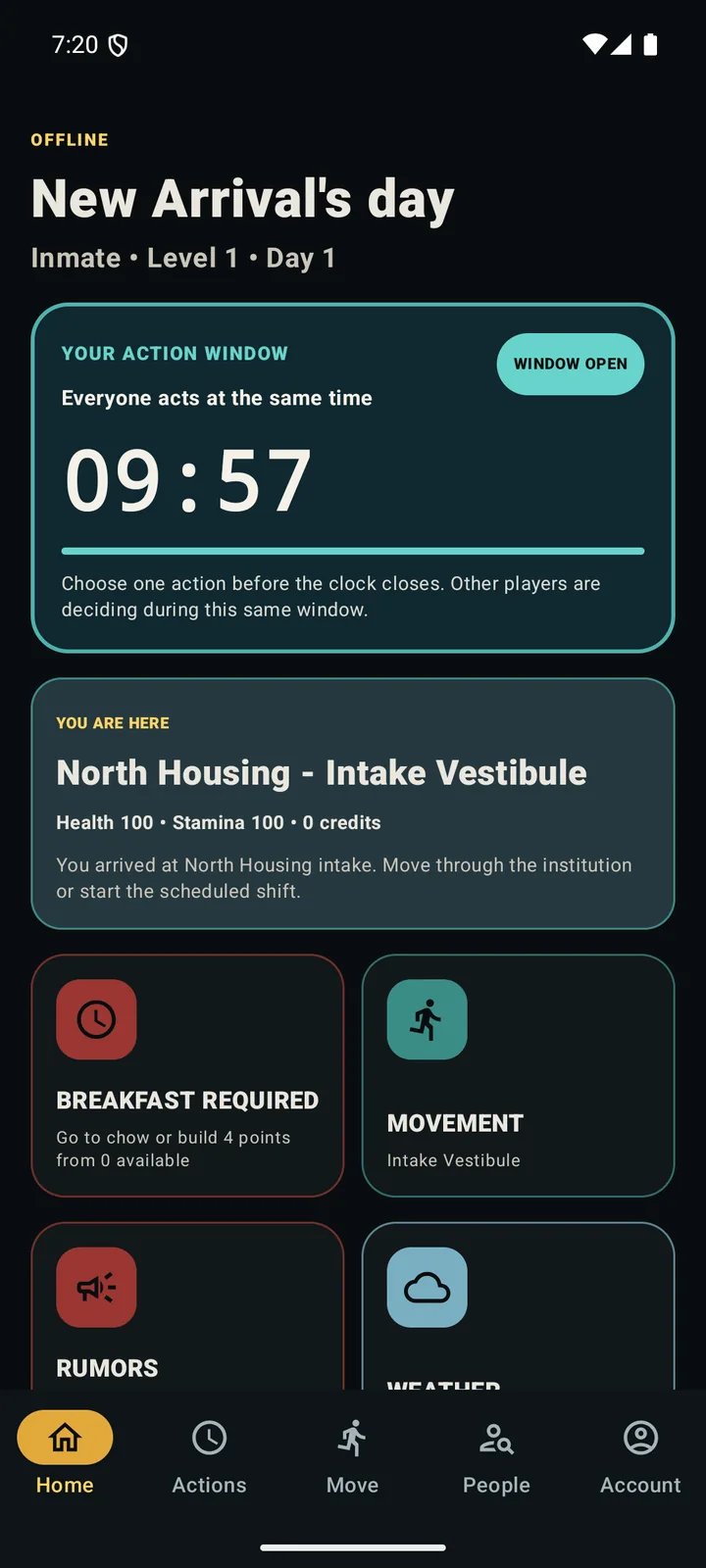
Everyone in the institution shares one repeating thirty-minute window and files one major action inside it, independently. Nobody waits in a thousand-person turn queue: one player deciding in the first minute and another deciding at the deadline both count, and a live countdown sits at the top of the screen.
Movement, conversation, checking your locker, reading mail, and looking people up stay available the whole time. If you never act, a saved default action resolves for you at the deadline, and the phone can send you one reminder in the last stretch of the window if you have not moved.
Consequence review, then a receipt
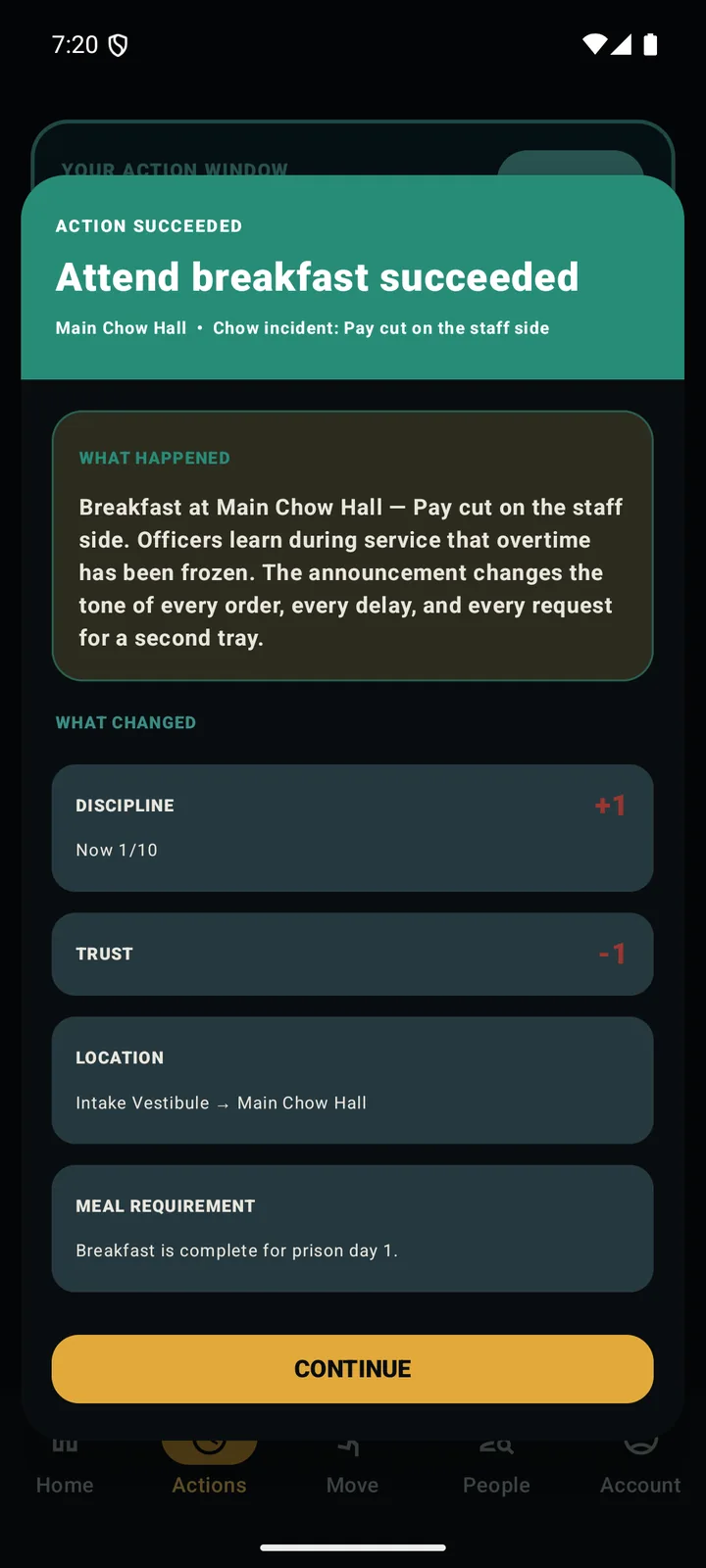
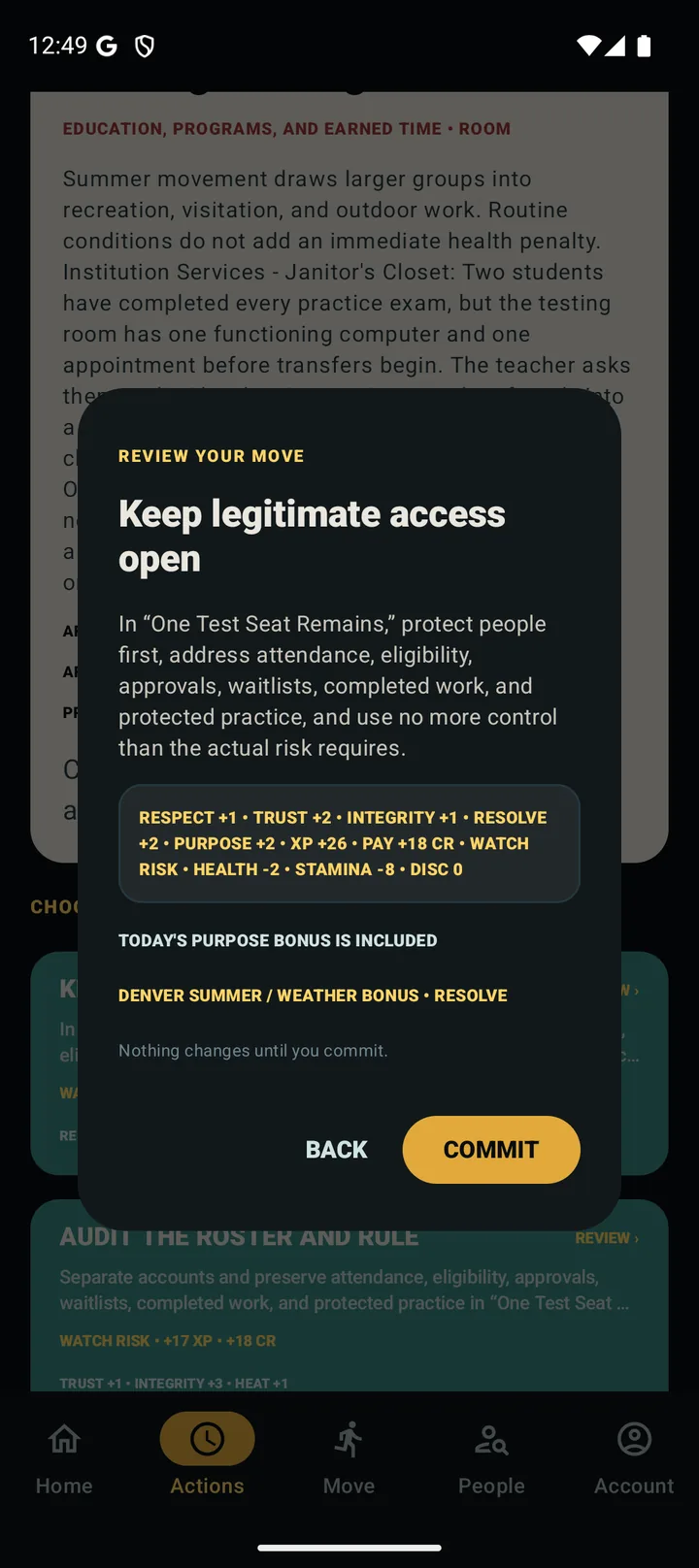
Choosing an action does not immediately do it. A review panel first shows exactly what the move is aimed at and what it will cost and pay - respect, trust, integrity, resolve, purpose, experience, credits, health, stamina, discipline - and says plainly that nothing changes until you commit. After it resolves you get a separate full-screen receipt: what happened in plain English, then a changed-stats list covering your condition, property, relationships, location, and what is now required of you next.
Careers with no final turn
An inmate career and an officer career both run indefinitely. You keep your level, formal rank, career meters, health, stamina, discipline, objective history, named relationships, credits, saved defaults, and organization membership across every session, every reconnection, and every transfer to another institution. Each finished action window pays earned commissary credits exactly once. Promotion comes from accumulated career experience, never from how long ago you signed up.
Inmate occupations
Inmates pick from thirteen level-gated work assignments - unit porter, kitchen crew, laundry, sanitation, grounds, chapel orderly, industries assembler, warehouse clerk, maintenance helper, library aide, education tutor, barber, and peer mentor. Every assignment publishes its location, three concrete responsibilities, its pay bonus, and which decision focuses it builds. Reliable work is the slow, safe way to earn money and experience; missing it costs you both.
Officer duty posts and the rank ladder
Officers choose among fifteen duty posts, from housing unit and yard through visitation, receiving, hospital, transport, central control, special housing, programs, and intelligence, up to shift commander, operations chief, executive command, and headquarters. Formal rank runs a ten-step ladder across fifty career levels: Correctional Officer, Sergeant, Lieutenant, Captain, Major, Colonel, Associate Warden, Warden, Headquarters Liaison, Headquarters Investigator. Each rank states its authority and its three standing duties in the game itself, so a promotion changes what you are expected to do, not just a title.
130 rooms across thirteen zones
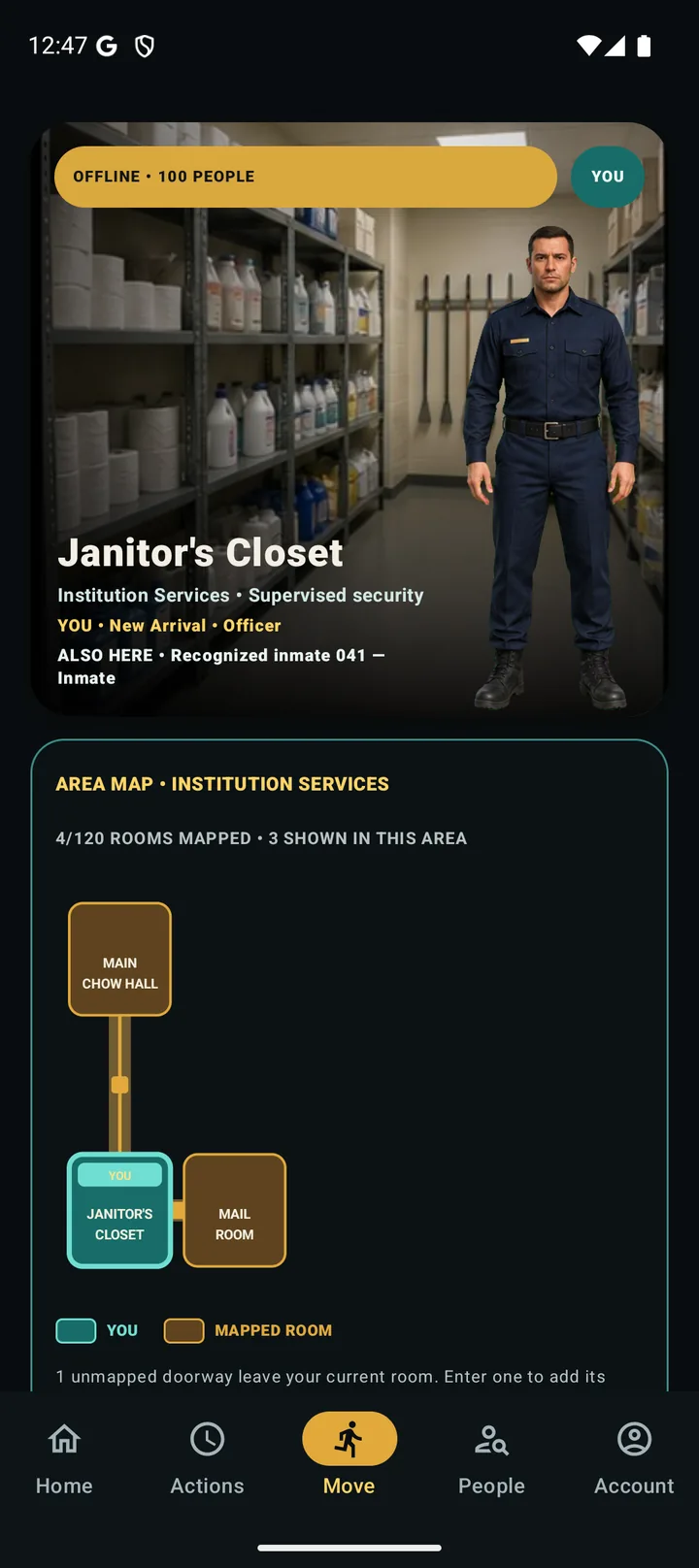
The institution is 130 connected, individually illustrated rooms grouped into thirteen zones: four housing units, education, industries, health services, administration, visitation, recreation, institution services, segregation, and movement and perimeter. You only learn a room by walking into it - the area map fills in chamber by chamber and unknown exits disclose nothing but their count. Each trip costs time and stamina, and where you are standing decides which people, events, and actions are even possible.
The room, drawn from overhead
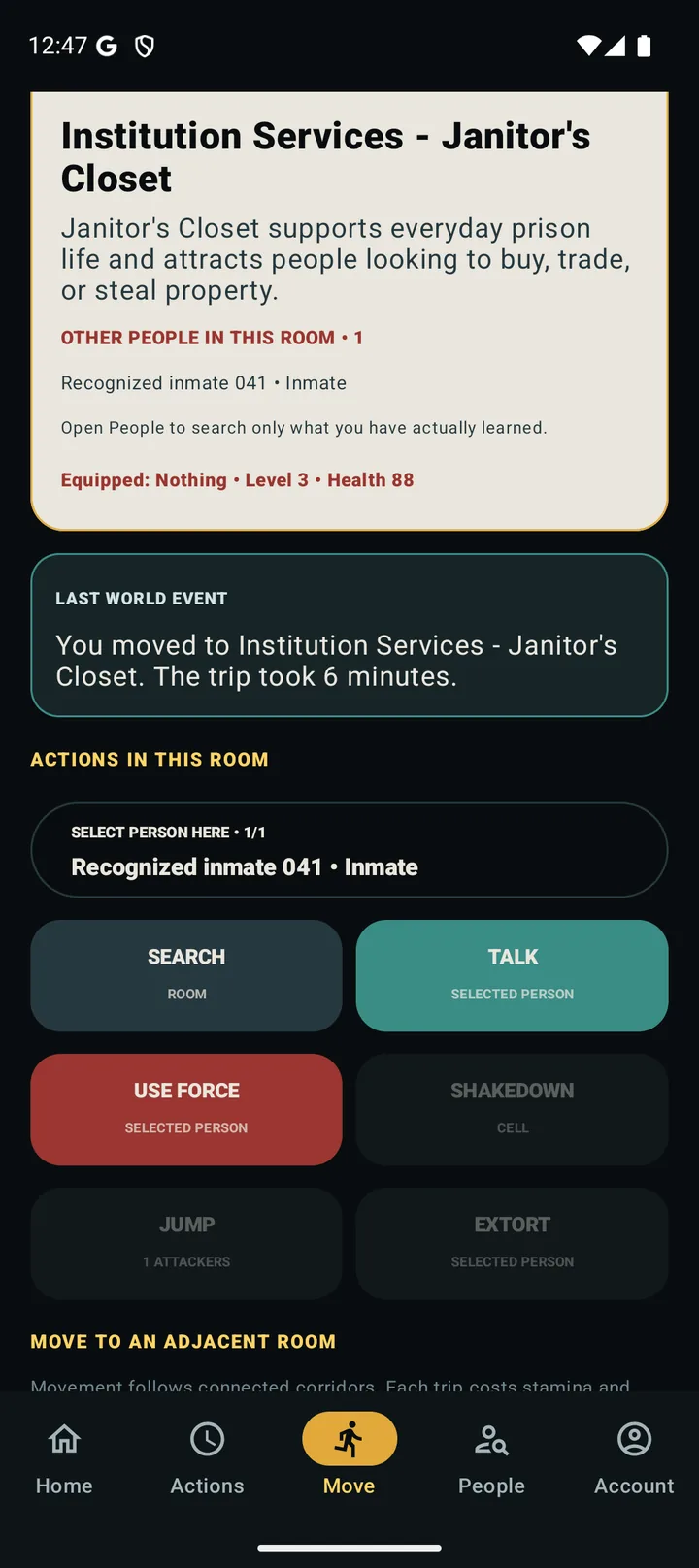
Opening a room shows the actual place: correct fixtures, a green marker for you, colour-coded occupants by your relationship with them, and up to fifty individually clickable people on the floor. The header names who is here and only what you have actually learned about them - a stranger stays 'Recognized inmate 041' until you earn better. You have to walk your marker over to someone before the interaction panel will open, and the room and area maps stay collapsed until you ask for them.
1,000-resident institutions
Every institution holds exactly 1,000 resident slots: 952 inmates and 48 officers, with the officer posts interleaved across the roster rather than bolted on at the end. Every slot you are not sitting in is run by the simulation, so the population keeps working, eating, patrolling, arguing, and getting into incidents whether one person is connected or a hundred. When a human joins online, they take over one AI-controlled slot one-for-one - the institution never grows an extra person to make room.
999 residents who are not waiting for you
The whole non-player population advances together each time the institution crosses one of its five daily moments: morning count and breakfast, work and posts, lunch and mid-day movement, afternoon recreation and searches, dinner and evening count. Each resident keeps their own room, credits, experience, level, health, stamina, discipline, meals, attendance, and last simulated moment, so they get promoted, injured, disciplined, and moved without you. Adding more AI residents never slows your turn down, because they resolve as one batch instead of taking turns.
People who are actually people
Every resident is generated from a catalog of 16 origins, 32 traits, 24 motivations, 36 quirks, and 50 multi-stage life events, producing twelve bounded behaviour weights including cooperation, aggression, honesty, loyalty, empathy, discipline, and patience. A life event bends what someone is likely to do; it never dictates a response or stamps them as violent or dishonest.
Their history is stable for that world, so moving away and coming back does not silently replace who they are. On top of that sits attachment and conflict style, stress behaviour, coping strategies, values, trust builders and breakers, pressure triggers, and blind spots.
Earned knowledge, not a database
You never get an omniscient directory of a thousand people. Knowledge of a person climbs through seven states - unknown, recognized, introduced, familiar, understood, trusted, confidant - and search only ever runs over facts you personally learned. Private backstory, motives, the source events behind a habit, money, inventory, and exact whereabouts stay hidden until trust is genuinely earned. Officers get one exception: duty-authorized roll call gives them names, classification, work assignment, and last reported location, and nothing about loyalty or personality.
41 person actions
Selecting somebody opens the actions that role pair actually allows - 41 in total across inmate-to-inmate, officer-to-inmate, inmate-to-officer, and officer-to-officer. Inmates can talk, trade, befriend, recruit, protect, threaten, extort, rob, challenge, attack, jump, ask about rumours, and settle debts; officers can question, order, search, confiscate, warn, discipline, escort, separate a fight, call medical, use force, and on the corrupt path run a cell shakedown.
The engine checks physical presence, duty status, room type, treatment and emergency restrictions, organization membership, and whether you actually have a gang ally standing nearby. If the target is another human being, the game records your approach - it never invents their consent.
Gangs
A level 8 inmate can found a gang, recruit, and promote members through a five-rank internal ladder - Prospect, Member, Enforcer, Block Rep, Shot Caller. Membership unlocks operations that a lone player simply cannot run, most obviously the gang-assisted jump, which requires an ally physically in the room with you. Zone control is real: thirteen zones each track a controller, a challenger, influence, control margin, volatility, and how often control has flipped, and resolved actions move those numbers.
Corrupt officer units
An officer who has taken enough of the wrong opportunities can, at level 8, found a corrupt network, invite eligible officers, and promote them through their own five-rank track - Contact, Trusted, Coordinator, Deputy, Chief - while still climbing the formal department ladder in public. The corrupt path is what unlocks the housing-unit cell shakedown and the propositions that arrive on shift. It also puts you squarely in front of the people whose entire job is watching for exactly that.
Investigations and hidden informants
Every 1,000-resident institution seeds covert roles you are never shown: 32 inmate informants, 4 officer informants, 4 fictional DEA plants, and 2 Office of Inspector General investigators. They observe misconduct, and their reports build staged cases with real recorded consequences - identities, locations, and source records stay private unless a later adjudicated event reveals them. Nobody is ever labelled a snitch by rumour: a resident is only ever described as having a reporting history after a report genuinely happened and you have earned confidant-level knowledge of them.
Fights
A fight is decided by who is physically in the room, so the sides can be badly uneven and often are. The server freezes the exact attacker and defender lists, computes power from career and your strongest equipped gear, holds bounded odds and a deterministic roll, and then applies one durable batch of consequences to every participant exactly once - health, stamina, discipline, heat, and medical treatment where it is needed.
You see your own receipt in full; you do not get to read everyone else's vitals. If your health reaches zero you are moved to the Observation Bay for two treatment actions - the career survives, the week does not.
Searching rooms and improvised projects
Rooms can be searched and their fixtures tampered with, and what you find is real property you keep. From those components the game exposes a searchable catalog of 100 concrete improvised projects - 60 pointed and 40 impact designs built from 22 named source materials and forms - each listing the property it consumes, the time and stamina it costs, its attention and detection risk, where it can be built, and what it is worth in a fight. There is no construction minigame and no instructions: the server resolves the project abstractly and hands you the tradeoff.
Commissary
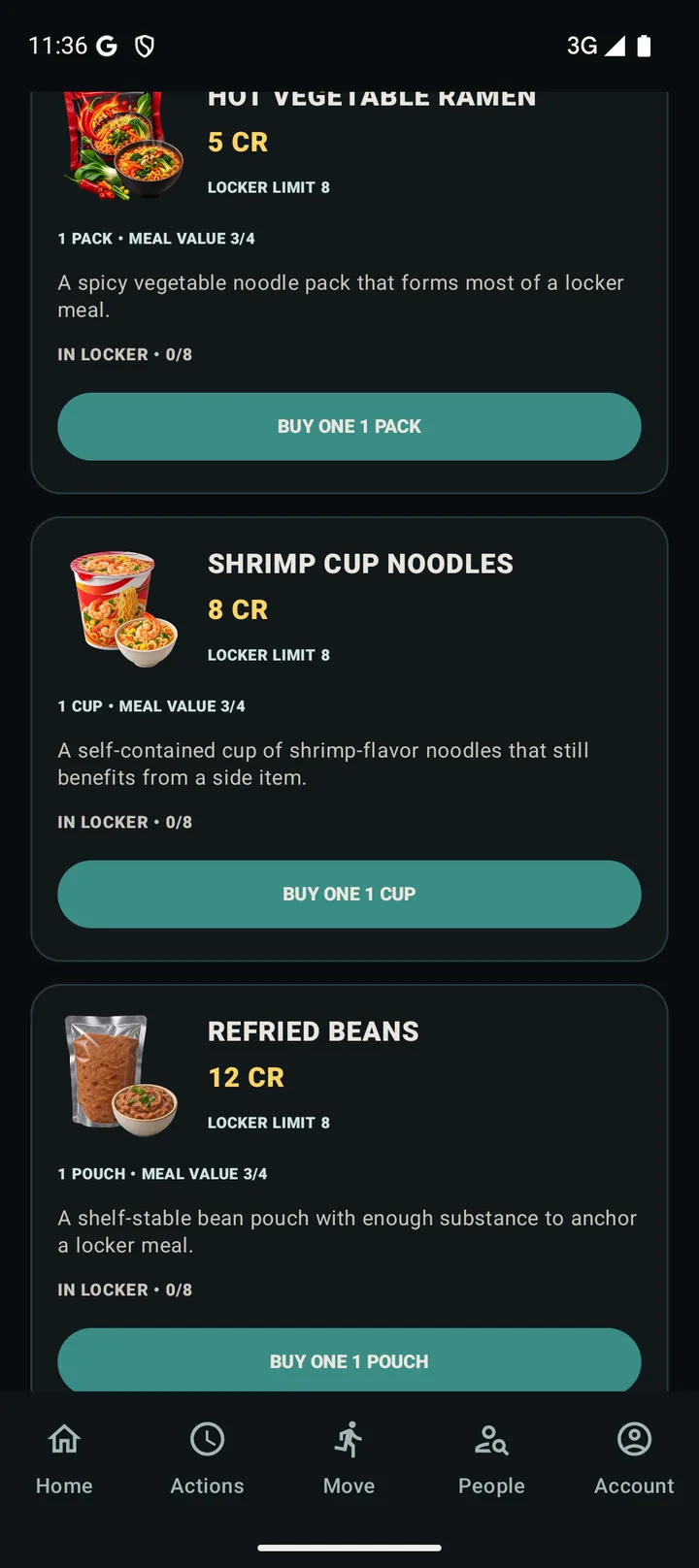
The store sells 100 individual foods across meal bases, protein, snacks, drinks, and condiments, plus eighteen durable items - soap, a sketchbook, coloured pencils, earbuds, yard denim, cosmetic trims and outfits. Every item has a picture, a credit price, a serving size, a meal value, and its own locker limit. Prices and names are grounded in published public canteen and commissary catalogs and then balanced as game values, and the store refuses a purchase at your locker limit instead of letting you overfill it.
Lockers and cells
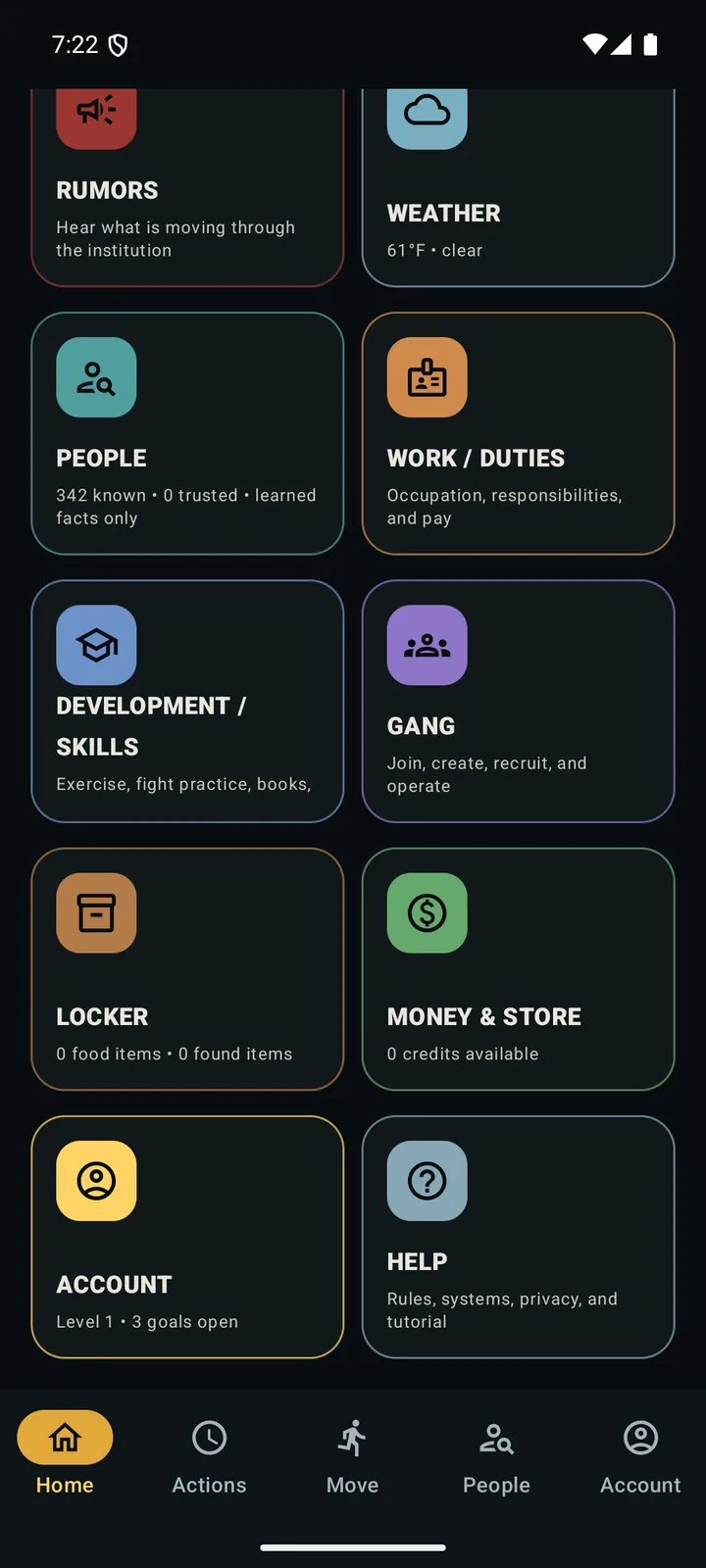
Your cell is drawn overhead from twenty distinct layouts, with an open-locker view, category thumbnails, live possession markers, and a saved four-way arrangement of your belongings. The locker is where food, found property, components, and finished projects actually live, each capped by its own item limit. Officers get a staff locker of their own. Earned-credit property can be lost to a robbery, extortion, shakedown, or fight; premium coins, paid outfits, mail tokens, and identity assets never move that way.
Chow waves
Breakfast, lunch, and dinner are hard gates: you cannot do the matching routine action until you have eaten. Going to chow is free, sends you to Main Chow Hall in one of three scheduled waves of up to 360 seats, and always produces a social incident you do not control. The alternative is eating from your locker - combine one to eight owned items to reach four meal points - which skips the incident entirely but restores less stamina and costs you the food.
Standard private mail between players is accepted immediately and becomes readable exactly sixty minutes later - real minutes, not game minutes - and it can cross between institutions to reach a friend on another server. A letter can carry a request for earned credits. Instant delivery consumes a held token. Mail uses in-world character names and opaque identifiers; there are no email addresses in it and no open chat anywhere in the game.
Daily objectives
Every prison day hands you three deterministic objectives drawn from a sixteen-template role-aware catalog. Progress and rewards are resolved authoritatively and can only ever be paid once. They are the steady spine under the improvisation: something to do on a day when nobody is trying to rob you.
Personal development
Between the dramatic days there is the boring, effective work: conditioning and exercise, fight practice, checking books out of the library and reading them in your cell, correspondence courses, and family relationship calls. These build bounded, gradual advantages that show up later in combat, in legal work, and in how people treat you. Development actions produce their own detailed receipts so you can see what an hour of reading actually bought.
Emergencies
Thirty-seven researched emergency types run as multi-phase operations rather than one-line announcements: warning where applicable, active response, recovery, clearance. Fires, floods, sewer failures, grid loss, camera and door-control failures, weather, chemical plumes, medical isolation, staffing collapse, mass refusals, and threats each close specific rooms, relocate the right occupants, change movement posture, and switch meals to in-place trays.
Officers get an operational order; inmates get the version of the day that is actually happening to them. Institution-wide events stage everybody, localized ones only touch the affected area, and nothing - a robbery, a search, a fight, a yard bout - gets to walk through a closed room.
Transfers between institutions
You can move to another active institution and take your life with you: career state, level, score, saved default actions, commissary credits, premium coins, mail tokens, inventory, equipped outfit, condition, and relationship memory all travel. A verified account owns one Bars or Badge character name across every institution, transfer, reconnect, and device, kept separate from the safe account alias other games see.
Lifetime endings
There are three deliberately exceptional ways a career can actually finish. An inmate can build a court-release case - researching the case, preparing filings, and seeking judicial review, which needs maxed legal knowledge and case preparation, 90 conduct, 70 outside support, three filings, and a long cooldown between hearings.
An inmate can instead pursue a deliberately abstract escape, which needs maxed readiness and opportunity, 80 secrecy, an even longer cooldown, and carries extreme risk - the game models the attempt, never a real method. An officer can file for retirement once service, pension standing, savings, and a clean record all clear their thresholds.
The screen says it plainly: these endings take a very long career.
The character creator
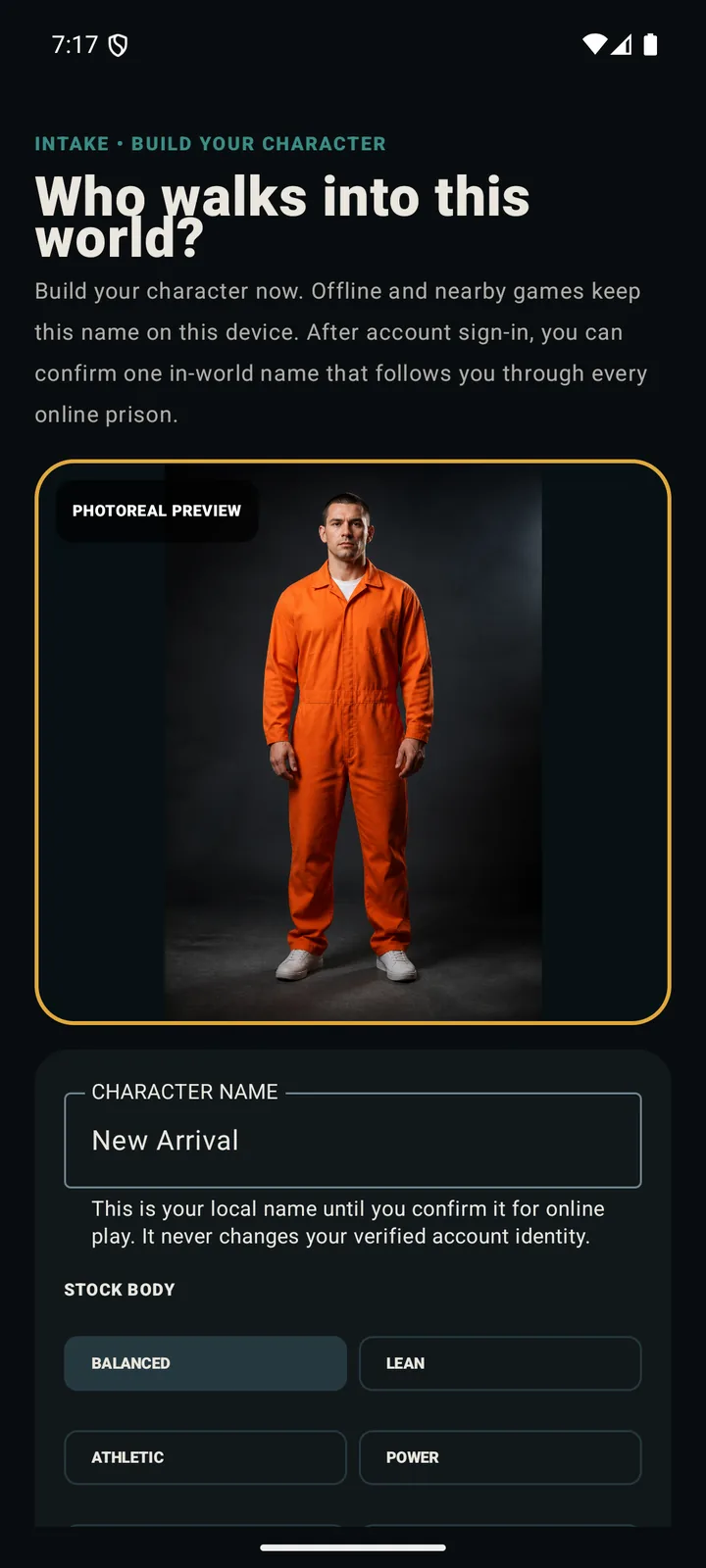
First run asks who walks into this world. You type an in-world name of your own, pick one of eight stock bodies - Balanced, Lean, Athletic, Power, Compact, Heavy, Tall, Veteran - and then adjust sex, height, weight, muscle, hair style, hair colour, skin tone, face shape, and shoulder width independently. It needs no face scan, no photo, and no external avatar account. Your name, role, and build follow you into the illustrated room scenes, and you can redesign the character later without losing the career.
Weather and season
The institution sits in a Denver climate that follows the real calendar and real current conditions and alerts, plus neutral official policy context, all of it frozen into one snapshot per action window so every player previews and resolves against the same weather. Season and conditions move residents between indoor and outdoor areas rather than inventing or deleting people, and they shift the modifiers on the day. If the official sources cannot be reached, the game says it is showing a season-only fallback rather than passing off stale data as current.
Cameras, patrols, fatigue, and visits
Cameras can catch you live or be reviewed after the fact, so an action that nobody saw is not automatically an action nobody knows about. Officers walk patrol routes and exercise judgment on what they find. Fatigue accumulates and sleep matters. Family visits happen, and so do the quiet propositions that come with them.
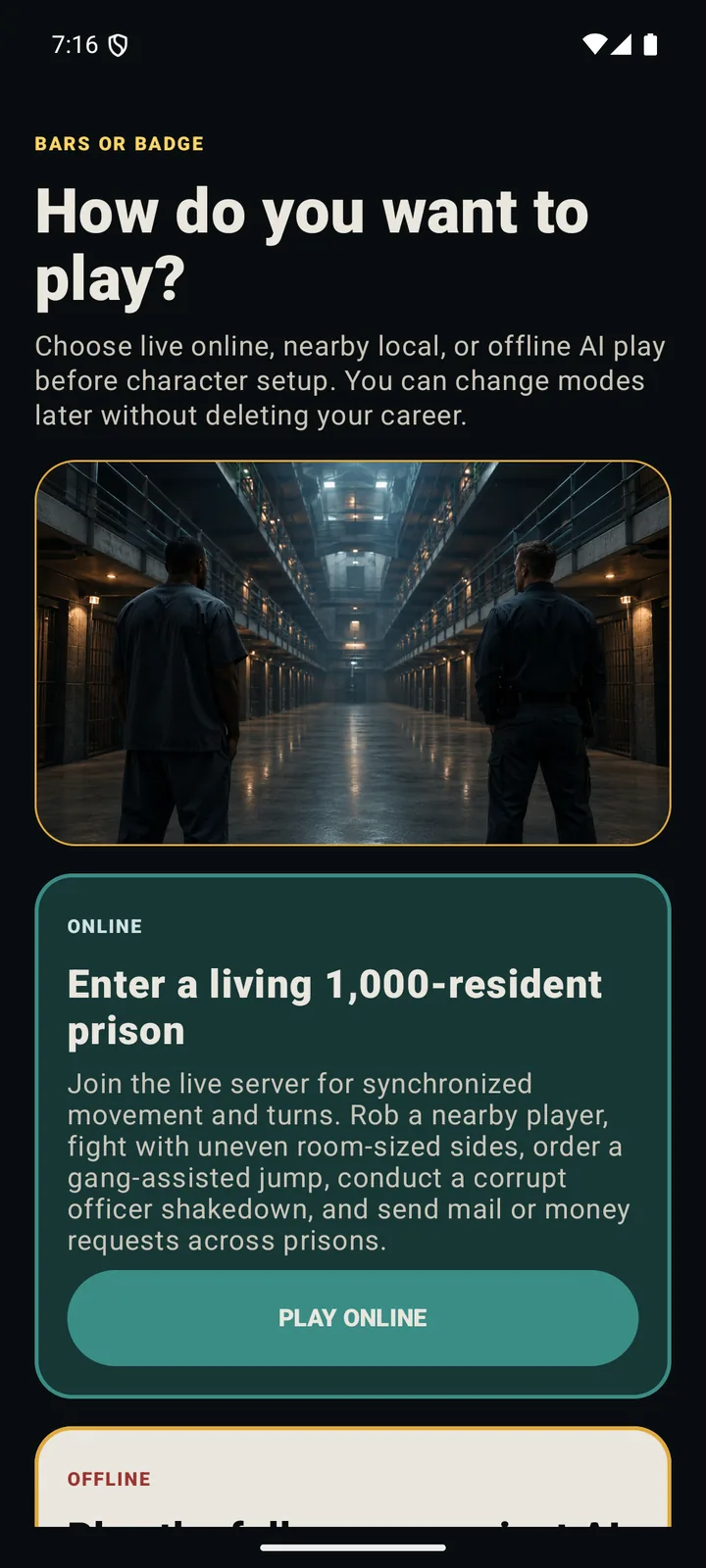
Three ways to play
Offline, online, or nearby.
The choice comes before anything else happens, and playing alone needs no account and makes no network request.
Offline against AI
Play the complete career with no account, no sign-in, and no network at all. You get one human - you - plus 999 stable, named AI inmates and officers running the same rooms, jobs, meals, incidents, emergencies, relationships, and economy, saved on the device. Every AI decision comes from the current game state and legal moves, using text that ships inside the app: no cloud model, no chat, no ads, and no data collection. This is the whole game, not a demo of it.
Online persistent institution
Sign in with a verified AutoSecureLogin account and enter a living 1,000-resident institution shared with other people. The server owns room presence, who is eligible to be targeted, gang membership and rank, fight participants, protected property, mail timing, and credit transfers, so nobody can invent an ally, drag in someone from another room, or rewrite a result. Rooms, movement, tension, conversations, arguments, staff orders, and NPC fights are synchronized for everyone in them. Come back later, or on a different device, and you re-enter the same placement with the same character, not a fresh one.
Local Star - nearby play
One phone hosts a complete 1,000-resident institution and nearby phones join by scanning a QR invitation on the host's screen - no internet, no account, and no cloud server involved. Both devices confirm matching authentication digits before anyone connects. Each accepted visitor takes over one anonymous AI slot and becomes a permanent resident of that host's world: when they walk away, the character stays and the host keeps running it, and reconnecting on the same device reclaims the same resident, name, role, appearance, location, and history. The invitation secret dies when hosting stops.
Screens
From the current build.
The arcade
Five smaller worlds.
Each is a complete native game with its own voice, playable offline against authored computer players, with friends and synchronized play when you sign in.
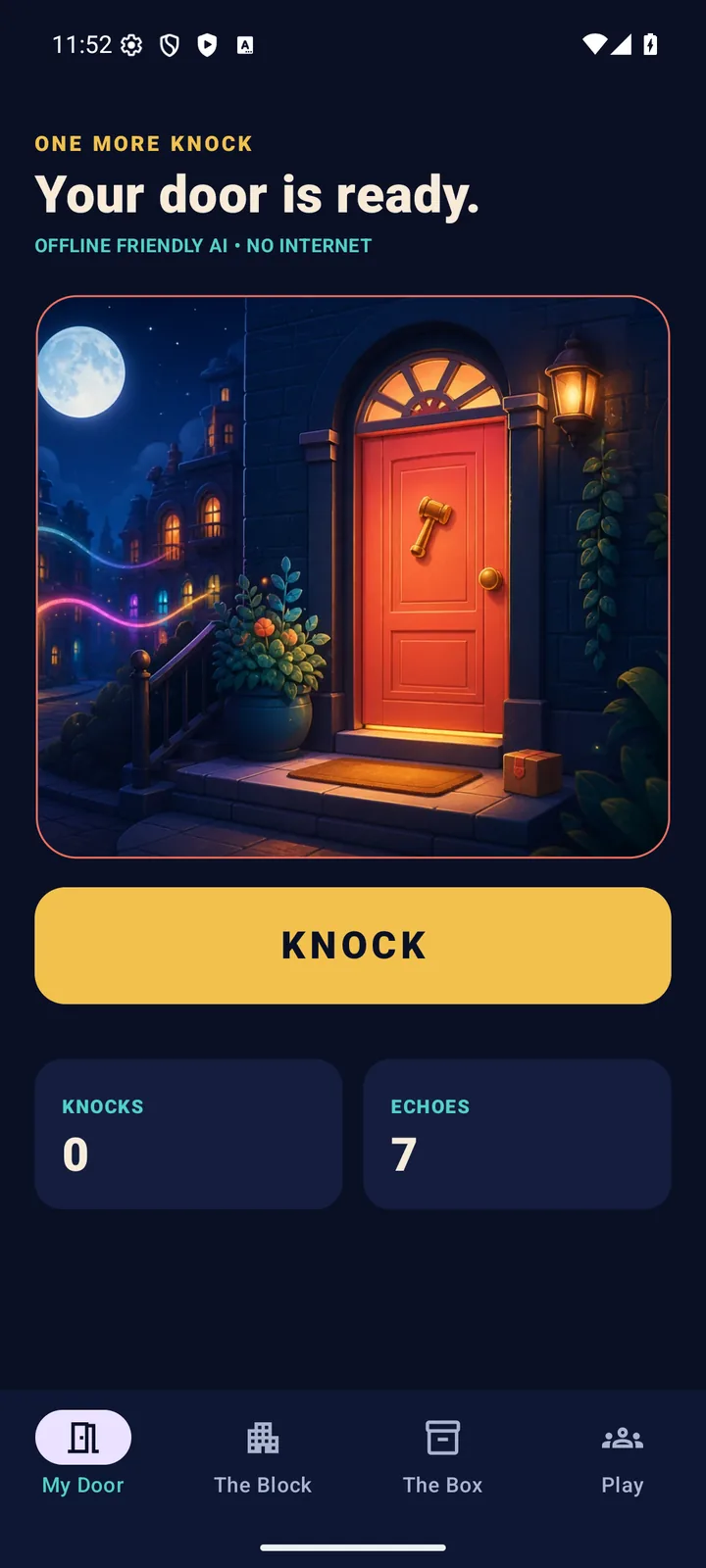
One More Knock
There is a door on your porch that was not there yesterday. Knock on it.A warm, deadpan neighbourhood ritual. You knock, and five neighbours decide whether to answer - each with their own rhythm and their own reasons. Earn Echoes, collect twelve authored Block Postcards and twelve distinct parcel reveals, and style your porch as the street starts recognising you. Choose online or offline before you play, and leaving mid-round no longer loses the round: the exact last knock and every neighbour's response comes back exactly as you left it. Two-player pools online, friendly AI neighbours off.
Download →Probably Weather
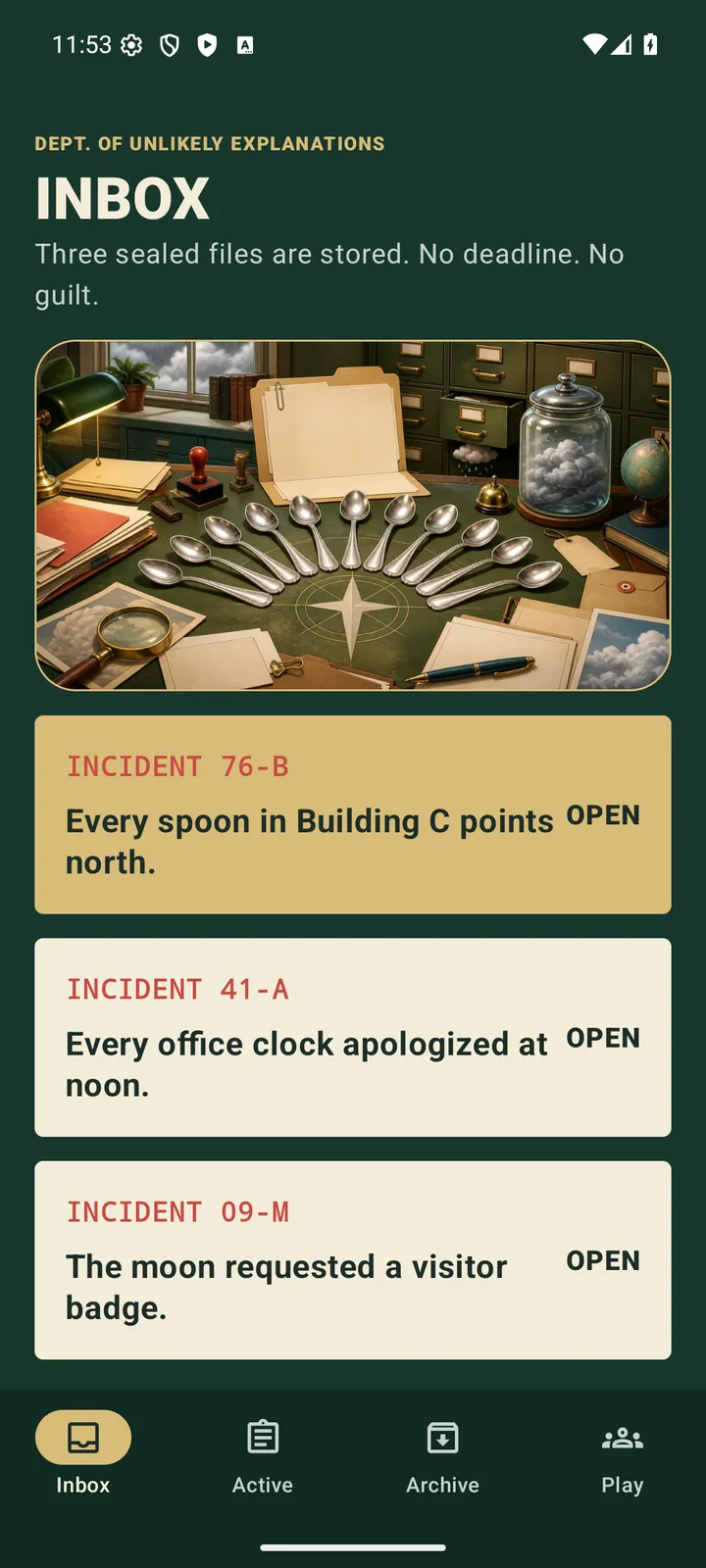
Every spoon in Building C points north. Somebody has to file this.You work for the Department of Unlikely Explanations, and impossible events are a scheduling problem. Open one incident from twelve authored cases, choose the Department's first explanation, and build a readable five-statement case file out of 180 context-bound mutation combinations and three physical stamps. Every closure has to still be about the object, the place and the people the incident actually started with - nothing generic, nothing recycled. Your draft survives an app restart, and the archive keeps every case you closed. Five-player relay online.
Download →Please Take a Number
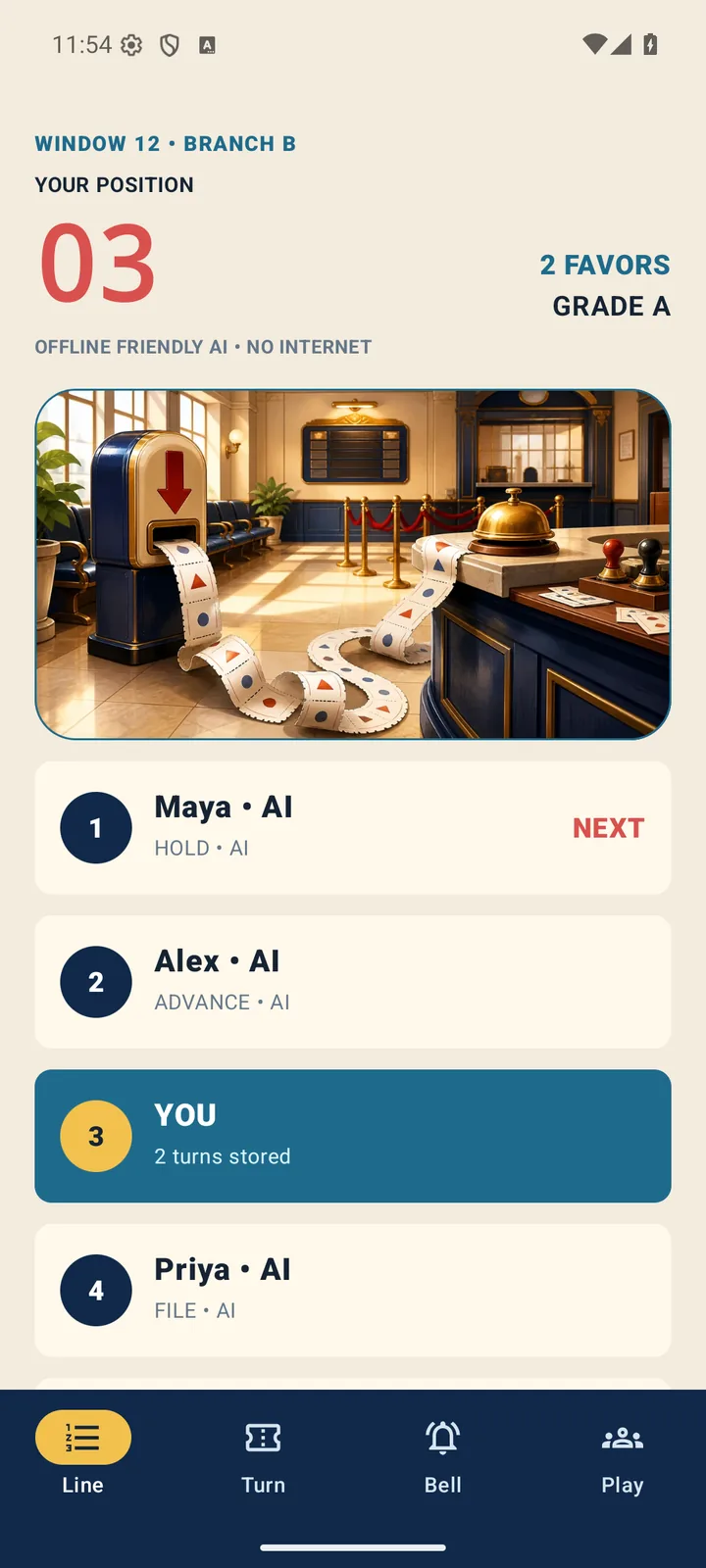
You are number 03. The bell is about to change what that means.Queue politics played completely straight, as important public business. Advance, Hold or File, spend and earn favours, raise a shield, and read the next of seven deterministic Bell rules before it fires. Every move produces a clean receipt in causal order: what you did, what any pass did, which public rule changed the line, and where you ended up - no hidden math and no unexplained jumps. Service Grade persists, receipts survive a restart, and four-player queues run online.
Download →Static Club
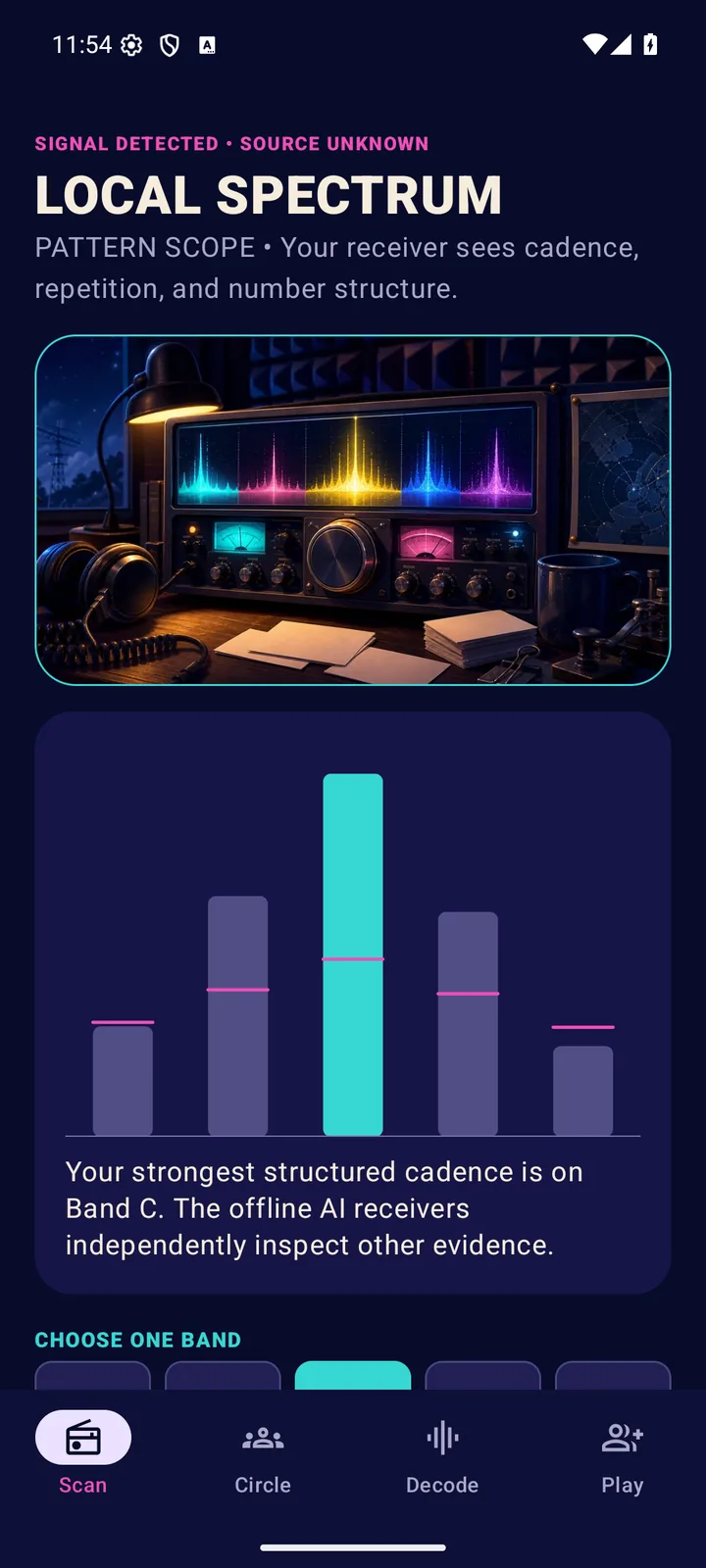
Four receivers, five bands, one broadcast nobody can source.An asymmetric listening puzzle. Each player's receiver sees different evidence - cadence, repetition, number structure - across a signal-specific five-band spectrum, and only by pinning field notes and combining them do you recover one of ten fully authored broadcasts, each a coherent miniature story with its own clarity-specific transcript. The game refuses to invent a decode before four real notes exist, so a guess never turns into a false reveal. QSL archive cards keep what you recovered. Three-player circles online, adaptive AI receivers off.
Download →Unclaimed Baggage
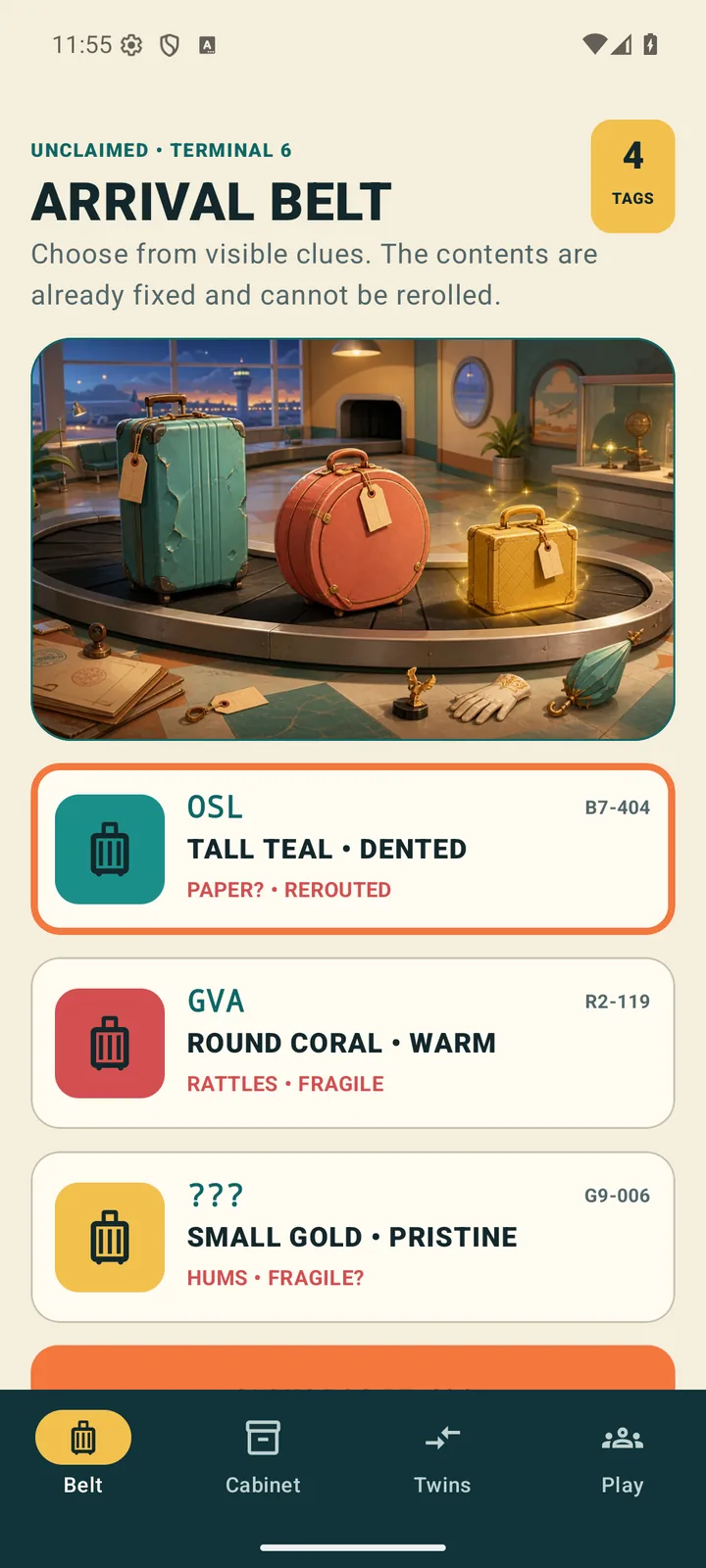
Tall teal, dented, rerouted, and it sounds like paper. You have four claim tags.A tactile airport collecting game built on readable evidence. Eighteen clue-rich suitcases with fixed, unrerollable contents hold 24 authored artifacts arranged in 12 Travel Twin pairs, and the visible clues - origin, shape, condition, weight, sound - are all published before you spend a tag. What a bag shows and what inspection reveals are kept deliberately separate, and the AI claimants have to cite the same visible clues you can see. Your cabinet, open inspection and latest matched record all survive a restart. Three-player arrival belts online.
Download →Questions
Before you install.
How much does it cost?
Nothing. The game is free to download and there is nothing to buy inside it - no purchases, no currency sales, no store checkout, and no ads anywhere. Offline play never contacts a server at all.
Do I need an account or an internet connection?
Not for the full game. Offline mode runs the complete career against 999 AI residents with no sign-in and no connection, saved on your device. Nearby play over a scanned invitation also needs no account and no internet. A free AutoSecureLogin account is only required if you want to enter shared online institutions, add friends, or send mail.
Why isn't it on the Play Store?
It is an early access game and it installs directly from this site instead. That means Android will ask once whether to allow an install from your browser - the standard prompt for any app that does not come from a store. Every download's exact size and SHA-256 hash is published in our integrity manifest so you can check the file you got is the file we built.
Which phones does it run on?
Any phone on Android 8.0 or newer. The main download is built for standard modern phones; a larger universal build is there for anything the main one will not install on. Both are the same version. Our layout checks were done on simulated devices rather than a physical phone, so if something looks wrong on yours we genuinely want to hear about it.
Is there chat? Can other players harass me?
There is no chat in this game, by design. The only player-to-player text is private mail between approved contacts or people who shared an institution, and it is length-limited and delayed by a real hour. You can block anyone, friendship needs the other person's approval, and your email address is never shown to another player.
Do I have to play as a criminal?
No. The officer career is a full, separate game with its own fifteen duty posts, its own ten-rank command ladder, and its own ending. It is not a difficulty setting or a side mode - it is the other half of the product. And the officer path itself splits: you can build an unimpeachable record, or take the offers that keep arriving and see how long that lasts.
Does the world keep going when I close the app?
Yes. Every slot you are not in is run by the simulation, so residents keep working, eating, patrolling, arguing and getting into incidents whether you are there or not. In online institutions the whole population advances at each shared deadline; offline, it advances on your device. Nothing about your career is deleted for being away.
How much time does it need?
One real decision per thirty-minute window, and you never wait on anyone else - everybody acts inside the same clock, independently. If you cannot get to it, a saved default action resolves for you at the deadline and your phone can nudge you once beforehand. You can also just move around, talk, read mail and check your locker without spending your action at all.
Pricing
There is no price on any page: the six games are free direct downloads today, and no in-game charging of any kind is switched on.
Good to know
- The game is not on Google Play. Installing it means allowing an APK download from a website, and Android will warn about that. Some people will not do it, and the funnel has to be honest about the friction instead of hiding it.
- Both APKs are debug-signed. That is fine for direct distribution but it means Android treats them as apps from an unknown source, and a future store-signed build will not upgrade in place over them.
- Visual acceptance was done on an emulator. Nobody has signed off on Bars or Badge running on a physical phone yet, so real-device performance, battery, and layout on unusual screens are unverified.
- The character art in room scenes is a placeholder. Four generated stand-in figures represent the player; skin tone, hairstyle, face shape and cosmetics are saved but not yet drawn into the scene, and the rigged 3D avatar system is not built.
- Nothing can be bought. Stripe is test mode only, live charging is disabled, Play Billing is not enabled, and checkout is hidden from the normal build. Any pricing or currency-pack language on the site would be a promise, not a product.
- Local Star nearby play is not yet at parity with online. A returning guest's privately earned credits, experience, health, discipline, inventory and property are not imported back into their career; guest tactical property and vitals are not mutated; and a connected human target does not get an accept/refuse/defend prompt. Guest schedule advancement and organization-dependent local actions fail closed with an on-screen explanation.
- The 1,000-resident figure is the saved population, mostly AI. It is not a claim of 1,000 phones connected at once. For Local Star specifically the code declares no fixed guest limit, so real nearby-guest capacity is bounded by the host phone and the nearby transport and has not been measured - do not publish a guest-count number.
- Most of the published screenshots are from earlier versions and say so. The countdown capture shows a ten-minute clock from before the window moved to thirty minutes, one room capture reads '4/120 rooms mapped' from before the map grew to 130, and one older capture still advertises a 100-player prison. Only the four current-version captures on the live site (Move, actions, locker, weapon projects) reflect what ships today.
Pick a side.
Install Bars or Badge, create the person who walks into the institution, and start your first prison-day. Playing alone needs no account.