 Auto Secure Login
Organize therapy scheduling, records and practice workflows
ASL Therapy brings scheduling, notes, billing and client-portal workflows together. Review bilingual support, access controls and early-access availability.
Your evenings back. A record that holds up.
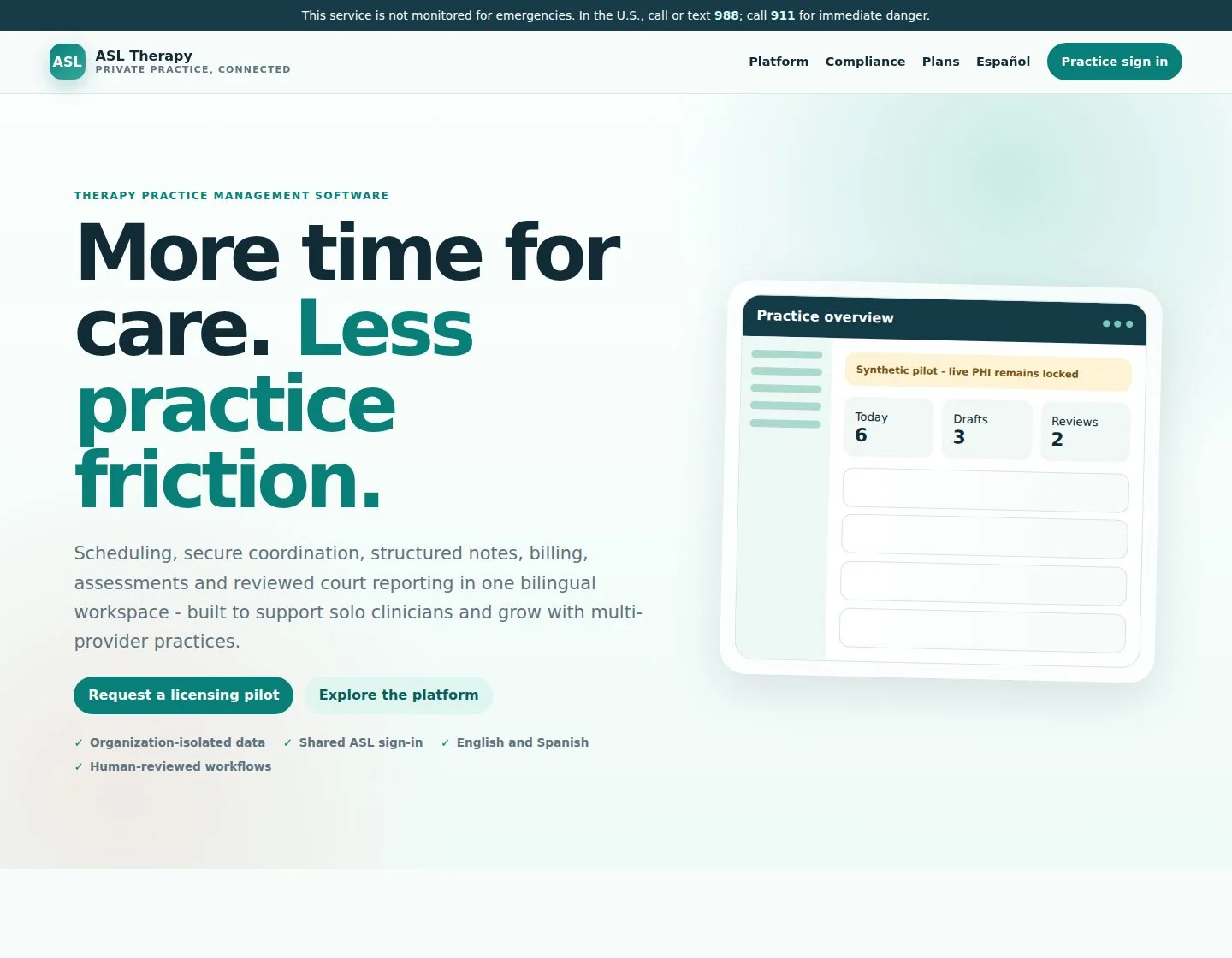
Scheduling, notes, billing, client portal and reviewed court reporting for therapy practices, in English and Spanish.
Built for: Solo licensed therapists and counselors who want one place for the schedule, the chart and the invoice · Group practices with therapists, supervisors, front-desk staff and a billing person who must all see different things · Court-directed treatment programs writing to probation, parole, a court or a state board · Offense-specific treatment providers working to the Colorado SOMB Adult Standards
In one sentence
Scheduling, notes, billing, client portal and reviewed court reporting for therapy practices, in English and Spanish.
The report approval rule is enforced rather than advisory: the author cannot approve their own report, and approval requires opening the actual text, so nobody can sign off on something they were never shown.
The problem
ASL Therapy exists because of this.
You saw six clients today. It is eight in the evening and you still have four notes to write, three invoices to raise, a progress report due to a probation officer on Friday, and a client who needs their intake packet in Spanish. The calendar is in one app, the notes in another, the invoices in a third, and the blank forms live in a folder on somebody's desktop that nobody has opened since the last version was superseded.
None of these systems know about each other, so every evening ends with you reconciling them by hand. The choice on offer has been an enterprise records suite priced and staffed for a hospital, or a stack of general-purpose tools that quietly puts client information somewhere it should not be.
Then there is the question of who can open what. A front-desk person needs the calendar and must never open a chart. A billing specialist needs the invoice and has no business reading a note. A supervisor oversees two clinicians and nobody else. A contract auditor needs a week of activity history and nothing else, ever again.
Most practice software ships three or four fixed roles and hopes your practice happens to match one of them. When it does not, practices do the dangerous thing: they share a login, or they hand someone administrator rights for an afternoon and forget. The day a board, an insurer or a court asks who could see this record and since when, the answer gets reconstructed from memory rather than read off a record.
And if any part of your work is court-directed, none of the paperwork is optional and the standard is not yours to set. A progress report goes to a probation officer, a court or a state board, and it has to say the right things, cite the governing standard, carry the right signature and arrive on time.
You need the standard in front of you while you write rather than in a PDF in another window. You need a second person's approval before anything leaves the building, and you need proof that the second person actually read what they approved. Software written for a general counseling practice has none of that in mind, so the reports get written in a word processor, filed in an email folder, and defended later from memory.
What changes
- The report approval rule is enforced rather than advisory: the author cannot approve their own report, and approval requires opening the actual text, so nobody can sign off on something they were never shown.
- Approving a report never sends it. Delivery stays a deliberate human act with the intended recipient shown for verification, because a report that reaches the wrong probation officer cannot be recalled.
- A signed clinical note cannot be deleted through the product. The attempt is refused and answered with the amendment route, so records are corrected rather than destroyed, which is the behavior a board or a court expects to find.
- Permissions deny by default and an explicit denial always wins. An unrecognized role receives the least access rather than the most, which is the opposite of the common failure where an unmapped role silently inherits administrator rights.
- Access rules are checked on every request rather than by hiding menu items, so a client outside your scope cannot be opened even with a direct link to the record.
- Bilingual means the working software. Staff flip the whole workspace between English and Spanish across 1,959 reviewed entries, and a Spanish-speaking client gets their entire portal and every notice in Spanish from the language on their file.
- Eleven treatment curricula ship with the product with their evidence base named on screen, 120 modules and 720 assignments in total, and practices can rename modules, reword prompts, hide assignments and add their own.
What it does
How ASL Therapy works, start to finish.
ASL Therapy is one workspace that carries a session from the calendar entry to the signed note to the invoice to the client's own portal, and, where the work is court-directed, on to a reviewed report. The day opens on a working queue rather than a dashboard: the notes you have not signed, the invoices issued and unpaid, the clients missing required paperwork, and any attendance problems against the policy your practice set, each one linking straight to the thing that needs doing.
What appears there is scoped to whoever is looking. A scheduler sees appointments. A billing specialist sees invoices. A therapist sees their caseload. Nobody needs a lecture about minimum necessary access, because the screen simply never contains what they should not see. Underneath that is a permission model built in three independent layers, because real practices never fit a fixed role list.
A base role sets the sensible default across the nine roles a practice can assign, covering how therapy practices are actually staffed. Six individual capabilities, being intake, discharge, clinical supervision, invoicing, billing administration and record export, are granted person by person independently of anyone's job title.
And each client record carries its own visibility: the whole practice, only assigned clinicians, supervisors, or practice owners alone. The narrowest applicable rule wins, an explicit denial always wins, and an unrecognized role receives the least access rather than the most. Every one of those rules is checked on every single request, so a client outside your scope cannot be opened even by someone holding a direct link to it.
Hiding a menu item is not access control; it stops an honest person and nobody else. Documentation behaves like a clinical record rather than a text box. Eleven note templates ship ready to use, including progress, SOAP, DAP, BIRP, GIRP, PIRP, SIRP, treatment plan, treatment plan review, case coordination and safety plan, each rendered as real fields so the structure survives whoever is typing.
Drafts save as you write. Signing commits a note to the record, and a signed note is never edited afterwards: corrections are filed as amendments that preserve the original and chain to it, and an attempt to remove a signed note is refused outright and answered with the amendment route instead.
Administrative contact notes stay deliberately separate, because a call from the front desk is not treatment and should not sit in a chart as though it were. Court, probation and board reports enter a review state where the author cannot be the approver, approval requires opening the actual text so nobody signs off on something they were never shown, and approval alone never transmits anything: delivery stays a deliberate human act, with the intended recipient shown for verification first.
Eleven structured treatment programs ship with the product, each built on a cited evidence base rather than assembled from whatever was to hand. They cover offense-specific work aligned to the January 2026 Colorado SOMB Adult Standards, domestic violence intervention, substance use, alcohol and drug recovery with the medical material a skills curriculum usually leaves out, a twenty-module comprehensive substance course for clients who need one long continuous track, trauma, anxiety and depression, grief and loss, couples and family, child and adolescent, and anger management.
Between them they carry 120 modules and 720 homework assignments with four prompts each, and every module states its purpose, evidence alignment, pacing, learning outcomes, suggested session sequence, core teaching and per-assignment review focus for the therapist. Programs are gated to the specialties your practice actually offers, so a general mental health practice never sees offense-specific modules.
Practices rename modules, reword prompts, hide assignments, add their own and attach their own documents. Assign an assignment and it appears as homework in the client's portal, where they answer it online and it returns straight into the record, or it prints as a worksheet on your letterhead if the client would rather work on paper.
Money and evidence are handled in the same place. Completing a billable appointment drafts the invoice, so nothing is quietly missed at month end, and clients pay online from their portal. Third-party payers work properly: a voucher from probation, parole, a court, a county, victim services or a grant funds a client's balance and is drawn down by invoices as a full ledger, so a balance can always be explained line by line rather than being a stored number nobody can account for.
Client identifiers, note text, message bodies, assessment answers and report narratives are encrypted at rest with AES-256, with searchable fields protected so a name can be looked up without the store holding it in the clear. The activity history binds each recorded event to the one before it, so alteration is detectable rather than merely discouraged, and it can be verified on demand from inside the app.
Nightly backups are encrypted, then decrypted again and integrity-checked before the run is recorded as good, because an unverified backup is a hope rather than a backup. ASL support holds no standing access to a practice: entry requires an explicit, time-boxed grant from the practice owner, can be revoked instantly, and every use is recorded where the practice can see it.
Features
Everything in the current release.
Each of these is built and working today. Nothing on this list is a roadmap item.
Start the day with a queue, not a dashboard
The practice overview lists the actual work: notes you have not signed, invoices issued and unpaid, clients missing required paperwork, and clients at or over your unexcused-absence limit. Each item links straight to the thing that needs doing rather than to a count you then go hunting for.
Required documentation is defined once for the practice, so staff see an outstanding-items banner naming what is missing on a client until each item is recorded, with the blank form attached to the requirement so people download the current version rather than an old copy.
Attendance limits can run over a rolling 365 days or the calendar year, and a client at the limit is flagged before it becomes a discharge conversation.
A client record that stays closed to the wrong people
Every client carries a visibility setting: the whole practice, only assigned clinicians, supervisors, or practice owners alone. That rule is checked on the record itself and on every note, report, document, invoice and export attached to it, so a client outside your scope cannot be opened even by someone holding a direct link.
Intake opens a record quickly using templates for general intake, mental health assessment, substance use, offense-specific evaluation, domestic violence, family, couples and juvenile work, and you only see the templates matching the specialties your practice offers. Discharge closes a record properly as successful, termination, lateral transfer or administrative, rather than leaving a file open forever.
Eleven note templates, and a signature that means something
Progress, SOAP, DAP, BIRP, GIRP, PIRP, SIRP, treatment plan, treatment plan review, case coordination and safety plan all ship ready to use, each rendered as real fields rather than a blank box so the structure survives whoever is typing. The record stores the template you actually chose, so a safety plan is filed as a safety plan.
Drafts save while you write and are readable only by their author until signed. Signing is what commits a note to the record, and a signed note is never edited afterwards: a correction is filed as an amendment that preserves the original and links to it, which is exactly what a reviewer expects to find.
Administrative contact notes for calls, visits and messages left are kept deliberately separate from the clinical record.
Scheduling that already knows how you bill
Book office, telehealth or phone sessions against a client and a service rate at the same time, and completing a billable appointment drafts the invoice for you. Reminders go out by email and, where the client has consent recorded with its method and date, by text; a client who replies STOP cannot be overridden by a staff member who forgot.
No-shows are captured as excused or unexcused at the moment the appointment is updated, rather than reconstructed later from memory. Beside the clinical calendar sits a staff work schedule that owners, schedulers and admin assistants build and everyone reads, carrying names and hours only so it can be printed and pinned to a wall without exposing a chart.
Outside people who keep regular hours with your practice, such as a contract interpreter, can hold shifts on the same board.
Court, probation and board reports with a real second signature
A report enters a review-required state, and its author cannot serve as the approver. Approval requires opening the report through a recorded read, so nobody can sign off on text they were never shown. You choose the level that fits your practice, whether that is any second authorized person, a supervisor, or explicit author-release for a genuine solo clinician, and every one of those choices is written to the activity history. Approval never transmits anything: delivery stays a deliberate human act, with the intended recipient shown for verification first.
Permissions in three layers, deny by default
Nine roles that a practice assigns set the sensible default, from practice owner and therapist through intake therapist, scheduler, billing, accountant, admin assistant, security and auditor. Six capabilities, being intake, discharge, supervision, invoicing, billing administration and record export, are granted person by person independently of job title.
And each client record carries its own visibility level. The narrowest applicable rule wins, an explicit denial always wins over any later promotion or role change, and an unrecognized role receives the least access rather than the most. Granting a capability, denying one, changing a role, disabling an account or relaxing the report-approval rule are all recorded with who did it and when, so an access review stops being an archaeology project.
The system also refuses to leave a practice without an owner.
Eleven treatment programs that ship ready to run
Offense-specific work aligned to the January 2026 Colorado SOMB Adult Standards, domestic violence intervention, substance use, alcohol and drug recovery, a twenty-module comprehensive substance course, trauma, anxiety and depression, grief and loss, couples and family, child and adolescent, and anger management. Each program lists its evidence base on screen with named citations, and each of the 120 modules carries its purpose, pacing, learning outcomes, suggested session sequence, core teaching notes and a per-assignment review focus for the therapist.
Programs are gated to the specialties your practice offers. Practices rename modules, reword prompts, hide or add assignments and attach their own documents, and those changes carry through to what the client actually receives.
Homework that goes out and comes back
Assign one of the 720 homework assignments and it appears in that client's portal, where they complete it and it returns straight into their record with nobody re-keying anything. If the client would rather work on paper, the same worksheet prints as a PDF or downloads as a document on your practice letterhead, ruled for handwriting.
A module with several assignments never marks itself complete from a single submission, because completion is a provider review decision rather than a submission counter. Enrollment progress shows on the client record, so a supervisor or a covering clinician can see where somebody actually is.
Group, couples and family work the record survives
A group note is written once and filed to every current member's individual record, which is what the clinical record actually requires, and it stays on the file of a member who later leaves. Group sessions create one appointment per member, so attendance, reminders and billing all stay per person.
Membership is kept as history rather than a current list, so months later you can still answer who was in the room on a given date. When a member's record is exported, the other members' names are replaced with stable pseudonyms, and the export says plainly that the replacement matches names only, so a reader knows to check for nicknames or descriptions before releasing it.
Billing, vouchers and third-party payers
Build a rate card once for individual, family, group, intake or your own codes, and invoices follow from the work itself. Drafts stay editable; issued invoices are locked and corrected by voiding and reissuing, which is what a reviewer expects to find. A voucher from probation, parole, a court, a county, victim services, an employer or a grant funds a client's balance and is drawn down by invoices as a full ledger, so the balance is never a stored number but a line-by-line account of every credit and debit.
Accounting sync carries opaque identifiers, amounts and a generic professional-service label, never a diagnosis, a note or a report narrative.
A client portal your clients will actually open
Invited clients get their own signed-in portal showing upcoming appointments, invoices with a payment button, and any documents or homework you have published to them. Nothing appears there until a clinician publishes it, so a prepared copy stays private until a person decides to release it. Sharing snapshots the text, which means a later amendment cannot retroactively change what a client already read. If the language recorded on their file is Spanish, the entire portal and every appointment reminder, invoice notice and cancellation message is in Spanish automatically, without the client having to find a setting.
English and Spanish in the working software
Bilingual support in most software means a translated marketing page. Here staff switch the entire workspace between English and Spanish with one control in the header, and the choice sticks for that person: navigation, every screen, dialogs, confirmations, tables and empty states all change, and so do the help topics, role guides and procedure library, because guidance in a language you do not read is not guidance.
The Spanish dictionary carries 1,959 reviewed entries and a check fails the release if any visible string is missing one. Clinical content is never machine-translated, so what a clinician wrote is what the record contains, in the language they wrote it. Carrier keywords like STOP and HELP deliberately stay in English inside Spanish text messages, because translating them would break the opt-out.
Screening scores that never become a diagnosis
Record PHQ-9, GAD-7 or your own instrument against a client and watch the number move across treatment, stored as structured data rather than buried in note text so change over time is visible at a glance. Every result is held as awaiting clinician review, and a raw score cannot reach the client's portal until a clinician has written down what it means.
That is the point rather than a limitation: sending an uninterpreted score to a client's phone is precisely the harm the design prevents. The clinician's interpretation is stored with the result, so the record shows both the number and the judgment applied to it.
A document library, and removal that has to be meant
The practice library holds the blank forms and paperwork staff reach for, with visibility set per document as the whole practice, administrators only, or just you, and downloads recorded. Removing a document requires a two-step confirmation in which the person types an exact phrase the system generates, and removal is deliberately blocked for anything attached to a client, in use as a required-document template, or inside a retention period, so the wrong upload can be cleared without the right one going with it.
For getting a document to an outside party, the product is built to deliver it as a password-protected link that expires after seven days with a five-open limit, emailing the link while staff relay the password on a separate channel, rather than letting anyone attach a PDF to an email.
Proof
Numbers we can stand behind.
Every figure below comes from the product's own release record or test suite, not from a marketing estimate.
- Backups are decrypted again and integrity-checked before the run is recorded as good. An unverified backup is a hope rather than a backup, and the record shows the outcome of that check each night.
- ASL support has no standing access to a practice. Cross-practice entry needs an explicit grant from the practice owner, lasts 15 to 240 minutes, cannot be granted by support to themselves, can be revoked instantly, and every use is recorded where the practice can see it.
- A screening score cannot reach a client until a clinician has written down what it means, and nothing in the product produces an automated diagnosis or treatment recommendation.
- Group work is modeled honestly: one note files to every current member's record and stays with a member who leaves, and exporting one member's record replaces the other members' names with pseudonyms while stating plainly that the replacement matches names only.
- The product publishes its own review findings and open scope rather than only its features, so a practice can see what was found, what was fixed, and what is deliberately still ahead.
Where it runs
Surfaces and status.
Status as of 2026-09-02. The public site and both language editions answer live: therapy.autosecurelogin.com returned 200 on 2026-09-02, as did the Spanish edition, while the practice workspace and the client portal correctly redirect to sign-in. The product is deployed and running, with a release history recorded through 2026-08-30 and 263 automated checks passing on the machine that serves it.
It is Early access rather than open sign-up for two deliberate reasons: a practice workspace is provisioned after a licensing conversation, and a practice is switched on for real clinical records only after a written activation review. Until that review completes a workspace runs on demonstration records, and the product enforces that gate itself rather than trusting a setting.
Works with
Worth more together.
Products on this platform share one sign-in, one support queue, and one engineering standard. These pair naturally with ASL Therapy.
ASL Meet
Telehealth appointments carry a protected video link generated from the appointment itself, so a remote session starts from the same calendar row that bills it.
Explore →ASL Shredder
Governs controlled removal and the retention ledger, so a practice owner can see and set what may be cleared and what is held, and anything attached to a client or inside a retention period is refused.
Explore →Policy Lens
Powers the plain-language standards search inside the report editor, so a clinician can quote the governing Colorado SOMB section while writing rather than hunting through a PDF.
Explore →ASL Doctor Search
Free lookup of a provider's official federal record, useful to a front desk checking a referral or a billing person confirming an identifier before an invoice goes out.
Explore →What is new
Recent progress.
This product ships often. The most recent verified changes, newest first.
a full line-by-line review of the product produced ten findings, and every code-level one was fixed in the same batch, including note templates that had been silently recorded as the wrong type, so that a safety plan could be filed as a progress note, and nine routes that trusted a record identifier without re-checking whether the person was allowed to see the underlying client. Client-facing Spanish landed the same day, followed within hours by the entire staff workspace becoming switchable between English and Spanish.
a WCAG 2.1 AA accessibility pass completed and an accessibility statement published, stating the product as partially conformant, with every release now gated on accessibility, bilingual coverage and the full check suite together. The same pass added a practice's own export of its records, calendar sync with Google and Microsoft, and a fix for a defect that could stall the service.
sign-in moved to the platform's current service with a second factor by authenticator app, email or text and self-service password reset, and the staff work schedule shipped beside the clinical calendar. The first real human sign-in through the gateway happened the same day.
the offense-specific program shipped as the full edition aligned to the January 2026 Colorado SOMB Adult Standards, with its Therapist Guide and Client Workbook downloadable for clinical staff and a new Manage Programs view so practices can rename modules, reword prompts, hide or add assignments and attach their own documents.
Every other program was then brought to the same depth and four new ones were written: alcohol and drug recovery, grief and loss, couples and family, and child and adolescent. Later the same day Long Road arrived, a twenty-module comprehensive substance recovery course running roughly six to twelve months in four phases, with overdose prevention placed at module three rather than the back half, because most overdose deaths follow a break in use.
The catalog now stands at eleven programs, 120 modules and 720 assignments. The marketing site was refreshed with every screenshot retaken from the running product. Across the month the automated check suite grew from 42 to 263, passing 127 in the middle of the month on the way.
Pricing
Pricing for ASL Therapy is quoted after a short conversation about your situation, because the right scope differs from one team to the next. There is no charge for that conversation.
Ask about pricingQuestions buyers ask
Straight answers.
What does it cost?
Plans are quoted per practice rather than published, because seat counts and specialty modules vary too widely for a list price to mean anything. The structure is a founding-practice arrangement by review, a solo plan covering up to three staff seats, and a group plan with up to twenty-five included seats. Tell us your size and the services you offer and you will get a straight number rather than a sequence of discovery calls.
We already use another system. How hard is moving?
Your client directory imports from a spreadsheet in one step, so the roster moves quickly. Historical notes stay where they are: we do not claim to migrate another vendor's clinical record, and any vendor who promises that without seeing your export is guessing. Most practices run the new workspace for new work from a chosen date and keep read access to the old system for the retention period, which is also the answer your board is comfortable with.
Is it ready to use with real clients?
The product is deployed, running and complete enough to work a full clinical day, and it is switched on for real clinical records per practice after a written activation review covering agreements, risk analysis, policies, workforce training and recovery testing. That gate is enforced by the software rather than left to a checkbox.
It exists because technical controls are only half of what a compliance program requires, and turning them on early would be the wrong kind of convenience. A full clinical acceptance pass by a practising provider is the next step ahead of us, and we would rather say so than imply it is behind us.
Who can see our clients' records?
Only the people you decide, and the rule is checked on every request rather than by hiding a menu item. Each client is visible to the whole practice, only assigned clinicians, supervisors, or practice owners alone, and a client outside someone's scope cannot be opened even with a direct link.
Client identifiers, note text, message bodies, assessment answers and report narratives are encrypted at rest with AES-256. ASL support has no standing access at all: entry requires a time-boxed grant from the practice owner that you can revoke instantly, support cannot grant it to themselves, and every use is recorded where you can see it.
What happens to our data if we stop paying?
It is your practice's data and you can take it with you. A full client record exports as a consolidated PDF or as structured data, and practice-wide export is available to anyone holding the export capability. Both are recorded acts, which is what a reviewer expects to find. There is no lock-in mechanism and no charge to leave.
Does this work for a genuine solo clinician?
Yes, with one caveat worth stating plainly. The report approval rule defaults to requiring a second authorized person, which a solo practice by definition cannot satisfy. Set the approval policy to author-release during setup and reports flow normally, and every self-release is written to the activity history, which is exactly what a board reviewer wants to see rather than a rule that was quietly switched off.
Is this only useful in Colorado?
No. The whole product, all eleven treatment programs, the notes, scheduling, billing, portal and reporting workflow work anywhere. What is Colorado-specific is the reference material: the SOMB standards search and the state CCTP rate table. A practice in another state runs the same report workflow with the same second-signature rule and simply does not get that state's reference content yet.
Does it include telehealth, and does an assessment score create a diagnosis?
Appointments generate protected video links, and running live clinical sessions on video still needs an approved configuration, notices, a recording policy and acceptance testing for your practice. On assessments, no: PHQ-9, GAD-7 and your own instruments are stored as structured data so you can see change over time, every result is held as awaiting clinician review, and a raw score cannot reach the client's portal until a clinician has written down what it means. Nothing here produces an automated diagnosis or a treatment recommendation.
Our practice is bilingual. Is the software really in Spanish, or just the brochure?
The working software. Staff switch the whole workspace with one control in the header and it stays switched for that person, across a reviewed dictionary of 1,959 entries covering navigation, screens, dialogs, tables and empty states, plus the help topics and role guides. A release fails its own checks if a visible string has no Spanish.
Clients are handled separately and automatically: the language on a client's file drives their entire portal and every appointment reminder, invoice notice and cancellation message, so nobody has to find a setting. What is deliberately never translated is clinical content, because what a clinician wrote is what the record has to contain.
What should I know before I rely on it?
We would rather you hear this from us than discover it later. As of 2026-09-02:
- A practice is switched on for real clinical records only after a written activation review covering agreements, risk analysis, policies, workforce training and recovery testing. Until that completes, a workspace runs on demonstration records by design, and the product enforces that rather than trusting a setting.
- The product does not claim to migrate another vendor's clinical record. Your client directory imports from a spreadsheet in one step; historical notes stay where they are, and practices usually run the new workspace for new work from a chosen date while keeping read access to the old system for the retention period.
- Supervisor co-signature on a note is designed but not yet built. Supervision relationships already drive who can see whose clients, and supervisors review work today, but a formal countersignature step on the note itself is still ahead.
- Online payment, text messaging and accounting sync are wired end to end but still point at their providers' non-production configuration. Moving real money and sending live text messages requires switching each connection to its live credentials for the practice.
- Sending a document out of the practice as an expiring password-protected link depends on the shared ASL file service being connected for your practice, which is a setup step rather than something on by default. The document library, its per-document visibility and recorded downloads work today.
- Telehealth links are generated from appointments, and live clinical video use still needs its own approved configuration, notices, recording policy and acceptance testing before a practice runs sessions on it.
- Retention is tracked as practice policy rather than enforced by automatic destruction, and no signed clinical note can be removed through the product. That is the safe direction, and it means a practice that must destroy records on a schedule handles it as a governed exercise rather than a button. Client date of birth is not yet stored, so a rule that keys off a client's age is not something the product can compute for you yet.
- The Colorado-specific reference material, meaning the SOMB standards search and the state CCTP rate table, is Colorado only. Practices elsewhere get the full product and the full curricula, and not another state's reference content yet.
- Team chat and the support ticket queue are built into the workspace and are waiting on a platform connection before they answer. Everything else described here works today.
- Accessibility is gated on every release and an accessibility statement is published, which states the product as partially conformant with WCAG 2.1 Level AA rather than claiming full conformance. Automated checks are a floor rather than a substitute for a full independent conformance audit.
Your evenings back. A record that holds up.
Scheduling, notes, billing, client portal and reviewed court reporting for therapy practices, in English and Spanish.
Prefer email? contact@autosecurelogin.com