 Auto Secure Login
Find the pillow your neck actually needs
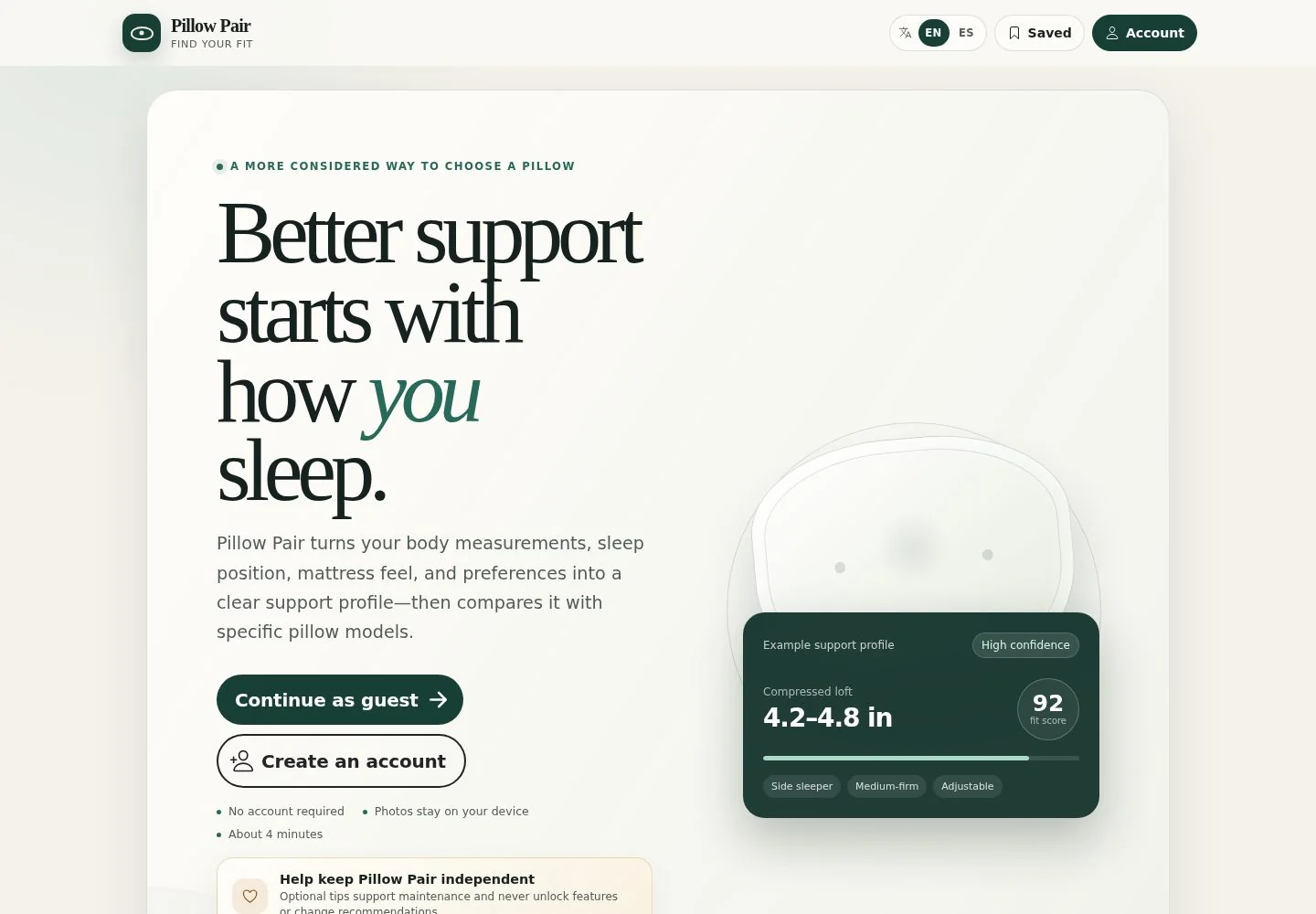
Estimates the pillow height your neck actually needs, then ranks real, named pillows against it.
Built for: Anyone who has bought two or three pillows and still wakes up with a stiff neck · Side sleepers with broad shoulders who keep landing between sizes · Back and stomach sleepers who suspect every pillow they own is too tall · People who changed mattresses and suddenly cannot get comfortable
In one sentence
Estimates the pillow height your neck actually needs, then ranks real, named pillows against it.
The camera work happens on your device and the photos are not uploaded, and that is verifiable rather than promised: in the Android app the entire assessment and vision path contains no network requests at all, and the app does not even hold a camera permission — it borrows the system camera and photo picker.
The problem
Pillow Pair exists because of this.
You have bought three pillows. Each one looked right, felt fine for the ten seconds you pressed it in a store, and turned out wrong the moment your head was on it for eight hours. One was too tall and pushed your chin toward your chest. One flattened by 3 a.m. You cannot tell which part of the problem is your shoulders, your mattress, or the pillow, so you buy another one and hope. The internet does not help. Most pillow finders are advertising with a quiz on top: five questions, then a recommendation that tracks who pays the site rather than what fits your body. The number printed on the box does not help either, because that is the height of an empty pillow sitting on a shelf. Under the weight of a resting head a pillow gives up part of that height, and it gives up a different amount depending on what it is made of. A fibre-fill pillow can end up holding roughly two-thirds of its listed height; a latex one holds most of it. Two pillows both labeled five inches can support your head at noticeably different heights all night, and neither box tells you which is which. The camera-based tools are worse in a different way. They ask you to stand in front of your phone and upload the photos, then stay quiet about where those pictures go and how long they stay there. And if your neck genuinely hurts, if you have numbness down an arm, if something changed after a fall, the quiz does not slow down at all. It sells you a pillow, which is exactly the wrong answer to that question.
What changes
- The camera work happens on your device and the photos are not uploaded, and that is verifiable rather than promised: in the Android app the entire assessment and vision path contains no network requests at all, and the app does not even hold a camera permission — it borrows the system camera and photo picker.
- Affiliate status is recorded on every product record but structurally excluded from the fit score, and a test that scores two otherwise identical products equally is part of the suite each release has to pass.
- It estimates compressed height under load, per material and adjusted for head load and pillow firmness, instead of matching the unloaded number printed on the box.
- The ranking rules are explicit and open to inspection rather than an opaque score: each match shows its reasons, its cautions, and the six components its score was built from — and when the list is empty, which constraint emptied it.
- It will stop and refuse to recommend anything when your answers describe symptoms that need a person to look at you, and it distinguishes an urgent stop from a wait-until-evaluated hold.
- It states its own limits on its own site, including in plain words that the fit formulas have not been validated against tape measurements, 3D scans or sleep studies, and that catalog heights come from manufacturers rather than independent measurement.
- Full Spanish parity in the browser version down to the urgent safety message, which is where most bilingual apps quietly fall back to English.
What it does
How Pillow Pair works, start to finish.
Pillow Pair works out how much space your head and neck actually leave above the mattress, converts that into a compressed pillow-height range, and then ranks real, named pillows against that range. Compressed height is the point: it estimates what a pillow will be holding your head at once your weight has been on it, not what the box says when it is empty. Different materials keep different amounts of their height under load, and the estimate applies a per-material retention factor, adjusted for how heavy your head is and how firm the pillow is. It starts with a short intake. Your height, optionally your weight, and optionally a tape measurement around your head. Which positions you sleep in, which one is primary, and whether you move between them. One question about your mattress, phrased as feel rather than a spec sheet: soft and deep-sinking, medium, or firm with little sink. What you cannot stand touching your face, and whether you sleep hot. Then, if you want, guided front and side photos. They are analyzed on your own device to estimate shoulder breadth, neck-to-shoulder distance, head breadth and depth, forward head offset and shoulder slope, scaled by the height you entered. The images themselves are never sent anywhere. Only the resulting numbers feed the recommendation, and you can skip the photos entirely and continue with a plainly labeled lower-confidence estimate instead. Before any of that becomes a shopping list, there is a safety screen. It asks about recent injuries, radiating symptoms, and anything a clinician has told you. Six answers stop product matching outright and send you toward urgent care. Five more, including a recent injury or symptoms that are getting worse, hold the recommendation until you have been evaluated. Neither case quietly shows you products anyway. If instead you have a stable, already-evaluated condition and your clinician told you something specific, that instruction becomes a hard rule the ranking cannot break: adjustable only, a contour or no contour, a height floor or ceiling. Products that violate it score zero and drop out of the list entirely rather than being ranked lower. The result is a support profile you can read, not a score you have to trust. You see the estimated head-support load as a range with an honest confidence label, the target compressed height for each position you sleep in, and up to six ranked products: brand, model, the exact variant and size, the maker's published height, and a link to that maker's own page so you can check the specification and the price yourself. The top three can be laid out side by side, and each match shows its own reasons and cautions and the six components its score was built from. If nothing matches, the app re-runs the same hard checks and names each constraint that eliminated products and how many it eliminated, instead of showing a blank page. Crucially, affiliate and commercial status is recorded on every product record but is never read by the scoring rules, and a test in the suite proves it by scoring two otherwise identical products identically. Then it follows up. Save a result and Pillow Pair can check in after 7 nights and again after 14, asking about neck comfort, morning headache frequency, upper-back comfort, sleep quality, whether the pillow felt too high or too low, and any note you want to add. It answers with exactly one conservative move: take a little fill out, add a little, keep a configuration that is working, or reassess the match. You can schedule those two check-ins as reminders, complete the whole flow as a guest with your profile and results held on your device, or make an optional account to sync across devices. Every screen, every safety message, every result sentence and every downloadable report exists in both English and Spanish in the browser version, in US or metric units, and you can export or permanently delete your account data yourself from inside the app.
Features
Everything in the current release.
Each of these is built and working today. Nothing on this list is a roadmap item.
A compressed-height range, not a “best pillow”
There is no universally correct pillow, so Pillow Pair does not name one. It estimates the height range that would keep your neck roughly neutral once your weight has compressed the pillow, and gives you a separate target for each position you actually sleep in. Side sleeping produces the tallest target, stomach the lowest. You see the range and the confidence attached to it, not just an answer.
Guided photos that are analyzed on your device
The front and side photos are processed on the device you are holding. Pillow Pair derives shoulder breadth, neck-to-shoulder distance, head breadth and depth, forward head offset and shoulder slope, and uses those numbers. The pictures are not uploaded, not stored on a server, and not attached to your account or your saved results. Skipping the photos is a supported path, not a punishment — you continue on a deliberately wider estimate that is labeled as such.
It refuses a bad photo instead of guessing
A blank frame, a dark room, a photo cropped above the ankles, a shot with no person in it: each is rejected and you are asked to retake it. The front image has to show a full body and a detected face; the side image has to show a full body. And if the on-device analysis itself fails to start, the flow now stops with a clear message — an earlier build let that failure through as a fabricated low-confidence result and carried on to real product matches, which was found on a physical phone and fixed in August 2026.
Rankings that ignore who pays
Every product record carries an affiliate field, and the scoring rules never read it. Ranking is built from six things only: estimated compressed-height fit, your sleep positions against the maker's own position guidance, firmness, adjustability, your clinician's constraints, and your material and cooling preferences. A test in the suite takes two otherwise identical products, marks one as an active affiliate, and asserts the scores come out equal. As it stands, no catalog record has an active commercial relationship at all.
Real products, exact variants, and the maker's own page
A recommendation is not a category. Every match names the brand, the model, the exact variant and size, and the height the maker publishes, with a link straight to that maker's own product page. That link matters because searching a shared product name can hand you a mattress instead of the pillow. Prices are deliberately not stored, because they move constantly; you check the current price at the source.
A safety screen that will stop the sale
Trouble breathing or swallowing, new bowel or bladder changes, new weakness, new trouble with balance or walking, recent significant trauma, or rapidly worsening severe unexplained pain — any one of those six stops product matching entirely and tells you to seek urgent care. New numbness or tingling, fever alongside neck or back pain, a recent injury, post-surgical status with no clinician guidance entered, or symptoms that are getting worse hold the recommendation until you have been evaluated. In both cases the product list is empty rather than merely reordered, and the app says plainly that it cannot tell whether a pillow caused any of it.
Your clinician's instructions become hard rules
If you have been told to use only an adjustable pillow, to use a cervical contour, to avoid a rigid contour, or to stay under or over a specific compressed height, enter it. Those become filters, not preferences: a product that breaks one scores zero and is dropped from the results rather than ranked lower. A stable condition that has already been evaluated can be included as context without stopping the recommendation, and it tilts the ranking toward adjustable products.
Your mattress is part of the answer
The same body needs a taller pillow on a firm mattress than on a plush one, because a soft mattress swallows part of the shoulder. Pillow Pair asks one question about your bed, in feel rather than jargon — soft and deep-sinking, medium, or firm with little sink — and that shifts every position target up or down. It is one of the reasons two people with nearly identical measurements can correctly end up with different pillows.
When nothing fits, it tells you what emptied the list
Hard constraints can eliminate everything, especially a clinician instruction combined with a material you cannot tolerate. Rather than showing a blank screen, Pillow Pair re-runs the same checks across the whole catalog and reports each constraint that excluded products and how many it excluded, out of how many. You can also leave an email address to be told when the catalog grows; that request stores only the address, your language, and the reason codes — no profile, no measurements, no results.
7- and 14-night check-ins that change the advice
Buying the pillow is not the end of the fit. Save a result and Pillow Pair can ask you, after a week and again after two, about neck comfort, morning headache frequency, upper-back comfort, sleep quality, whether the pillow felt too high or too low, and anything you want to write down. It answers with one conservative move: lower the fill slightly, raise it slightly, keep a configuration that is working, or reassess the match. It never guesses in both directions at once, and it does not treat symptoms.
Reminders on your terms
You can schedule the two check-ins as private reminders on Android, timed to 9 a.m. after 7 and 14 calendar days, or download a two-event calendar file in the browser and on desktop — a closed browser cannot reliably fire a scheduled notification without a push service, so Pillow Pair hands you a calendar file instead of pretending otherwise. Nothing is scheduled unless you ask, notification permission is requested only at the moment you set a reminder, and tapping the reminder returns you to the exact saved result it belongs to.
Complete in English and Spanish
In the browser version both languages cover everything: intake, camera guidance, safety messages including the urgent one, the explanation of your estimate, product match details, and the reports you download, share or email. The app follows your device language on first launch and remembers your choice afterwards. Units default to feet, inches and pounds with a one-tap switch to centimeters and kilograms. On Android, the fully bilingual assessment and US-unit defaults are in the update currently with the store for review.
Guest mode by default, an account only if you want one
You can complete the entire flow without registering, with your profile and results kept on your own device. An optional account syncs your profile, saved results and check-ins across devices and does not require email verification to get started, and sign-in can also run through the shared Auto Secure Login account you may already use for other products in this family. Guest mode is honest about its edges rather than claiming total silence: the browser version reports de-identified counters such as “camera started” or “analysis failed”, and a check-in you complete as a guest is sent anonymously, including any note you type. Neither carries your name, account, photos or profile, and the Android assessment sends nothing at all.
Take your result with you
In the browser a finished result can be saved to your on-device library, downloaded as a plain report, sent through your device share sheet, opened in your email or text-message app, or mailed straight to your own account address once you are signed in. There is a Google Drive action too: where that connection is configured it uploads directly, using access limited to files the app itself created, and where it is not, it saves the report and opens Drive so you can drop it in — and says so rather than claiming an upload happened. The Android app shares a result summary through the system share sheet. Every product in that report carries brand, model, exact variant, size, published height and the official link, so it stays useful when you are standing in a store.
Export and delete, from inside the app
Download my data gives you a full copy of your account, profile, saved results and check-ins. Delete my account is a two-step confirmation that permanently removes them, and the deletion cascades through your saved results and follow-ups rather than orphaning them. If you ever opted in to informational text messages, the record proving you consented and later opted out is kept and detached from you, because messaging rules require that proof to survive the account it came from.
Proof
Numbers we can stand behind.
Every figure below comes from the product's own release record or test suite, not from a marketing estimate.
- Free, with no paid tier and no account required — and specific about the small amount it does record in guest mode instead of claiming it records nothing.
Where it runs
Surfaces and status.
Status as of 2026-09-08. Checked live on 2026-09-02. The home page, the pillow fit guide, the methodology page and the account-deletion page all answered successfully, and the privacy, text-message opt-in and text-message terms pages answered at their canonical addresses. The service reported itself healthy with saved-result storage available, the installable web-app manifest loaded, and the live catalog returned all 19 pillow variants — every one of them labeled manufacturer-published rather than independently measured. Accounts, password-reset email, result email, text-message consent and the shared Auto Secure Login sign-in were all reported enabled in the live configuration. The methodology page itself states, in its own words, that the formulas have not yet been validated against tape measurements, 3D scans or sleep studies. The Android app is separately in early access with an invited group: 1.3.1 is what that group runs, 1.3.2 was submitted for store review on 2026-09-01, and 1.3.3 was built the same day but has not been uploaded. The iPhone and desktop versions are in development and are not downloadable.
Works with
Worth more together.
Products on this platform share one sign-in, one support queue, and one engineering standard. These pair naturally with Pillow Pair.
ASL Doctor Search
When the safety screen stops your pillow search and tells you to get evaluated, the next question is who to see. Doctor Search helps you look up real providers.
Explore →Aya Scam & Privacy Lookup
The same instinct applied to the rest of your shopping: check whether an offer, a seller or a message is what it claims to be before you hand over money or details.
Explore →Kavanah Journal
If tracking how you actually slept and felt over weeks is useful to you, Kavanah is a private journal built on the same principle that your records stay yours.
Explore →What is new
Recent progress.
This product ships often. The most recent verified changes, newest first.
The installed app now opens the shared help pages instead of showing its own saved offline screen in front of them. Everything it had already stored for offline use is preserved exactly as it was.
was a heavy day for the Android app. A full pre-release review on a private device found three real product problems and fixed them: the entire assessment — questionnaire, results and the urgent safety message — was still English-only even though the home and account screens were bilingual; the Spanish that did exist had no accents; and measurements were metric-only when US units should have been the default. Version 1.3.2 fixed all three, adding bilingual coverage down to both safety messages and making feet, inches and pounds the default with a one-tap metric switch, and it was submitted for store review the same day. Version 1.3.3 followed hours later: the download shrank from roughly 52 MB back to 33.6 MB, about a third smaller, once 44 MB of dead leftover web files were removed; the store data-safety declaration was rewritten to match what the app actually collects, dropping phone number, app-interaction tracking, crash logs and diagnostics because the app collects none of them; fresh English and Spanish store imagery was produced; and three interface defects were fixed — a duplicated title bar on newer Android versions, a header colliding with the status-bar clock, and screen-capture protection that now applies to shipped builds only. Earlier in the same window: version 1.3.1 reached the invited group on.
with on-device photo analysis brought to parity with the browser version, and in mid-August three defects found on a real phone were fixed and deployed — no way back to the camera step from the results screen, a camera preview that left dead space on real hardware, and an analysis failure that could produce a fabricated low-confidence result instead of stopping.
Pricing
Free. No price, paid tier, subscription or purchase appears anywhere in the product or its documentation, and access does not depend on payment. The only amounts Pillow Pair ever names are optional one-time support contributions — the browser version offers $5, $10, $20 and $50, and the Android app carries a single support link — and contributions are stated never to unlock features, change fit scores, or affect access or rankings.
Open Pillow Pair →Questions buyers ask
Straight answers.
What does it cost?
Nothing. The app is free to use, there is no paid tier or subscription, and you do not need an account to get a full result. The browser version offers optional one-time support amounts of $5, $10, $20 and $50, and contributing changes nothing at all about your access, your fit score, or which products appear at the top of your list — that isolation is stated in the product's own documentation.
Do my photos get uploaded anywhere?
No. The front and side photos are analyzed on your own device, and only the resulting measurements — things like shoulder breadth and neck-to-shoulder distance — go into the recommendation. The images are not sent to Pillow Pair, not attached to your saved results, and not kept on a server. In the Android app the whole assessment and vision path makes no network requests at all, and the app holds no camera permission, so photos have no route off the device even in principle. You can also skip the photos entirely.
How do I know you are not just recommending whoever pays you?
Because commercial status is not an input to the score. It is recorded as ordinary data on each product record, and the ranking rules never read it. The rules look only at compressed-height match, your sleep positions against the manufacturer's own guidance, firmness, adjustability, your clinician's constraints, and your material and cooling preferences. A test in the suite marks one of two otherwise identical products as an active affiliate and asserts they score the same. As it happens, no product in the catalog has an active commercial relationship today.
I already have a pillow I like. Why bother?
If you sleep well and wake up without a stiff neck, you probably should not bother. This is for the case where you have replaced pillows repeatedly and cannot work out why none of them are right, or where something changed — a new mattress, a new sleeping position, a shoulder that started hurting — and the pillow that used to work stopped working. Getting a target height range takes a few minutes and tells you whether height is the problem at all.
Is it actually ready, or is this early?
The web version is live and you can use it right now in a browser, or install it to your phone from the browser. The Android app is in early access with an invited group while the public store listing is finished. What is genuinely early is the science: the formulas connecting your measurements to a pillow height are transparent, research-informed estimates that have not been validated against direct measurement, and the app says so itself on its methodology page rather than pretending otherwise.
What happens to my data, and can I get rid of it?
As a guest, your profile and saved results stay on your device. The browser version does send de-identified counters with no identifier attached, and a check-in you submit as a guest is sent anonymously including any note you write — no name, no account, no photos, no profile. If you create an account, Download my data gives you a full copy of your account, profile, saved results and check-ins, and Delete my account is a two-step confirmation that permanently removes them, cascading through your saved results and follow-ups. Both controls are inside the app in English and Spanish. The one thing kept is the record proving you consented to and later opted out of text messages, if you ever used that. It is detached from you but retained, because messaging rules require that proof to survive.
What if I stop using it, or it goes away?
Your result is not locked inside the app. Download it as a plain report, share it, email it to yourself, or save it to Google Drive, and it will still name every recommended pillow by brand, model, exact variant, size and published height, with a link to the manufacturer's own page. There is nothing to cancel and no subscription to lose, and the report stays readable with or without the app.
My neck actually hurts. Can I still use it?
Carefully, and the app is built to say no when it should. Six answers stop it outright and tell you to get urgent care: trouble breathing or swallowing, new bowel or bladder changes, new weakness, new trouble with balance or walking, recent significant trauma, and rapidly worsening severe unexplained pain. New numbness or tingling, fever with neck or back pain, a recent injury, post-surgical status with no clinician guidance entered, or symptoms that are getting worse hold the recommendation until you have been evaluated. In both cases you get no product list at all. If your condition is stable and already evaluated you can include it as context, and anything your clinician told you about pillow height, contour or adjustability becomes a hard rule that removes products which break it.
Does it work without an account, and does it work offline?
Yes to the first. Guest mode gives you the complete flow — intake, safety screen, photos if you want them, the support profile and the ranked matches — with nothing to register for. On Android the questionnaire and the recommendation engine run entirely on the device with the catalog built in, so they work with no connection; signing in, cloud history, export, deletion and the manufacturer links are the parts that need a network.
How many pillows will it show me?
Up to six matches, ranked, with the top three laid out side by side for comparison. Each one shows its estimated compressed height for every position you sleep in, the reasons it placed where it did, and any cautions — including a standing caution that its dimensions are manufacturer-published and have not been compression-tested by Pillow Pair. If your constraints eliminate everything, you get a breakdown of which constraint removed how many products instead of an empty screen.
What should I know before I rely on it?
We would rather you hear this from us than discover it later. As of 2026-09-08:
- The formulas that turn your measurements into a pillow height are informed by published ergonomics research but have not been validated against tape measurements, 3D scans or sleep studies. The app says exactly this on its own methodology page rather than burying it.
- Catalog heights come from what each manufacturer publishes, not from Pillow Pair measuring the pillows itself, and all 19 records are labeled that way — every product match carries that caution on its face. A physical measurement program is written up and the logging path exists, covering an unloaded baseline, loaded readings out to eight hours and rebound readings at both the center and the edge, but no product has completed it yet.
- The per-material compression factors that turn a published height into an expected compressed height are development assumptions, not measurements. A real measurement for a specific product would replace the assumption for that product, and none exists yet.
- The head-support estimate rests on a published regression from a study of 15 cadaver heads, whose own authors noted the measured masses were probably low. That is why the app shows a range with a confidence label instead of a single number, and widens the range further when you have not entered a head measurement.
- The catalog is a starter set of 19 variants across 7 brands. It is not the whole market, and a pillow that would suit you may simply not be in it yet.
- Only 3 of the 19 variants are adjustable and all three come from a single maker, and only 5 are contoured across two makers. A clinician instruction requiring an adjustable or a contoured pillow therefore narrows the list hard. The app names the constraint that emptied your results rather than showing a blank page.
- Guest mode keeps your profile and saved results on your device, but it is not total silence: the browser version sends de-identified operational counters, and a check-in you complete as a guest is sent anonymously, including any free-text note you type. Neither carries your name, account, photos or profile, and the Android assessment sends nothing at all.
- Prices are not stored, because they change constantly. You check the current price on the manufacturer's page.
- The Android app is in early access with an invited group and is not downloadable by the general public.
- The fully bilingual assessment and US-unit defaults landed in the Android update currently with the store for review; the build the invited group is running still has an English-only assessment flow. The browser version has been bilingual throughout.
Find the pillow your neck actually needs
Estimates the pillow height your neck actually needs, then ranks real, named pillows against it.
Prefer email? contact@autosecurelogin.com