 Auto Secure Login
You cannot look it all up between shifts.
Research and drafted documents for someone incarcerated, requested by message and paid for with one-time credits.
Built for: A parent, partner, sibling, or friend who pays for the messaging account and does the looking-up on the outside · The person inside, who has time and questions and no way to search anything · Someone preparing for release who needs addresses, forms, phone numbers, and letters drafted before the date · A family member who keeps being asked to “find out” something and cannot get to it between shifts
In one sentence
Research and drafted documents for someone incarcerated, requested by message and paid for with one-time credits.
Meets the person inside on the channel they already have — nothing to install, learn, or request on the inside.
The problem
Outside Access exists because of this.
He asks you to find out one thing. What the parole board actually looks at. Whether the storage unit is still paid. What that statute everyone in there keeps repeating really says. You tell him you will look into it. Then you are at work, then it is Thursday, and the next message says “did you find out yet?” Every message costs. You pay by the stamp, the box cuts you off, and the thing you finally found is four pages long. So you retype it badly, in pieces, and hope the parts land in the right order. You are never quite sure the one you sent last week arrived at all, and you paid for it either way. You are careful with the account, too, because it is the only line you have, and nobody wants to be the reason it gets shut off. And some of it you cannot do at all. You are not going to read sixty pages of policy and boil it down to something he can use. You do not know how to draft the letter he needs, or which office to call in a county you have never been to. He has time and no way to look anything up. You have a phone and no time. Everything gets lost in the gap between those two facts.
What changes
- Meets the person inside on the channel they already have — nothing to install, learn, or request on the inside.
- Prices are fixed, published per action, and set by the service; a checkout whose amount, currency, or credit grant does not match is refused.
- Delivery work is excluded from the automatic retry sweep, so a send whose result is uncertain is raised for a person instead of being repeated.
- Work that fails releases its hold; you are charged after successful processing, not before.
- Nobody is added until you read back the exact legal name, correctional ID, facility, and state and confirm it yourself.
- Unspent credits assigned to a person come back to your family balance when you archive them.
- You are never asked for your own messaging sign-in — there is no field in the service that would take it.
What it does
How Outside Access works, start to finish.
Outside Access is a research and drafting service built around the message channel that already reaches inside. The person inside writes a plain message asking for something — no app, no new number, no special access on their end. That message is read, sorted into a kind of request, checked against the credits you assigned to them, and worked. The answer is written to come back as messages in the same conversation. Be clear about the state of it. The research and drafting half runs in production today: on 1 September 2026 a real, de-identified acceptance run passed request classification, current web research, and structured cited document drafting on the live service. The delivery half — reading a message out of the conversation and sending the answer back — is built and tested but switched off. It has not yet carried a single real message for a single real person, and it is turned on deliberately, one account at a time, with a person watching. If you buy credits today you are buying into that sequence, not into an answer arriving this afternoon. Answers are built for a message box, not for a screen. A long answer is normalized and cut into numbered, labeled parts that each fit under the safe character limit, broken at paragraph and word boundaries so nothing arrives mid-sentence. The automated test drives fifty thousand characters through it and requires every part to come back at nineteen thousand five hundred characters or fewer, each tagged with the same reference so they can be put back in order. Research has to come back with live sources attached or the work fails instead of shipping something unsourced. A drafted document comes back structured and cited, with legal material marked as a draft that has not been filed, and the full text and structure are kept on record. You run the money side from a normal website. You buy a one-time pack of credits — nothing renews, nothing expires. You activate your account, then you enter your person's exact legal name, correctional ID, facility, and state. Before anything happens, the service reads those details back to you on a confirmation screen and tells you plainly that nothing has been added yet. Only when you press confirm is the person added, and only when you deliberately move credits to them does setup get queued: at least five credits, which cover the welcome message explaining what they can ask for. You are never asked for your own messaging sign-in, and there is no field anywhere in the service that would accept it — it works through its own authorized Friends & Family account instead, which is why it needs your person's exact record details. Beyond research and documents, the person inside can ask what a public account has been posting on X, Bluesky, or YouTube, or what a specific public web page says, with a small number of public images pulled along if they want them. The accounting is deliberately boring and that is the point. Every price is fixed, published, and set by the service rather than by the page in front of you; a checkout whose amount does not match is refused. Credits are held before the work runs and released if the work fails, so failed work is not charged, and a duplicate payment event cannot grant the same credits twice. If a message may already have gone out but the result is not certain, the service stops and waits for a person instead of sending it again and burning another stamp. It does not bypass sign-in checks, private accounts, or paywalls, it does not touch anything a facility has restricted, and it never files anything with a court.
Features
Everything in the current release.
Each of these is built and working today. Nothing on this list is a roadmap item.
The request arrives as a plain message
Nothing has to be installed on the inside and no new number has to be learned. The person inside writes what they want, in their own words, in the message box they already use. The service reads it, sorts it into a kind of request, and checks it against the credits you assigned to them. This path is written and covered by automated tests; it stays switched off until your account is turned on by hand.
Long answers, sized for the message box
An answer that would never fit in one message is cut into numbered, labeled parts, each carrying the same reference so they can be read in order. Breaks land on paragraph and word boundaries, so nothing arrives cut in half. The automated test pushes fifty thousand characters through and requires every part to come back at nineteen thousand five hundred characters or fewer.
Research that has to show its sources
A research request is answered from current public information, and the work is required to come back with real sources attached or it fails rather than shipping something unsourced. Failed work is not charged. This is the part of the service that has actually run in production: classification and cited web research both passed a real acceptance run on 1 September 2026. A research request is a fixed 15 credits plus the stamps used to deliver it.
Documents drafted, structured and cited
Ask for a letter, a request, a summary, or a checklist and it comes back as a structured document with citations, not a vague paragraph. Legal material is marked as a draft that has not been filed. The full text and structure are kept on record. Structured cited document drafting also passed the 1 September 2026 acceptance run. Document drafting is a fixed 15 credits plus delivery.
Public posts and public pages, read out loud
The person inside can ask what a public account has posted on X, Bluesky, or YouTube, or what a specific public web page says. Public content only — no private accounts, no direct messages, nothing behind a login. It costs 5 credits, or 10 if they want the public images pulled along, up to five of them.
Create a picture from a description
Describe an image in a plain message and it is generated and sent back. A created picture is 20 credits plus the stamp to deliver it.
Edit or combine photos
Take a photo the person pulled from their own public social media and change it — a new background, a combined scene — then send it back. Editing or combining a photo is 25 credits plus delivery.
Colorado policy and rules, answered from the source
A question about Colorado statutes, regulations, or Department of Corrections and parole rules is answered from official Colorado sources with the citation attached, not guessed. A policy answer is 15 credits plus delivery.
Invite family to join and send credits
The person inside can ask us to invite someone by email or text to join Outside Access and fund their requests. The invitation carries a sign-up link and a clear way to opt out. An invitation is 5 credits.
A prepaid reply stamp so they can always write back
The welcome message includes a paid reply stamp so the person inside can send their first request even with no stamps of their own, and they can turn a reply stamp on for future answers. Each reply stamp is one stamp (5 credits).
You confirm exactly who, before anything is added
You enter the legal name, correctional ID, facility, and state, and the service reads them back on a dedicated screen that says plainly that nothing has been added yet, alongside a warning to confirm only if the details match the current record. Only your confirmation creates the record. Setup is not queued until you deliberately move credits to that person, and the first transfer has to be at least five credits.
One-time credits that do not expire
There is no subscription, no auto-renewal, and no paid app download. Packs are $9.99 for 100 credits, $19.99 for 250, $34.99 for 500, and $49.99 for 750. Buy when you need them, and what you do not use is still there next month. Nothing renews, so there is nothing to remember to cancel.
Fixed prices you can check before you spend
Research is 15 credits. A drafted document is 15. Reading public posts is 5, or 10 with images. Every delivery stamp is 5 credits, where a text is one stamp and each attached image is one more, up to five images. The catalog lives on the service, not in the page you are looking at, and a checkout whose amount, currency, or credit grant does not match is refused.
Failed work is not charged
Credits are held before the work starts and released if it fails, so you pay after something is actually done. A retry reuses the same hold instead of taking a second bite. Duplicate payment notifications cannot grant the same credits twice, and a refund or dispute puts the account into billing review rather than quietly rewriting credits that were already spent.
A delivery that might have gone out is never repeated automatically
Ordinary stuck work is swept back onto the queue and retried. Delivery work is deliberately excluded from that sweep: if a send has been running too long without a confirmed result, it is raised for a person to look at instead of being sent again. That means an occasional wait, and it means you should not pay twice for one message. The rule is in the shipping code and covered by tests; it has not yet been exercised against a real delivery.
Credits follow the person, and come back
Credits land in your family balance first and you assign them to a specific person. More than one person can be connected, each with their own assigned balance, and work only runs when both your balance and theirs can cover it. If you archive someone, their unspent credits return to your unassigned balance, and the payment, message, and delivery records are kept rather than quietly erased.
Consent is built before any outside message is possible
The rule the service is built on is that nobody outside receives anything until they have agreed — agreement is tracked separately for email and for texts, an invitation carries an opt-out link, and a STOP reply opts that number out permanently across every contact record using it. Be clear on what that means today: relaying a message from your person to someone outside is not yet usable, because there is no way to add an outside contact. The consent ledger and the opt-in and opt-out pages exist ahead of the feature they will guard.
Boundaries written down, not implied
Outside Access does not bypass private accounts, sign-in checks, security prompts, or paywalls, and it does not work around anything a facility has restricted. It stops rather than guesses when identity, sign-in state, delivery status, consent, or stamp accounting is unclear. It is not a law firm, a medical provider, or an emergency service, and it never files anything with a court. It is not affiliated with or endorsed by the messaging provider, and everything sent through a monitored channel stays monitored.
Proof
Numbers we can stand behind.
Every figure below comes from the product's own release record or test suite, not from a marketing estimate.
- Research fails rather than returning an answer with no sources behind it.
- One-time credits that never expire — nothing renews, so there is no subscription to remember to cancel.
- The gaps are published rather than implied: what is not switched on yet is listed on the page, not discovered after you pay.
Where it runs
Surfaces and status.
Status as of 2026-09-08. The storefront is genuinely running: the service status check and the home, privacy, terms, and support pages were verified responding on 2026-09-02, with the four one-time credit packs and the real support address rendering live, and the same public pages were verified on 2026-09-01 immediately after the current release was activated. That release passed 227 automated checks across 47 test files with zero failures. One-time credit purchases were switched to live payments on 2026-08-31; the only live checkout on record is a $0 capability probe with no payment method attached, which expired and finished canceled with nothing collected. On 2026-09-01 a real, de-identified production acceptance run passed request classification, current web research, and structured cited document drafting. A full purchase, activation, resident confirmation, credit transfer, and welcome-message sequence was completed with the credit accounting verified line by line — but in an isolated database, on a test-mode payment, with the provider edge simulated and no real contact or message created. It is labeled In development rather than Early access because the core promise has not happened once. No message has ever been delivered to a person inside by the production service. The delivery worker is off by default in configuration and off in the production example; the repository states plainly that polling and sending remain disabled and that the production browser bridge remains disabled pending a controlled test with a real authorized resident; and six delivery items on the repository's own completion checklist are still unchecked — live selectors mapped and tested, automated sign-in from a clean profile, inbound messages ingested once, outbound delivery references observed in the conversation, uncertain sends stopping instead of duplicating, and stamp balances reconciling. Early access would imply real people are already using it for the thing it is for. They are not yet.
Works with
Worth more together.
Products on this platform share one sign-in, one support queue, and one engineering standard. These pair naturally with Outside Access.
Aya Scam & Privacy Lookup
Families of people inside get the call claiming their person is in trouble and needs money right now. Aya checks who is really on the line, in plain language, before anyone sends anything.
Explore →ASL Files
Outside Access does not attach files, so when a drafted document has to reach a lawyer, a case manager, or a family member, Secure Send is how you hand it over — password-protected and expiring rather than an email attachment that lives forever.
Explore →Colorado Complaint Access
If a licensed professional involved in the case mishandled something, this walks a family through filing with the right board instead of guessing which office to write to.
Explore →ASL Support
One public front door to reach a real person about any Auto Secure Login product, including this one, without needing an account first.
Explore →What is new
Recent progress.
This product ships often. The most recent verified changes, newest first.
The Android app 1.2.0 (code 7) was rebuilt and signed with its original key, then accepted by Google Play as a production draft that reports ready to release for 177 countries. It is a saved draft, not a public release.
Outside Access 0.4.2 went live with searchable help guides and a status page in English and Spanish, sharing the same help engine that now serves every product on the platform.
Photo editing runs behind a capability gate that fails closed: where the capability is not enabled, an edit request is refused rather than quietly attempted.
Colorado public-policy questions, from statutes and regulations to agency guidance, correctional policy and parole rules, are answered from grounded official sources instead of a general search. Image generation was connected end to end and delivered with the reply. August 31, 2026 — pricing moved off monthly plans to one-time credit packs that never expire, and the payment side was switched to live mode. There is nothing to renew and nothing to cancel. The only live checkout on record so far is a $0 capability probe with no payment method attached. August 31, 2026 — the setup order was rebuilt so credits land in your family balance first. Nobody is created until you read the exact legal name, correctional ID, facility, and state back on a confirmation screen and press confirm, and it is your deliberate first credit transfer that queues setup and the welcome guide. August 31, 2026 — a full run through purchase, activation, confirmation, transfer, and welcome message was completed with the credit math verified line by line: 100 bought, 25 assigned to a person, 5 used for the welcome delivery, 75 left unassigned. It ran in an isolated database on a test-mode payment with the messaging step simulated, and four defects it exposed were fixed. September 1, 2026 — answers got stricter. Research now has to come back with live sources attached and a drafted document has to come back both structured and cited, or the work fails instead of shipping something unsourced — and failed work is not charged. A real, de-identified production acceptance run then passed classification, current web research, and structured cited document drafting. September 1, 2026 — notices now go out through the company's consent-checked text and email services, proven by authenticated probes that deliberately sent nothing. September 1, 2026 — the service now ships as versioned releases with a one-step return to the previous version. The release running today passed 227 automated checks across 47 test files with zero failures, and the site, privacy, terms, and support pages were each verified responding. Still open, and deliberately so: delivery to the person inside remains switched off, and turning it on for the first real account is the next step.
Pricing
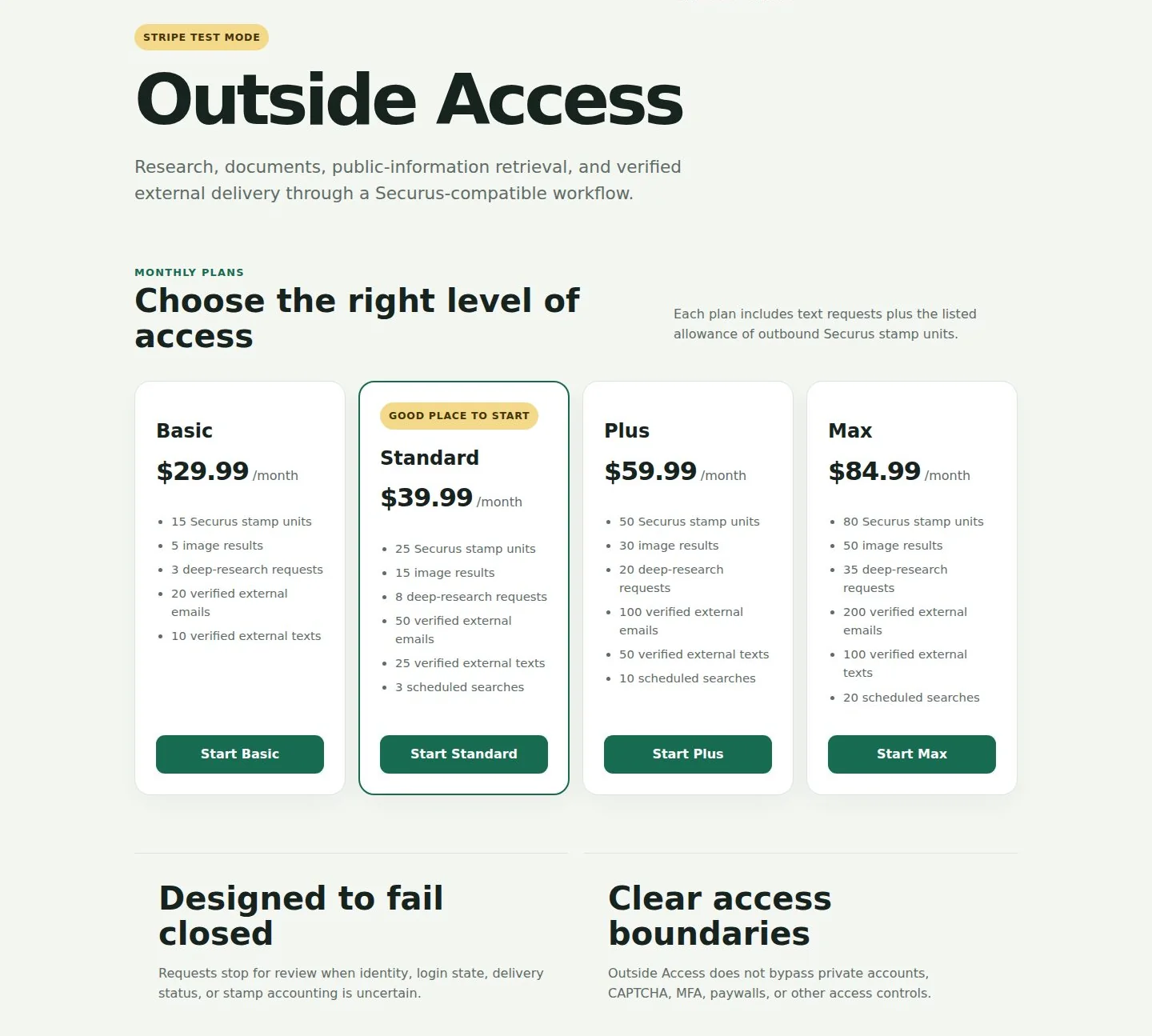
The app is free and there is no subscription. You buy one-time credit packs that never expire: Starter $9.99 for 100 credits, Everyday $19.99 for 250, Plus $34.99 for 500, and Launch Max $49.99 for 750. Work is priced in credits at fixed, published rates: a research request is 15 credits, a drafted document is 15, reading public posts is 5 (10 if public images are pulled along), and every delivery stamp is 5 credits — a text is one stamp and each attached image is one more, up to five. The first credit transfer to a new person must be at least 5 credits, which cover the welcome message. Prices are set by the service, and a checkout whose amount, currency, or credit grant does not match is refused. Making a picture is 20 credits and editing or combining an existing photo is 25. A Colorado policy, statute, or rules question is 15 credits, answered from official Colorado sources with citations. Inviting someone by email or text to join and fund a person is 5 credits.
Open Outside Access →Questions buyers ask
Straight answers.
Is it ready, or am I paying to find out?
Be clear-eyed about it. The website is running and takes real payments, the current release passed 227 automated checks with no failures on 2026-09-01, and the research and drafting work has actually run in production — a real acceptance run on 2026-09-01 passed request classification, current web research, and cited document drafting. What has not happened is a message actually going to a person inside. Sending is switched off and gets turned on for one account at a time with a person watching. If you buy today, you are early, and you should expect a wait rather than an answer this afternoon.
What is this actually going to cost me?
There is no subscription and nothing renews. You buy credits once — 100 for $9.99, 250 for $19.99, 500 for $34.99, or 750 for $49.99 — and they do not expire. A research request costs 15 credits, a drafted document 15, reading public posts 5 (10 with images), and every delivery stamp 5, where a text is one stamp and each image is another. Your first transfer to a person has to be at least 5 credits, which cover the welcome message. You can see what each thing costs before you spend it.
We already message him directly. Why would I pay for this?
You are not paying for the channel — you already have that. You are paying for the work you cannot get to: reading the policy, finding the office, drafting the letter, and turning four pages into something that fits in a message box in the right order. The service uses the same stamps you would use, at the same one-per-text-plus-one-per-image rate, and charges after the work is actually done.
Do I have to give you my messaging login?
No. You are never asked for it, and there is no field anywhere in the service that would accept it. Outside Access reaches your person through its own authorized Friends & Family account, which is why you enter their exact legal name, correctional ID, facility, and state rather than your sign-in. The free Android companion does not accept credentials of any kind.
Is this allowed? I cannot risk losing the account.
The service does not bypass sign-in checks, private accounts, paywalls, security prompts, or anything a facility has restricted. It stops rather than guesses when identity, sign-in state, delivery status, consent, or stamp accounting is unclear, and it never repeats a message that may already have gone out. It is not affiliated with or endorsed by the messaging provider — facility rules still apply, and everything sent through a monitored channel stays monitored.
Can it send a document to my lawyer or case manager?
Not through the service. Outside Access does not attach or email files to anyone, and relaying a message to someone outside is not available yet. What comes back is message text, and getting a long document onward is still a manual step for you today.
What happens if I stop paying?
Nothing gets cancelled, because there is nothing recurring to cancel. Your credits stay where they are and do not expire. If you archive a person, their unspent assigned credits come back to your family balance, and the payment and delivery records are kept so an accounting question can still be answered later rather than quietly erased.
What do you keep, and who can read it?
The service keeps what it needs to do the work and prove what happened: your account and sign-in details with the password stored only as a secure hash, the association to your person, the requests and answers, delivery and stamp records, contacts and their consent, and the credit ledger. Full payment-card numbers are never stored. Records are kept only as long as reasonably needed to run the service, keep billing and delivery honest, and stop a duplicate send. You can ask for access, correction, or deletion of account information, and anyone outside can withdraw consent at any time.
What if a message never arrives, or I think I was charged twice?
Report it once and do not ask for an immediate retry — a delivery whose result is uncertain is deliberately preserved for review so it cannot be sent, and charged, twice. Send the account email, a short description of what happened and when, the request or delivery reference if one was shown, and whether a stamp looks like it was charged. Never include a password, one-time code, PIN, or card number; support does not need any of them to investigate.
What should I know before I rely on it?
We would rather you hear this from us than discover it later. As of 2026-09-08:
- No message has yet been delivered to a person inside by the live service. Sending is switched off and is turned on deliberately, one account at a time, after a supervised first test. Buying credits today does not mean an answer arrives today.
- Relaying a message from your person to someone outside by email or text is not available yet. The consent rules and the opt-in and opt-out pages are built, but there is no way to add an outside contact, so such a request is held rather than delivered.
- The service does not attach or send files. There is no PDF, DOCX, HTML, or TXT delivery to anyone — answers come back as message text, and images ride along with the message. Getting a long document to a lawyer or case manager is still a manual step for you.
- Picture generation and photo editing are not available. A request for one is held and reported back rather than silently dropped.
- The shipping guidance mentions replying HELP for the guide again. That shortcut is not implemented yet; a plain request works, a bare HELP will not return the guide.
- Delivery runs through a third-party messaging service. Facility rules, account standing, and provider availability all affect it, and no delivery time is promised or guaranteed.
- You cannot connect your own messaging account. The service reaches your person through its own authorized Friends & Family account, so the contact appears from that account rather than from you.
- Answers are drawn from public information. This is not legal advice, it is not a lawyer, and nothing is ever filed with a court on anyone's behalf. Drafted legal material is marked as a draft that has not been filed.
- Up to five images can ride along with a message, and each one costs another stamp.
- When a delivery result is uncertain, the service stops and waits for review rather than sending again. That is deliberate, and it can mean a wait.
You cannot look it all up between shifts.
Research and drafted documents for someone incarcerated, requested by message and paid for with one-time credits.
Prefer email? contact@autosecurelogin.com