 Auto Secure Login
Find a bed tonight without making an account first.
A free nationwide finder for shelter, food, healthcare and showers. No account, and every listing says where it came from.
Built for: Someone who needs shelter, a meal, a shower, or a clinic tonight and has one phone and little battery · Outreach workers and case managers who keep a paper list that is always three weeks stale · Library, church, and front-desk staff who get asked "where can I sleep?" and want a real answer · Hospital and clinic staff discharging someone at 9 p.m. with nowhere to send them
The problem
HomelessHelper exists because of this.
It is four in the afternoon. You have nowhere to sleep tonight, a phone with a cracked screen, and the last three numbers you called either rang out or told you to call somewhere else. The site a caseworker wrote down wants you to create an account before it will show you a single address. The place you walked to last week moved. Nobody will tell you plainly whether there is a bed, what documents you need, or whether they take men, women, families, or anyone at all. Every wrong walk costs you an hour and a piece of your daylight. If you are the one helping, the problem is shaped differently and hurts the same. You keep a list in a notebook that goes out of date the week you write it. You call five places to find one open door. Search results are full of ad farms and directories scraped years ago. The official federal finders are real, but each one covers a slice: health centers here, housing counselors there, food somewhere else, veterans somewhere else again. None of them tells you the intake rule that actually decides whether the person in front of you gets in. And the providers are stuck in the middle of it. A shelter changed its intake time in March. Four websites still show the old one. There is no obvious place to correct it, no way to say "twelve dinners left, doors close at seven," and no way to stop a listing that was never theirs from carrying their name. So people arrive at the wrong hour, staff spend the evening turning them away, and everyone learns to trust the directory a little less.
What changes
- No account is ever required to find help. There is no sign-up wall between a person and an address.
- Every location carries a source label and a last-checked date, and community-mapped data is never presented as official government data.
- When a publisher does not supply an update date, the listing says the date was not supplied instead of inventing one.
- A reviewer cannot approve or reject a listing they never opened. The service refuses the decision, so it is a guarantee rather than a habit.
- A report never auto-hides a listing or transfers ownership, no matter how many arrive.
- Domestic-violence, abuse and safe-house locations are deliberately excluded from the public map and routed to the national hotline instead.
- Distance sorting runs on the device. Coordinates are never sent to HomelessHelper or tied to an account.
What it does
How HomelessHelper works, start to finish.
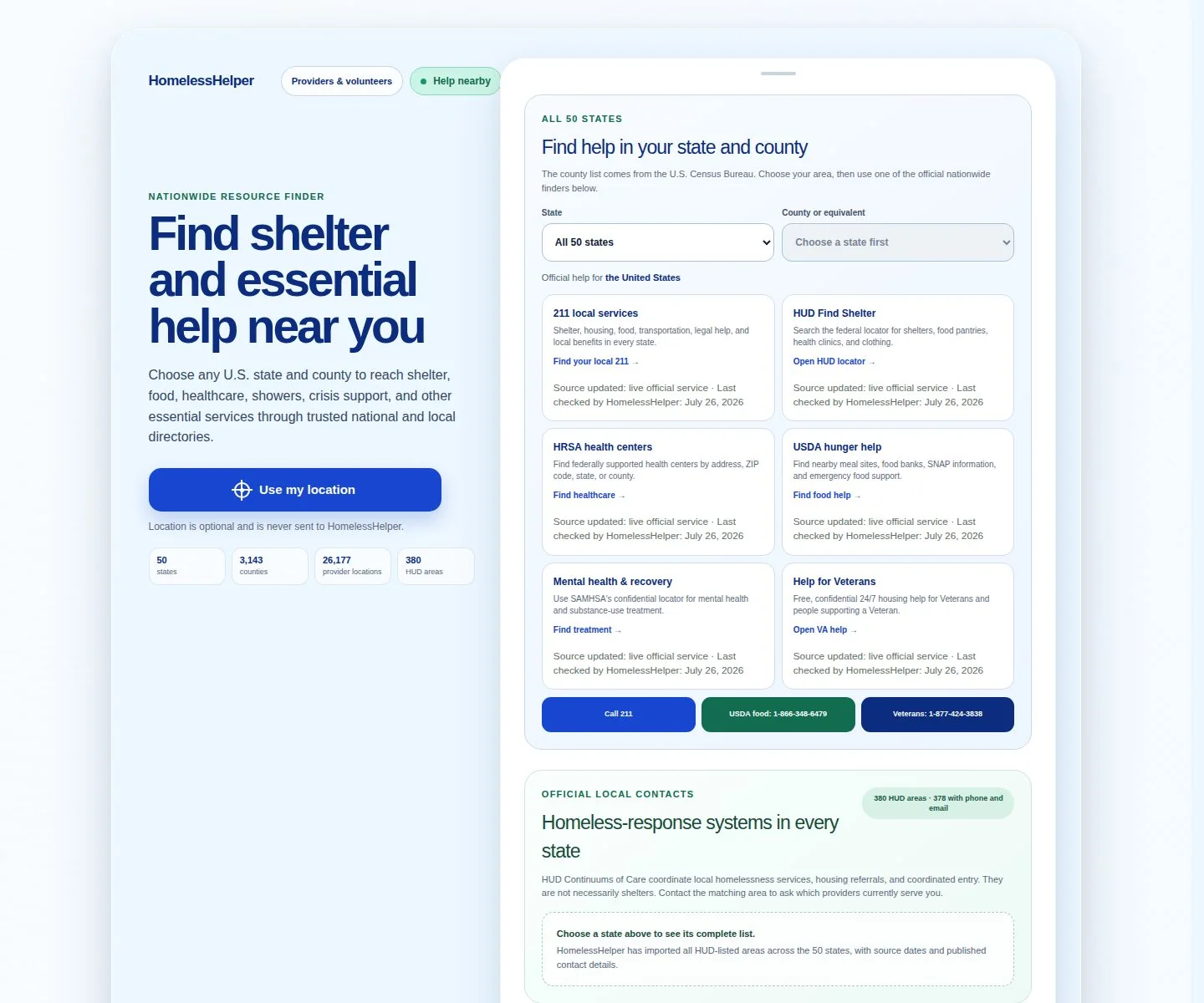
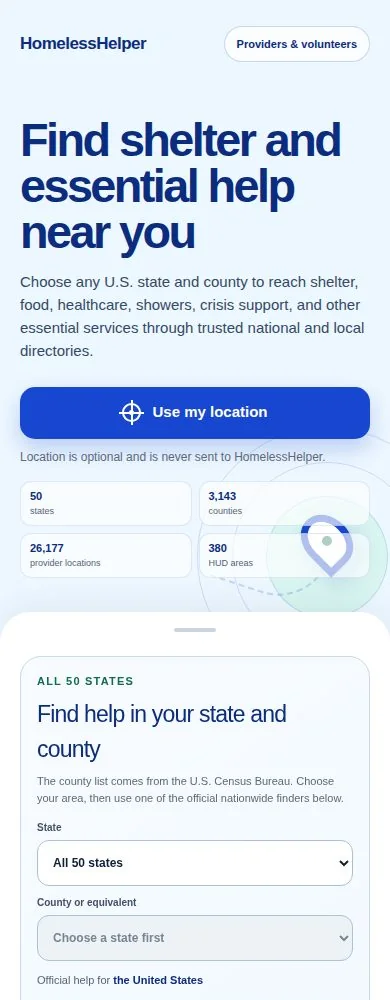
HomelessHelper is a directory of essential services that works the way a person in trouble actually uses a phone. You open it, pick your state and your county, and you get help: shelter, meals, healthcare, showers, crisis support, housing assistance, veterans' services. There is no sign-up wall, no email box, no "create a profile to continue." The finder covers all 50 states and 3,143 counties and county-equivalent areas from the current Census list, and it currently shows 27,895 provider locations. The part that makes it trustworthy is that it refuses to blur where anything came from. Each location carries a plain label: official federal data, community-mapped, or provider-submitted and moderated. Official records come from the federal health-center program, HUD's public housing agencies and approved housing counseling agencies, and the Department of Veterans Affairs, and they link straight back to the original government record. Community records come from OpenStreetMap contributors, are labeled as such, and link to their own map entry. When a publisher does not supply an update date, the listing says the date was not supplied rather than inventing one, and shows separately when HomelessHelper last checked. Nothing on the page pretends to be a live bed count. Imported listings instead carry a written availability note in the publisher's own terms, such as "call to confirm hours and current programs" or "hours and eligibility may change, verify before traveling," because that is the honest instruction. On top of that national layer sits a hand-verified set of 42 Colorado listings. These carry the actual services offered and the eligibility and intake details that decide whether someone gets in the door: who it fits, whether a referral is required, what documents to expect, what it costs. Four of the 42 also carry an hour-by-hour schedule, so their card computes whether the place is open right now and until when; the rest carry a written availability note instead. You can filter by what you need and by who a place actually serves, including women and gender-diverse people, men, youth, families, older adults, and low-barrier access. Tapping "use my location" sorts the list nearest-first, and the calculation happens on the device; your coordinates are never sent to HomelessHelper. Anything you save goes into a help list held on your own phone or browser, which is why it needs no account. Because a directory can never be the whole answer, HomelessHelper also hands you the official front doors: one tap to 211, 988, and 911, and direct links to the federal shelter, food, healthcare, mental-health, and veterans' finders, plus food banks, civil legal aid, eldercare, child care, job centers and the federal benefits screener. It lists the 380 HUD-designated homeless-response areas that coordinate housing and referrals in every state, 378 of them with a published phone number and email, so you can call the organization that actually knows what is open in your county this week. Providers get their own door. A shelter or program signs in once, claims its listing, and can then correct it, report a problem or an ownership dispute, propose a location the directory is missing, and publish short-lived updates such as open beds, meals remaining, or a temporary closure. Those updates carry a publish time, an expiry, a last-checked time, and a named source, and they disappear on their own instead of rotting on the page. A claim is approved either by proving control of an official organization email whose domain matches the organization's website, or by a person reviewing the evidence; every proposed new location and every report goes to a human, and the review is built so a reviewer cannot approve or reject something they never opened. A report from the public never quietly deletes a listing or hands ownership to someone else. HomelessHelper runs in any phone browser and can be added to a home screen, and an "Ask HomelessHelper" box on the site answers questions about using the service in English or Spanish, quoting its own reviewed help content with sources and saying plainly when it does not know.
Features
Everything in the current release.
Each of these is built and working today. Nothing on this list is a roadmap item.
Pick a state and a county. That is the whole search.
No address, no ZIP code, no account, no wizard. Choose from all 50 states and 3,143 counties and county-equivalent areas drawn from the current Census list, and the page fills with what is available there. Somebody with three minutes of battery can get to an address and a phone number in two taps.
Every listing says where it came from
Each location is labeled official federal data, community-mapped, or provider-submitted and moderated, and links back to the original record. Federal health-center, housing-agency, housing-counseling and veterans' records are marked as government sources; contributor-mapped records are marked as community data. Nothing is dressed up to look more official than it is.
Hand-verified Colorado listings with eligibility spelled out
Forty-two Colorado locations are checked by hand and carry the actual services offered, the neighborhood, and the intake rules. Four of them also carry a full hour-by-hour schedule, so their card computes whether the place is open right now and until when; the other thirty-eight carry a written availability note such as "walk-up intake 24/7" or "community-agency referral required." This is the layer that shows what local verification looks like when it exists.
Nearest first, without giving up your location
Tap "use my location" and the list re-sorts by distance from you. The distance is worked out on your own device, and your coordinates are never sent to HomelessHelper or stored in any account. Location is optional the whole way through; searching by state and county returns the same directory.
Live openings that expire on their own
An approved provider can publish a short-lived update such as open beds, meals remaining, showers available, or a temporary closure, with a quantity and a note. Each update shows when the provider published it, when it expires, when HomelessHelper last checked, and the official website or account it came from. Updates last between fifteen minutes and a day, then disappear, so a stale "beds available" cannot sit on the page for a week.
The people who coordinate housing in your area, by name
The directory lists all 380 HUD-designated homeless-response areas across the 50 states, 378 of them with a published phone number and email. These are the organizations that run coordinated entry and referrals locally, so calling one is often faster than calling five shelters. The listing is clear that a coordinating body is not itself a shelter.
One tap to 211, 988, 911 and the official federal finders
The emergency and national numbers are always one tap away, on every screen and in the footer. Alongside them sit direct links to the official federal finders for shelter, food, health centers, mental-health and substance-use treatment, and veterans' housing help, plus food banks, civil legal aid, eldercare, child care, job centers and the federal benefits screener. Every one of those cards shows when HomelessHelper last checked it.
A help list that needs no account
Save the places you want to try and they stay in a list on your own phone or browser. HomelessHelper never receives it. Clear it yourself at any time, and nothing follows you if you switch devices or hand the phone to someone else.
Eligibility and intake before you walk there
Open a verified listing and you get the details that actually decide whether someone gets in: who it may fit, how to access it, whether a community-agency referral is required, and what to ask about documents and cost. You can also filter by who a place serves, including women and gender-diverse people, men, youth, families, older adults and low-barrier access. It is better to read "referral required" on a phone than to learn it after a two-mile walk.
A workspace where programs fix their own listing
A shelter, clinic or meal program signs in once and can claim its listing, correct wrong information with a source, report a problem or an ownership concern, and propose a location the directory is missing. Imported listings arrive unclaimed, so nothing is assigned to an organization on its behalf. A claim is approved either by proving control of an official organization email whose domain matches the organization's website, or by a person reviewing submitted evidence.
Reviews that cannot be rubber-stamped
Every proposed new location arrives pending and waits for a person. Before that person can approve or reject it, they have to open the full item, including the address, phone, website and services, or the service refuses the decision outright. The same rule covers claim decisions and report resolutions. It is enforced by the service itself, not just by a hidden button in the interface, so nobody can approve content they never actually read.
Reports that never quietly delete a listing
Anyone signed in can report a listing as wrong, closed, unsafe, fraudulent, or wrongly claimed. It takes three different signed-in people within thirty days, each with a report detailed enough to pass an automated reasonableness check, before a human is alerted, and even then the listing stays published and ownership does not move. A directory that could be taken down by one angry message would be a weapon rather than a service.
Ask a question and get a cited answer, in English or Spanish
An "Ask HomelessHelper" box on the site answers questions about using the service, drawing only from reviewed help content and showing its sources with each answer. Switch it to Spanish and it answers in Spanish. When it has no reviewed answer it says so and points you to 211 or 988 instead of guessing, which is the behavior that matters when the person asking has no room for a wrong answer.
Sensitive locations deliberately left off the map
Locations tagged or named as domestic-violence, abuse, sexual-assault or safe-house services are excluded from the public location import on purpose. Publishing a map pin for a confidential shelter endangers the people inside it. Anyone looking for that help is routed to the national domestic-violence hotline's own provider directory instead, with a note to use a safer device if internet use may be monitored.
Proof
Numbers we can stand behind.
Every figure below comes from the product's own release record or test suite, not from a marketing estimate.
- Provider availability updates expire on their own, so a stale "beds available" cannot outlive the night it was posted.
- The app states plainly that it is independent and not a government entity, and links each government-derived result straight to the original official record.
- The built-in question answering abstains when it lacks reviewed evidence rather than producing a confident guess.
Where it runs
Surfaces and status.
Status as of 2026-09-08. Checked on 2026-09-02: the site answered with the full finder, and its published release record shows release 20260901T135831Z deployed 2026-09-01 from the current head of the project. The nationwide directory index loads and reports 27,853 imported locations across 50 states, the Colorado file returns its 512 locations, the privacy page loads, the provider workspace is up and its protected endpoints correctly answer "sign in first" without a session, and the Ask HomelessHelper box returned a grounded answer the same day. The Android app is listed separately as in development because the project's own dated records state that the internal-testing track is inactive, the store listing is a draft, and uploading or submitting the 1.1.2 build for review is still an outstanding action.
Works with
Worth more together.
Products on this platform share one sign-in, one support queue, and one engineering standard. These pair naturally with HomelessHelper.
WIC Companion
Many of the same families are trying to spend WIC benefits before they expire. WIC Companion turns the benefit into a plain shopping list, checks products against the state's approved list, and reminds people before a category lapses unused.
Explore →ASL Recovery Center
Housing and substance-use recovery are the same conversation for a lot of people. Recovery gives structured recovery support to the organizations already working with the people HomelessHelper points toward shelter.
Explore →ASL Doctor Search
HomelessHelper lists health centers by location. Doctor Search goes the next step and helps someone find and check a specific clinician.
Explore →ASL Municipal Utilities
City and county offices that hand out this directory usually also run billing, work orders and a resident portal on separate systems. Municipal Utilities puts those on one login.
Explore →ASL Intake
The shelters, clinics and counseling programs in the directory need intake, scheduling and case records of their own. Intake covers that side of the same organization.
Explore →What is new
Recent progress.
This product ships often. The most recent verified changes, newest first.
HomelessHelper 1.1.5 (code 8) is in Google Play review, with four current language listings and 28 screenshots taken from the app itself across phone and both tablet sizes in every language.
The app remembers your language and translates navigation, source disclosures and errors. Searching for a service now ignores accents in both English and Spanish, and all 20 help and policy articles exist in each language.
The public directory site was translated too: the optional provider workspace, saved lists, benefits, search, disclosures and policies. Switching language keeps your forms, selections, saved entries and search intact.
the site was redeployed with a full provenance record (release 20260901T135831Z), and the provider sign-in was reworded after a real user hit the confusion - it now says plainly that the first sign-in creates the account, including through Google, rather than implying you must register somewhere else first.
fixes to the workspace's audit record handling and to provider data caching, a version bump on the Android project, and signed release binaries removed from the source repository.
to.
a full source-disclosure pass on the Android app after Google Play rejected the earlier listing for describing government information without clear links to the originals. The app now carries a prominent independent-app disclaimer on the opening screen, a dedicated Official Sources screen, the source name on every result, and direct government links - all verified on both an emulator and a physical Pixel 8, with the remediated build not yet uploaded or submitted for review.
the Android client was rebuilt as a native app.
Pricing
Free to use. No account is required to find help, and the product contains no payment, subscription or billing of any kind. No pricing is published for organizations that want their own version.
Open HomelessHelper →Questions buyers ask
Straight answers.
What does it cost?
Nothing to use. There is no account, no payment and no paywall anywhere in the product, because charging a person who needs a bed would defeat the point. If an organization wants its own branded version, its own verified listings, or a version tied to its own service area, that is a conversation with us; no price for that is published.
We already give people the 211 number. Why hand out this too?
Keep giving out 211 - HomelessHelper puts it at the top of the page and in the footer. The difference is what happens when the line is busy, when it is 2 a.m., or when someone needs to see addresses and intake rules for themselves. HomelessHelper brings together what 211, HUD, the federal health-center program, the VA, and the food and legal-aid networks each cover separately, on one page, with the source of each record shown.
How current is any of this?
It depends on the record, and the app tells you which kind you are looking at. Federal health-center, housing-agency, housing-counseling and VA records come from official datasets and were last imported on 2026-08-20. The HUD homeless-response contacts were retrieved on 2026-07-24. Community-mapped records are contributed by volunteers and can be out of date; they are labeled that way. Verified Colorado listings and provider-published updates carry their own dates. Where a publisher gives no date, the listing says the date was not supplied rather than guessing.
What do you collect about the people who use it?
For someone just looking for help: no account, no profile, no location. If you tap "use my location" the distance calculation runs on your own device and the coordinates are never sent to us. Saved listings live in your own phone or browser storage and never reach us. Signing in is only for providers and volunteers who want to claim or correct a listing, and that side is described in full in the privacy policy.
Our shelter's listing is wrong, or we are not in there at all. How do we fix it?
Sign in to the provider workspace and claim your listing; the first sign-in creates the account for you, so there is nothing to register separately. A claim clears either by proving control of an official organization email whose domain matches your website, or by submitting evidence that a person reviews. If your program is missing entirely you can propose it, and a human reviewer has to open and approve it before it appears. Nothing about your organization is claimed on your behalf.
If we stop working with you, what happens to the people relying on it?
The public finder is free and does not depend on any organization's participation, so it keeps working. If you had claimed listings, they go back to being unclaimed imported records and stop receiving your live updates. The underlying directory is assembled from public federal and community sources, so nothing you contributed is locked away from you; ask and we will hand over what relates to your listings.
Is this actually finished, or is it early?
The website is live now, redeployed on 2026-09-01, covering all 50 states, 3,143 counties and 27,895 provider locations. The provider workspace, the review process, the availability updates and the question answering are all running. The honest caveats are that hand verification exists in Colorado only so far, no community-submitted listing and no live availability update has been published yet, and the Android app is built and device-accepted but has not been submitted to Google Play.
Do you list domestic violence shelters?
Deliberately not. Locations tagged or named as domestic-violence, abuse, sexual-assault or safe-house services are excluded from the public location import, because publishing the address of a confidential shelter puts the people inside it at risk. Anyone who needs that help is sent to the National Domestic Violence Hotline's own provider directory, with a note about using a safer device if internet use may be monitored.
What should I know before I rely on it?
We would rather you hear this from us than discover it later. As of 2026-09-08:
- Only Colorado has the extra hand-verified layer. The other 49 states show federal and community-mapped data with source labels and no local verification.
- Within that Colorado set, only 4 of the 42 listings carry an hour-by-hour schedule that computes open-now status. The other 38 show a written availability note instead, such as "call for current intake, hours, and bed availability."
- The imported nationwide set leans heavily toward healthcare and housing: 19,237 healthcare and 4,751 housing records against 694 shelter records and a single shower record. For shelter beds outside Colorado, the local homeless-response contacts and 211 remain the better path, which is why they sit at the top of the page.
- This is not a live vacancy feed. Unless an approved provider has published an update, the listing shows a written availability note telling you to call or verify before travelling.
- No provider has published a live availability update yet. The feature is built and running, but the live-updates feed was empty when it was last checked on 2026-09-02.
- No provider-submitted listing has been published yet; that count currently stands at zero. The submission and review path is built and running, but the community-contributed part of the directory is still empty.
- Community-mapped records can be incomplete or out of date, and many carry no phone number at all - in Colorado, 41 of the 125 community-mapped records have one. They are labeled rather than hidden, and they link to their own map record so you can judge them yourself.
- The national link cards carry a last-checked date of July 26, 2026, and the HUD homeless-response contacts were retrieved on July 24, 2026. Those checks are periodic, not continuous.
- The directory needs a connection, on the website and in the Android app alike. Neither keeps a stored offline copy. What does work with no data is dialling 211, 988 and 911, which are ordinary phone calls.
- The site's pages are written in English. The built-in question answering handles English and Spanish; the rest of the pages do not yet.
Find a bed tonight without making an account first.
A free nationwide finder for shelter, food, healthcare and showers. No account, and every listing says where it came from.
Prefer email? contact@autosecurelogin.com